
ISRA FACTSHEETS
ISRA FACTSHEETS
AUSTRALIA AND SOUTHEAST INDIAN OCEAN
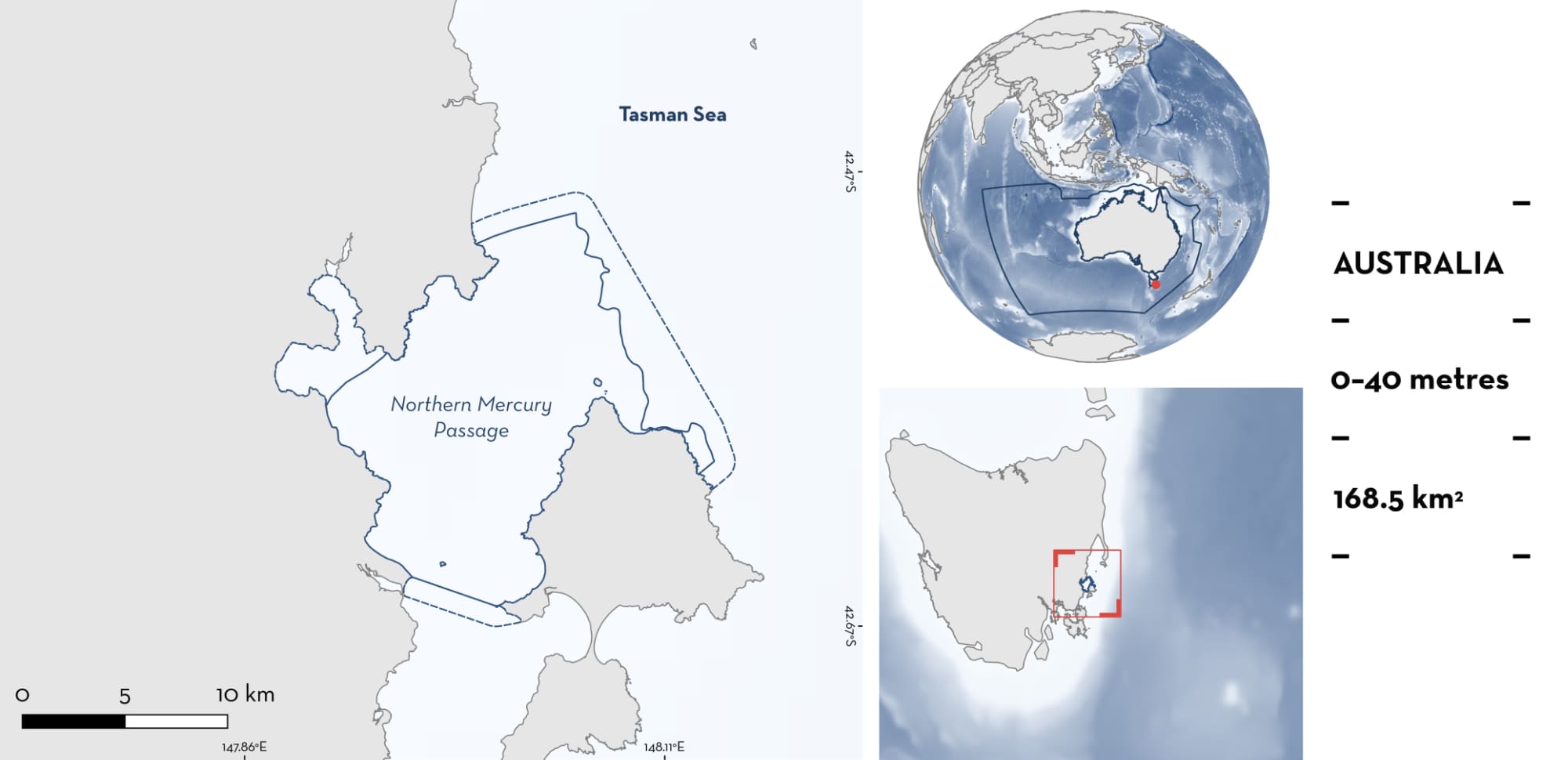
Northern Mercury Passage
Summary
Northern Mercury Passage is located on the east coast of Tasmania, Australia. The area encompasses the channel which separates mainland Tasmania from Maria Island. It is characterised by sandy substrates and fringing reefs. It is influenced by the East Australian Current and freshwater runoff. The area overlaps with a Key Biodiversity Area, a marine reserve, a national park, and a Shark Refuge Area. Within this area there are: range-restricted species (e.g., Rusty Carpetshark Parascyllium ferrugineum).
Download factsheet
Northern Mercury Passage
DESCRIPTION OF HABITAT
Northern Mercury Passage is located on the east coast of Tasmania, Australia. The area encompasses the channel which separates mainland Tasmania from Maria Island. The northern part of the area includes Okehampton Bay and Cape Bougainville Peninsula on mainland Tasmania, east to Waterfall Bay on Maria Island. The southern part of the area extends south of Bloodstone Beach on Maria Island and Jack’s Beach on mainland Tasmania. The area fully encompasses Lachlan Island. The habitat is characterised by sandy substrates and fringing reefs (DPIPWE 2010).
The area is influenced by the East Australian Current (EAC) which transports warm water during the austral summer months (EPA Tasmania 2021). The temperature varies between ~8–24oC (DPIPWE 2010). Locations within this area that are near Prosser River are influenced by catchment runoff following heavy rainfall, which results in reduced salinity levels (EPA Tasmania 2021).
The area overlaps with Maria Island Key Biodiversity Area (KBA 2025), Maria Island Marine Reserve, Maria Island National Park (TPWS 2025), and the Mercury Passage Shark Refuge Area (Tasmanian Government 2025).
This Important Shark and Ray Area is benthic and is delineated from inshore and surface waters (0 m) to 40 m based on the bathymetry of the area.
CRITERION B
RANGE RESTRICTED
This area holds the regular presence of Rusty Carpetshark and Banded Stingaree as resident range-restricted species.
Rusty Carpetsharks are regularly reported in this area and the species has been through both Natural Values Atlas observations (n = 4 individuals; Natural Values Atlas 2025), which collates observations from various sources including citizen scientists, and Reef Life Survey (RLS) (n = 33 individuals; Edgar & Stuart-Smith 2014; Edgar et al. 2020; RLS et al. 2025; A Cooper pers. comm. 2025). Historical sightings (2000–2009; n = 13) were recorded in 2000 (n = 1), 2004 (n = 1), 2005 (n = 9), 2008 (n = 1), and 2009 (n = 1). Contemporary records (2010–2025; n = 24) were observed in 2010 (n = 2), 2011 (n = 1), 2012 (n = 1), 2013 (n = 4), 2014 (n = 1), 2016 (n = 1), 2018 (n = 1), 2021 (n = 2), 2023 (n = 1), 2024 (n = 9), and 2025 (n = 1). Estimated size data were available for more than half of the contemporary observations (62.5%, n = 15). These Rusty Carpetsharks measured between 30–75 cm total length (TL). The size-at-birth of this species is 17 cm TL and the size-at-maturity is 60–75 cm TL (Ebert et al. 2021). Although the citizen science monitoring effort is not standardised across the state, this area has the largest and one of the only known clusters of regular and predictable observations of Rusty Carpetshark.
Banded Stingarees have been recorded in Northern Mercury Passage through both Natural Values Atlas observations (n = 5 individuals; Natural Values Atlas 2025) and RLS which undertook underwater visual census along a 50 m transect line (n = 479 individuals; Edgar & Stuart-Smith 2014; Edgar et al. 2020; RLS et al. 2025; A Cooper pers. comm. 2025). Historical records (1992–2009; n = 263) were reported in 1992 (n = 9), 1993 (n = 49), 1994 (n = 9), 1995 (n = 8), 1996 (n = 6), 1997 (n = 9), 1998 (n = 9), 1999 (n = 10), 2000 (n = 12), 2001 (n = 36), 2002 (n = 4), 2004 (n = 9), 2005 (n = 23), 2006 (n = 29), 2007 (n = 22), 2008 (n = 10), and 2009 (n = 9). Contemporary sightings (2010–2024; n = 221) were recorded in 2010 (n = 44), 2011 (n = 20), 2012 (n = 6), 2013 (n = 10), 2014 (n = 19), 2015 (n = 29), 2016 (n = 20), 2017 (n = 3), 2018 (n = 5), 2019 (n = 3), 2020 (n = 2), 2021 (n = 4), 2022 (n = 10), 2023 (n = 25), and 2024 (n = 21). Estimated size data were available for most contemporary observations (94.6%, n = 209). Banded Stingarees measured between 10–50 cm TL and most were mature individuals (70.8%, n = 148) measuring = >30 cm TL. Thirty Banded Stingarees were neonate/young-of-the-year (YOY), measuring = <20 cm TL (Edgar & Stuart-Smith 2014; Edgar et al. 2020; RLS et al. 2025). The size-at-birth of the species is ~15 cm TL and the size-at-maturity is 20–22 cm TL (Last et al. 2016). Banded Stingarees are seasonally present in this area between December–June, with abundance peaking in April (Edgar & Stuart-Smith 2014; Edgar et al. 2020; Natural Values Atlas 2025; RLS et al. 2025). Although the citizen science monitoring effort is not standardised across the state, this area has the largest known number of contemporary observations of the species in Tasmania, highlighting the national importance of this area.
Rusty Catshark and Banded Stingaree are restricted to the Southeast Australian Shelf Large Marine Ecosystem (LME).
Download factsheet
SUBMIT A REQUEST
ISRA SPATIAL LAYER REQUEST
To make a request to download the ISRA Layer in either a GIS compatible Shapefile (.shp) or Google Earth compatible Keyhole Markup Language Zipped file (.kmz) please complete the following form. We will review your request and send the download details to you. We will endeavor to send you the requested files as soon as we can. However, please note that this is not an automated process, and before requests are responded to, they undergo internal review and authorization. As such, requests normally take 5–10 working days to process.
Should you have questions about the data or process, please do not hesitate to contact us.

