ISRA FACTSHEETS
ISRA FACTSHEETS
EUROPEAN ATLANTIC
Ortegal Terrace
Summary
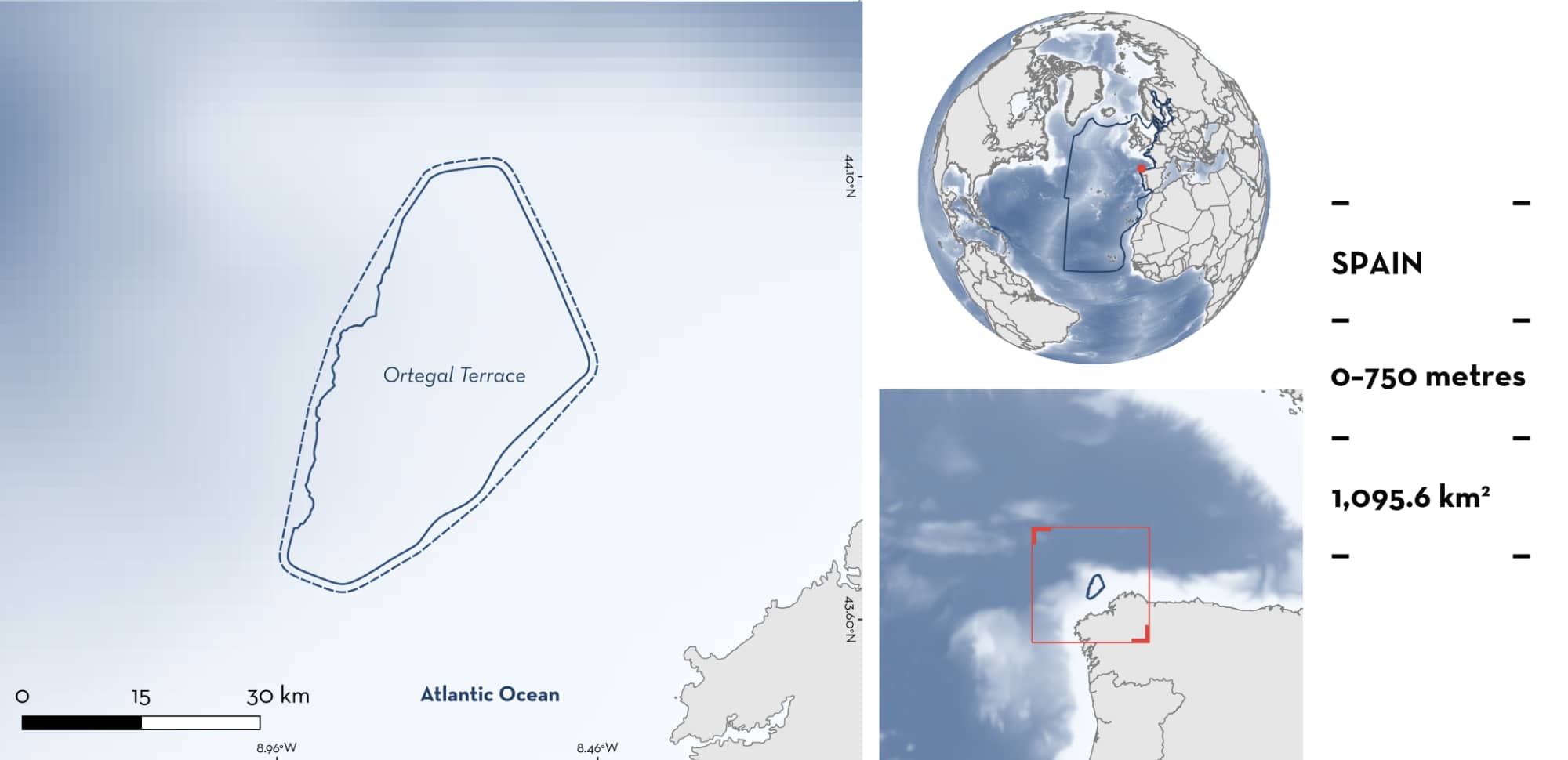
Ortegal Terrace is located offshore of A Coruña province, Galicia, Spain. This area encompasses part of the continental shelf, the Ortegal Terrace, and part of the slope of La Coruña Valley. It is characterised by fine and very fine sand substrates. It is influenced by a seasonal coastal upwelling and hydrographical mesoscale activity resulting in high productivity. The area overlaps with the West Iberian Canyons and Banks Ecologically or Biologically Significant Marine Area and the Costa da Morte Key Biodiversity Area. Within this area there are: threatened species (Rabbitfish Chimaera monstrosa) and reproductive areas (e.g., Bluntnose Sixgill Shark Hexanchus griseus).
Download factsheet
Ortegal Terrace
DESCRIPTION OF HABITAT
Ortegal Terrace is located offshore of A Coruña province, Galicia, Spain. This area encompasses part of the continental shelf, the Ortegal Terrace, and part of the slope of La Coruña Valley. Ortegal Terrace is characterised by fine and very fine sand substrates and contourite channels with pockmarks (cone-shaped, circular, or elliptical depressions) (Rey & Medialdea 1989; Jané et al. 2010).
The area is influenced by a seasonal coastal upwelling (boreal spring and summer) and hydrographical mesoscale activity along the northwestern shelf-break resulting in high productivity (Gil 2008). Ortegal Terrace is influenced by the Poleward Current, which carries warmer and more saline waters compared to the surrounding regions as it flows northward. This current forms anticyclonic rings over the shelf break, supplying the area with these warm, saline waters. In contrast, coastal waters of continental origin introduce cooler, fresher inputs (Gil 2008).
The area overlaps with the West Iberian Canyons and Banks Ecologically or Biologically Significant Marine Area (EBSA; CBD 2025) and the Costa da Morte Key Biodiversity Area (KBA; KBA 2025).
This Important Shark and Ray Area is benthic and pelagic and is delineated from inshore and surface waters (0 m) to 750 m based on the bathymetry of the area.
CRITERION A
VULNERABILITY
One Qualifying Species considered threatened with extinction according to the IUCN Red List of Threatened Species regularly occurs in the area. This is the Vulnerable Rabbitfish (Finucci 2020).
CRITERION C
SUB-CRITERION C1 – REPRODUCTIVE AREAS
Ortegal Terrace is an important reproductive area for one shark species and one chimaera species.
Neonate and young-of-the-year (YOY) Bluntnose Sixgill Sharks were recorded from a compilation of research survey and fishery data off Galicia and in the Cantabrian Sea (Rodríguez-Cabello et al. 2018). Benthic trawl surveys were conducted annually during autumn (September–October) between 1983–2015, with a few conducted during spring (mean of 120 hauls per year) using otter trawl (Rodríguez-Cabello et al. 2018). Fishery data (location, species weight, and type of fishing gear), from electronic logbooks of commercial fishing vessels during 2004–2010 were also reviewed (Rodríguez-Cabello et al. 2018). Finally, between 2011–2015 an experimental tagging survey focused on deepwater sharks using benthic longlines (average 900 hooks per set) was conducted in the Cantabrian Sea (Rodríguez-Cabello & Sánchez 2014; Rodríguez-Cabello et al. 2018).
Between 1984–2015, a total of 31 neonate/YOY Bluntnose Sixgill Sharks were caught in the area (21.3% of the total Bluntnose Sixgill Sharks captured in the border region; n = 146) measuring <83 cm total length (TL; Rodríguez-Cabello et al. 2018). The species has an estimated size-at-birth of 61–74 cm TL (Ebert et al. 2021). Individuals in this size range were observed in the area during 16 years of the 32 surveyed years (Rodríguez-Cabello et al. 2018). Since surveys were undertaken primarily in September and October (Rodríguez-Cabello et al. 2018), additional temporal data are required to confirm seasonality in reproductive behaviour. Although there are records of neonate/YOY Bluntnose Sixgill Sharks in the Cantabrian Sea and off Galicia, this area has the highest number of known catch records of Bluntnose Sixgill Shark at this life history stage in northern Spain.
Between 1993–2021, Rabbitfish neonates and YOY were captured during the Northern Spanish Shelf Groundfish Survey in the Cantabrian Sea and off Galicia by trawl (ICES 2015; Fernández-Zapico et al. 2023). During this period, a total of 1,589 Rabbitfish were caught in the area. Of these, 43% (n = 682) were neonates/YOY measuring <20 cm TL (ICES 2025). The species has an estimated size-at-birth of ~15 cm TL (R Jac pers. comm. 2025). Individuals in this size range were observed in every year of the survey, and during contemporary years, numbers were: 2010 (n = 40), 2011 (n = 51), 2012 (n = 50), 2013 (n = 39), 2014 (n = 15), 2015 (n = 27), 2016 (n = 50), 2017 (n = 57), 2018 (n = 60), 2019 (n =60), 2020 (n = 45), and 2021 (n = 33) (ICES 2025). Since surveys in this area were undertaken in September and October, additional temporal data are required to confirm seasonality in reproductive behaviour. Although there are records of neonate/YOY Rabbitfish in the Cantabrian Sea and off Galicia, this area has national importance as it has one of the highest known catch records of Rabbitfish at this life stage in northern Spain.
Download factsheet
SUBMIT A REQUEST
ISRA SPATIAL LAYER REQUEST
To make a request to download the ISRA Layer in either a GIS compatible Shapefile (.shp) or Google Earth compatible Keyhole Markup Language Zipped file (.kmz) please complete the following form. We will review your request and send the download details to you. We will endeavor to send you the requested files as soon as we can. However, please note that this is not an automated process, and before requests are responded to, they undergo internal review and authorization. As such, requests normally take 5–10 working days to process.
Should you have questions about the data or process, please do not hesitate to contact us.