ISRA FACTSHEETS
ISRA FACTSHEETS
EUROPEAN ATLANTIC
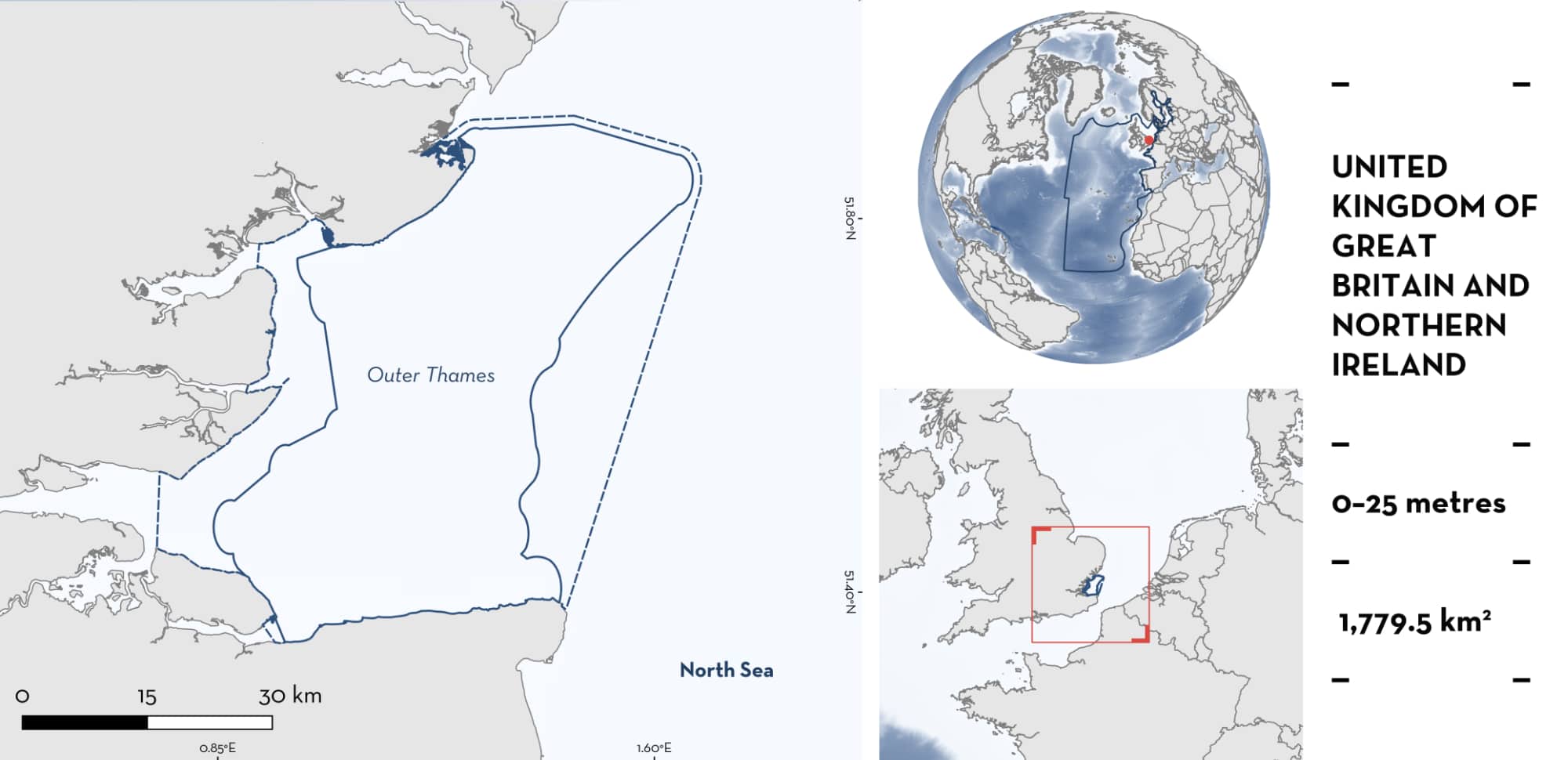
Outer Thames
Summary
Outer Thames is located on the east coast of England, United Kingdom of Great Britain and Northern Ireland. The area is an estuarine system characterised by mudflats, salt marshes, and sandbanks. It is influenced by multiple rivers providing freshwater input and nutrients. Within this area there are: reproductive areas (Thornback Skate Raja clavata).
Download factsheet
Outer Thames
DESCRIPTION OF HABITAT
Outer Thames is located on the east coast of England, United Kingdom of Great Britain and Northern Ireland. It is an estuarine system that sits on the European continental shelf. The area is characterised by mudflats, salt marshes, and sandbanks, with large tidal streams shifting mobile sediments continually (Baugh et al. 2013). Substrates are mud, silt, and gravel.
North Sea tides enter the estuary from the northeast, and the English Channel tides enter from the southern part of the estuary. The tidal range can be up to 5 m (Rossington & Spearman 2009). The area is influenced by multiple rivers, which provide nutrients through freshwater input. This includes the Rivers Orwell and Stour to the north. Along the Essex coastline, the area is influenced by the Rivers Colne, Blackwater, Crouch, and Roach. On the north coast of Kent, the area is influenced by the Rivers Thames, Medway, and Swale.
This Important Shark and Ray Area is benthic and is delineated from inshore and surface waters (0 m) to 25 m based on the bathymetry of the area.
CRITERION C
SUB-CRITERION C1 – REPRODUCTIVE AREAS
Outer Thames is an important reproductive area for one ray species.
Early life stages of Thornback Skate are regularly and predictably observed, year-to-year, in this area (Ellis et al. 2012, 2024a, 2024b). Five stations within this area have been surveyed across multiple years through the annual United Kingdom beam trawl survey (ICES 2025). Since 2010 (excluding 2022 when these stations were not fished), 830 Thornback Skates were caught at these stations. Of these, an average of 66% (range: 22–96% annually) are considered neonates/young-of-the-year (YOY), measuring =< 30 cm total length (TL). Fishery-independent length frequency data clearly indicate the first cohort at =< 30 cm TL. Size-at-birth for this species is reported at ~10–13 cm TL (Last et al. 2016) with individuals up to 30 cm TL being considered neonate/YOY in other regions (Alkusairy 2019).
Another survey operating in the area during 2012, 2022, 2023, and 2024, using a 2 m beam trawl, recorded 95 Thornback Skates (ICES 2025). On average, 74% were neonate/YOY measuring =< 30 cm TL. The proportion of neonates/YOY of all life stages was recorded in 2010 (67%), 2022 (80%), 2023 (69%), and 2024 (72%). Both spent and in situ Thornback Skate egg cases were found at 52% of the fishing stations in another contemporary survey in the same area in 2018 (Cefas unpubl. data 2025). This area has some of the highest and most regular and predictable observations of early life stage Thornback Skate in the United Kingdom of Great Britain and Northern Ireland.
Download factsheet
SUBMIT A REQUEST
ISRA SPATIAL LAYER REQUEST
To make a request to download the ISRA Layer in either a GIS compatible Shapefile (.shp) or Google Earth compatible Keyhole Markup Language Zipped file (.kmz) please complete the following form. We will review your request and send the download details to you. We will endeavor to send you the requested files as soon as we can. However, please note that this is not an automated process, and before requests are responded to, they undergo internal review and authorization. As such, requests normally take 5–10 working days to process.
Should you have questions about the data or process, please do not hesitate to contact us.