ISRA FACTSHEETS
ISRA FACTSHEETS
POLAR WATERS REGION
Pikialasorsuaq
Summary
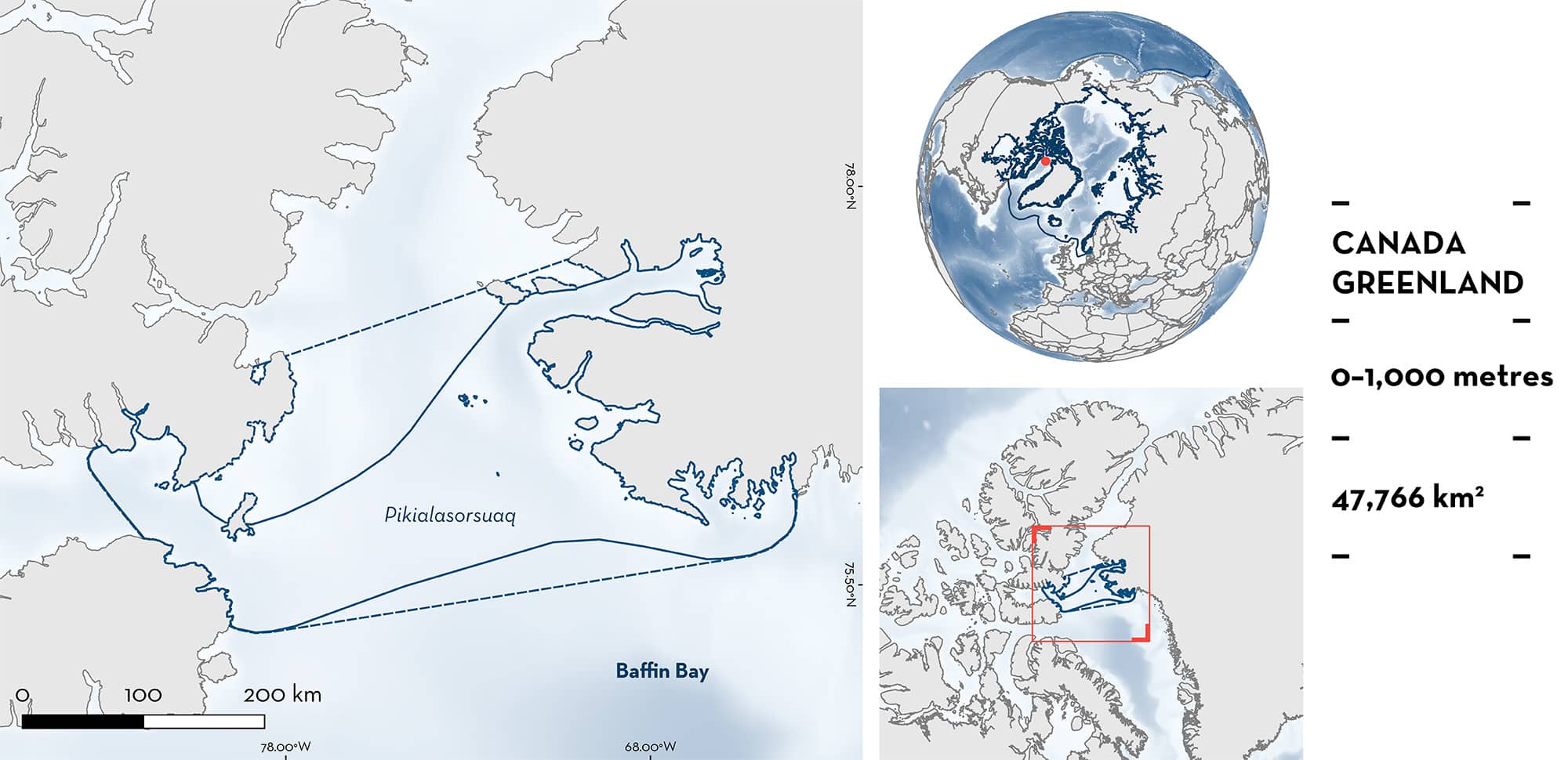
Pikialasorsuaq is located in the northern part of Baffin Bay within the waters of Canada and Greenland. The area is predominantly characterised by a benthos of fine-grained sediments with sea pens. It is the largest area of open water surrounded by ice (polynya) in the Canadian Arctic and is one of the most biologically productive regions north of the Arctic Circle. The area overlaps with three Key Biodiversity Areas. Within the area there are: threatened species and areas important for movement (Greenland Shark Somniosus microcephalus).
Download factsheet
Pikialasorsuaq
DESCRIPTION OF HABITAT
Pikialasorsuaq is located in the northern part of Baffin Bay within the waters of Canada and Greenland. The area is predominantly characterised by fine-grained sediments with Sea Pens Umbellula encrinus (Kenchington et al. 2016). Pikialasorsuaq is the name for one of the largest areas of open water surrounded by ice (polynya) in the Arctic, also known as North Water Polynya. This is one of the most biologically productive regions north of the Arctic Circle (Heide-Jorgensen et al. 2012). The name means ‘great upwelling’ and is the word used by the Inuit in Greenland. In Canada, the area is known as Savarjuaq by the Inuit of Nunavut. Pikialasorsuaq remains ice-free in the boreal winter (December to February), and by the end of July, the ice formation that separates the polynya from the Baffin Bay melts (Bryndum-Buchholz et al. in press). This area connects Jones Sound to the south of Ellesmere Island, in Canada, to Northwest Greenland from Inglefield to Melville Bay, locations that receive significant glacial meltwater influence during summer months (Carroll et al. 2016; Bhatia et al. 2021).
The seasonal formation and physical conditions of the polynya primarily depend on forming an ice arch across the southern Kane Basin in winter, blocking Arctic sea ice. When stable, this arch allows northerly winds and currents to continuously sweep ice southward from the blockage, promoting a deep mixed layer and high nutrient availability for spring phytoplankton blooms. Additionally, the West Greenland Current’s input of warmer Atlantic water limits sea ice growth up from Melville Bay and provides nutrients for high primary productivity (Ribeiro et al. 2021). The West Greenland Current flows northward along the coast of Greenland and crosses northern Baffin Bay, on the southern end of Pikialasorsuaq and joins the Baffin Island Current flowing south along the coast of Baffin Island (Morison et al. 2012). The fjords off northwest Greenland, from Inglefield Bredning to Melville Bay, are deep coastal regions where productivity is also enhanced by the mixing of Arctic and Atlantic Ocean waters which also retards the sea ice formation compared to western Baffin Bay (Willis et al. 2018).
This area overlaps with three Key Biodiversity Areas (KBAs): Coast between Appaliarsulissuaq and Kap Atholl Areas (KBA 2024a), Saunders Island (KBA 2024b), and Cambridge Point (KBA 2024c).
This Important Shark and Ray Area is benthopelagic and is delineated from inshore and surface waters (0 m) to 1,000 m based on the depth range of Qualifying Species in the area.
CRITERION A
VULNERABILITY
One Qualifying Species considered threatened with extinction according to the IUCN Red List of Threatened Species regularly occurs in the area. This is the Vulnerable Greenland Shark (Kulka et al. 2020).
CRITERION C
SUB-CRITERION C4 – MOVEMENT
Pikialasorsuaq is an important area for movement of one shark species.
Between 2014 and 2015, tagged Greenland Sharks (n = 7) moved seasonally between Jones Sound (eastern Canadian Arctic) and northwest Greenland. The use of the transboundary movement corridor between Canada and Greenland was recorded by all tagged animals in both years, occurring regularly and predictably prior to the formation of sea ice in the high Arctic (October) (Hussey et al. 2018).
In August 2014, two Greenland Sharks (270 and 284 cm total length [TL]) were equipped with pop-up archival satellite tags (PSATs) in Jones Sound, with pop-off programmed for the end of September 2014. The tags popped off in Inglefield Bredning and north Melville Bay, northwest Greenland, by the end of September (Hussey et al. 2018). In August 2015, five Greenland Sharks (175–310 cm TL) were equipped with PSATs and multiple mark report satellite tags (mrPAT) in Jones Sound (Hussey et al. 2018). All PSATs were programmed to pop off prior to sea ice formation (end of September 2015), while mrPATs were programmed to pop off from each animal consecutively after a period of 8–10 days, creating a sequential record of pop-off geolocations for each animal. From these data, it was possible to reconstruct coarse-scale horizontal tracks based on real location data for each individual. All five Greenland Sharks undertook a directed movement, passing between northeast Devon Island and Coburg Island, crossing the open water of northern Baffin Bay and then entering the coastal waters and fjords of northwest Greenland from Inglefield Bredning to Melville Bay, spending up to 15 days in coastal waters prior to tag pop off. Sharks took ~ 16 days to cross the open waters of Baffin Bay arriving in the vicinity of coastal regions of Greenland. The sharks were estimated to have remained in the area of Grise Fjord for 5–10 days post-tagging prior to undertaking this directed movement.
These data represent the only available horizontal tracks for this species, supporting regularity of movement by location and periodicity. Jones Sound, where sharks were tagged, is a large waterway with a high abundance of sharks during the ice-free period (Devine et al. 2018). The movement corridor overlaps with the area of the North Water Polynya (Pikialasorsuaq), a high biodiversity hotspot and is a key habitat and migration corridor for many Arctic species (Bryndum-Buchholz et al. in press). Two out of 11 sharks tagged in Cumberland Sound, made northern movements to the same region as those in this study, identifying this as a potential winter hotspot for the seasonal occurrence of this species in Arctic waters (Campana et al. 2015). Further work is required to understand the drivers of this movement prior to the formation of sea ice.
Download factsheet
SUBMIT A REQUEST
ISRA SPATIAL LAYER REQUEST
To make a request to download the ISRA Layer in either a GIS compatible Shapefile (.shp) or Google Earth compatible Keyhole Markup Language Zipped file (.kmz) please complete the following form. We will review your request and send the download details to you. We will endeavor to send you the requested files as soon as we can. However, please note that this is not an automated process, and before requests are responded to, they undergo internal review and authorization. As such, requests normally take 5–10 working days to process.
Should you have questions about the data or process, please do not hesitate to contact us.