
ISRA FACTSHEETS
ISRA FACTSHEETS
SOUTH AMERICAN ATLANTIC REGION
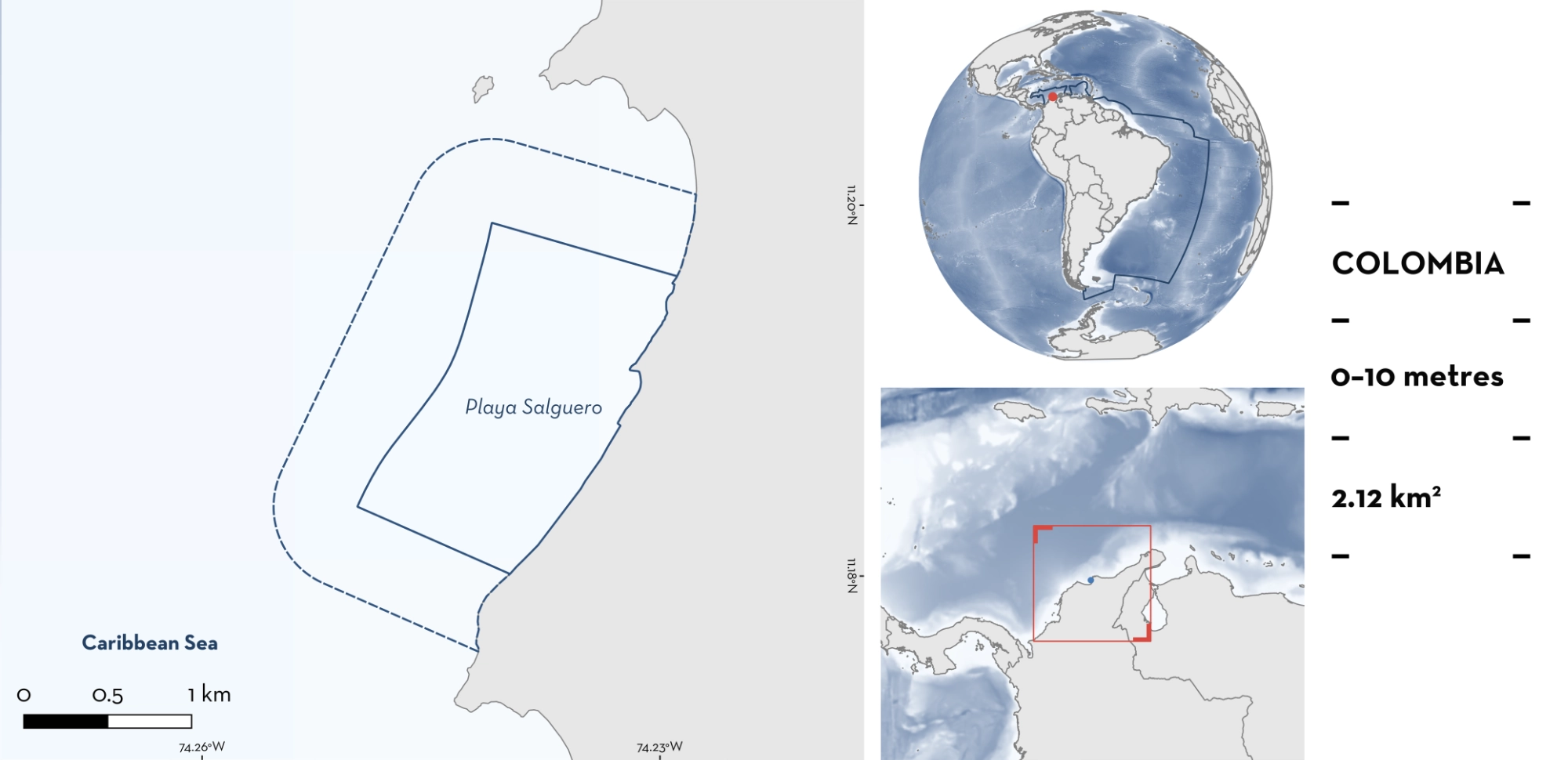
Playa Salguero
Summary
Playa Salguero is located in Magdalena Department on the Caribbean coast of Colombia. The seabed in the area is gently sloping with sandy beaches. Waters are generally turbid with reduced salinity due to the proximity of the Ciénaga Grande de Santa Marta (a large marshy swamp) and the Magdalena River. The area is influenced by the typical climatic pattern of the Caribbean coast, with prominent dry and wet seasons. Within this area there are: threatened species (e.g., Chola Guitarfish Pseudobatos percellens); range-restricted species (Venezuelan Round Ray Urotrygon venezuelae); and reproductive areas (e.g., Caribbean Numbfish Narcine bancroftii).
Download factsheet
Playa Salguero
DESCRIPTION OF HABITAT
Playa Salguero is located in Magdalena Department on the Caribbean coast of Colombia. The seabed in the area is gently sloping with sandy beaches. Due to the contributions of a large swampy marsh (Ciénaga Grande de Santa Marta) and the Magdalena River, both to the south of the area, waters are predominantly turbid with reduced salinity. Sediment input is mostly medium- to fine-grained sand (INVEMAR 2000; Grijalba-Bendeck et al. 2012).
Playa Salguero is influenced by the typical climatic pattern of the Caribbean coast, with two distinctive climatic seasons, the dry season (December–March) characterised by the influence of the trade winds and the Caribbean Current, and the wet season characterised by heavy rainfall (April–November).
This Important Shark and Ray Area is benthic and is delineated from inshore and surface waters (0 m) to 10 m based on the bathymetry of the area.
CRITERION A
VULNERABILITY
Two Qualifying Species considered threatened with extinction according to the IUCN Red List of Threatened Species regularly occur in the area. These are the Endangered Chola Guitarfish (Pollom et al. 2020a) and Venezuelan Round Ray (Pollom et al. 2020b).
CRITERION B
RANGE RESTRICTED
This area holds the regular presence of Venezuelan Round Ray as a resident range-restricted species. This species has been a regular incidental catch of artisanal fishers operating in the area (Grijalba-Bendeck et al. 2012; Acevedo et al. 2015). Between August 2005 and October 2006, a total of 269 Venezuelan Round Rays were recorded during daily monitoring (four days per week) of catches from the area, making it the most commonly recorded ray (Grijalba-Bendeck et al. 2012; Acevedo et al. 2015). The species was recorded in all months across the study period. In contrast, no Venezuelan Round Rays were recorded at another monitored site (Don Jaca), ~10 km south of this area (Grijalba-Bendeck et al. 2012). Contemporary daily monitoring (four days a week) at Playa Salguero between April and October 2025 recorded five individuals demonstrating its continued occurrence in the area, although suggesting some level of population reduction (C Polo-Silva unpubl. data 2025). Venezuelan Round Ray is restricted to the Caribbean Sea Large Marine Ecosystem.
CRITERION C
SUB-CRITERION C1 – REPRODUCTIVE AREAS
Playa Salguero is an important reproductive area for two ray species.
The incidental catch of rays by local artisanal fisheries was monitored daily (four days a week) between August 2005 and October 2006 (no monitoring occurred in January 2006; Grijalba-Bendeck et al. 2012; Acevedo et al. 2015). These fisheries operate close inshore within the area. Size (total length; TL) and sex were recorded, and individuals were dissected to examine reproductive biology. These historical data were complemented with contemporary monitoring during 2020–2021 (Navia et al. 2021) and between April and November 2025 (C Polo-Silva unpubl. data 2025).
Between August 2005 and October 2006, a total of 198 Caribbean Numbfish (140 females, 58 males) were recorded, ranging in size 5–54 cm TL (Moreno et al. 2010; Grijalba-Bendeck et al. 2012). Females were recorded year-round, but males were present only in September and October. Mature females (28.2–33.2 cm TL) dominated from August 2005 to January 2006, especially between October and November, while pregnant females were observed between February and April. Pregnant Caribbean Numbfish (n = 38) represented 27.1% of all examined females. Neonates (n = 48; 5.0–12.1 cm TL) represented 19.5% of recorded Caribbean Numbfish (Moreno et al. 2010; Grijalba-Bendeck et al. 2012). Size-at-birth for this species is ~9 cm TL (Last et al. 2016). Between April and October 2025, 39 Caribbean Numbfish (20.5–70.0 cm TL; mean size 40.39 ± 11.68 cm TL) were recorded including a single pregnant female (C Polo-Silva unpubl. data 2025), confirming the continued contemporary use of the area for reproductive purposes.
Between August 2005 and October 2006, a total of 172 Chola Guitarfish (85 females, 87 males) were recorded. Based on dissections, egg development occurs simultaneously with embryonic growth while pupping and mating occur between October and April. Pregnant Chola Guitarfish (n = 14) represented 16% of all examined females. Neonates (n = 33; 17.0–17.4 cm TL) represented 16% of recorded Chola Guitarfish (Grijalba-Bendeck et al. 2008, 2012). Size-at-birth of the species is ~17 cm TL, corresponding to the smallest individuals recorded (Grijalba-Bendeck et al. 2008, 2012). Between 2020 and 2021, a total of 12 specimens of this species were recorded, ranging in size from 19–77 cm TL which included neonates/young-of-the-year (~19 cm TL; Navia et al. 2021). Between April and October 2025, 135 Chola Guitarfish (70 females, 65 males) were recorded and of the 46 mature females examined, six (13%) were pregnant (C Polo-Silva unpubl. data 2025), demonstrating the continued contemporary use of the area for reproductive purposes.
Download factsheet
SUBMIT A REQUEST
ISRA SPATIAL LAYER REQUEST
To make a request to download the ISRA Layer in either a GIS compatible Shapefile (.shp) or Google Earth compatible Keyhole Markup Language Zipped file (.kmz) please complete the following form. We will review your request and send the download details to you. We will endeavor to send you the requested files as soon as we can. However, please note that this is not an automated process, and before requests are responded to, they undergo internal review and authorization. As such, requests normally take 5–10 working days to process.
Should you have questions about the data or process, please do not hesitate to contact us.

