ISRA FACTSHEETS
ISRA FACTSHEETS
EUROPEAN ATLANTIC
Ponta do Pico
Summary
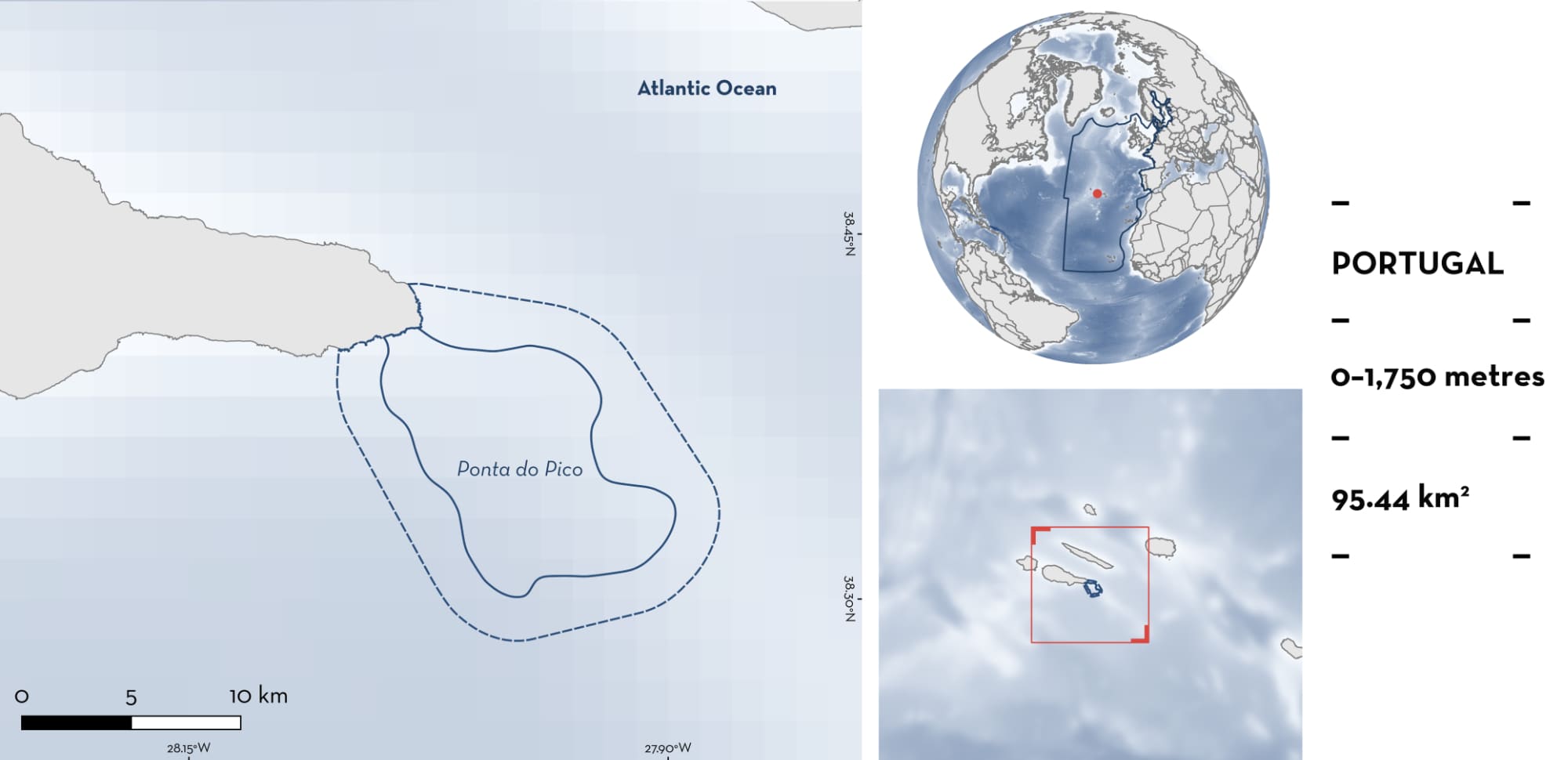
Ponta do Pico is located on the southeast coast of Pico Island, in the Azores Archipelago, Portugal. The coastline is characterised by bays, inlets, and rocky reefs with an absent shelf in the steep south facing wall and a long submarine prolongment of the island towards the southeast forming a large and productive bank. Sea surface temperatures are lower in the boreal winter and higher in summer, with chlorophyll-a concentrations being highest in winter and spring. Within this area there are: threatened species and feeding areas (Whale Shark Rhincodon typus).
Download factsheet
Ponta do Pico
DESCRIPTION OF HABITAT
Ponta do Pico is located on the southeast coast of Pico Island, in the Azores Archipelago, an autonomous region of Portugal. The coastline is characterised by the presence of bays, inlets, rocky areas, and reefs with an almost absent shelf in the steep south facing wall and a long submarine prolongment of the island towards the southeast forming a large and productive bank (Azevedo Neto et al. 2020; EEA 2025).
The area has temperate conditions as a result of the confluence of the North Atlantic Current and the Azores Current and is highly influenced by strong currents (Afonso et al. 2020). Sea surface temperatures are lower in the boreal winter (~14–15°C) and higher in summer (~23–24°C), with chlorophyll-a concentrations being highest (~0.43 mg m-3) in winter and spring (Amorim et al. 2017).
This Important Shark and Ray Area is pelagic and is delineated from inshore and surface waters (0 m) to 1,750 m based on the bathymetry of the area.
CRITERION A
VULNERABILITY
One Qualifying Species considered threatened with extinction according to the IUCN Red List of Threatened Species regularly occurs in the area. This is the Endangered Whale Shark (Pierce & Norman 2016).
CRITERION C
SUB-CRITERION C2 – FEEDING AREAS
Ponta do Pico is an important feeding area for one shark species.
Observations from fishery observers, animal-borne camera tags, and underwater visual census (UVC) surveys have shown that Whale Sharks regularly aggregate in the area to feed on baitfish (Fontes et al. 2020, 2024; B Macena et al. unpubl. data 2025).
Records of Whale Sharks associated with the pole-and-line tuna fishery in the Azores operating between May–November were collected by fishery observers between 2008–2013 (Fontes et al. 2020). Whale Sharks were recorded in association with tunas and were observed preying on bait balls of snipefishes (Macroramphosus spp.) corralled by large schools of Bluefin Tuna (Thunnus thynnus), Bigeye Tuna (T. obesus), Skipjack (Katsuwonus pelamis), and Yellowfin Tuna (T. albacares), with the second largest number of associations across the archipelago (after Santa María Island) recorded in this area (Fontes et al. 2020, 2024; B Macena et al. unpubl. data 2025). This behaviour was also observed daily during UVCs and tagging trips conducted in the area during summer between 2019–2024 and from videos recorded by animal-borne tags where 166 sightings of Whale Sharks feeding were recorded (B Macena et al. unpubl. data 2025). It has been reported that Whale Shark observations increase in these months when the sea surface temperature is highest (22–24°C) and chlorophyll-a decreases (Afonso et al. 2014).
Photographs were also collected between 2008–2022 from UVCs and the diving community across the Azores (Alsina 2021; B Macena et al. unpubl. data 2025). Of 182 Whale Sharks photo-identified, 80 (43.9%) were recorded around Ponta do Pico. Individuals were recorded between July–November with a higher number observed in August and September (Alsina 2021; B Macena et al. unpubl. data 2025) which matches the season when the tuna fishery operates in the area. In addition, Whale Sharks tagged either with satellite transmitters (n = 19) or with biologgers (n = 24) and monitored between 2019–2024 showed that individuals move around Ponta do Pico during summer months (B Macena et al. unpubl. data 2025).
Download factsheet
SUBMIT A REQUEST
ISRA SPATIAL LAYER REQUEST
To make a request to download the ISRA Layer in either a GIS compatible Shapefile (.shp) or Google Earth compatible Keyhole Markup Language Zipped file (.kmz) please complete the following form. We will review your request and send the download details to you. We will endeavor to send you the requested files as soon as we can. However, please note that this is not an automated process, and before requests are responded to, they undergo internal review and authorization. As such, requests normally take 5–10 working days to process.
Should you have questions about the data or process, please do not hesitate to contact us.