ISRA FACTSHEETS
ISRA FACTSHEETS
AUSTRALIA AND SOUTHEAST INDIAN OCEAN
Port Douglas
Summary
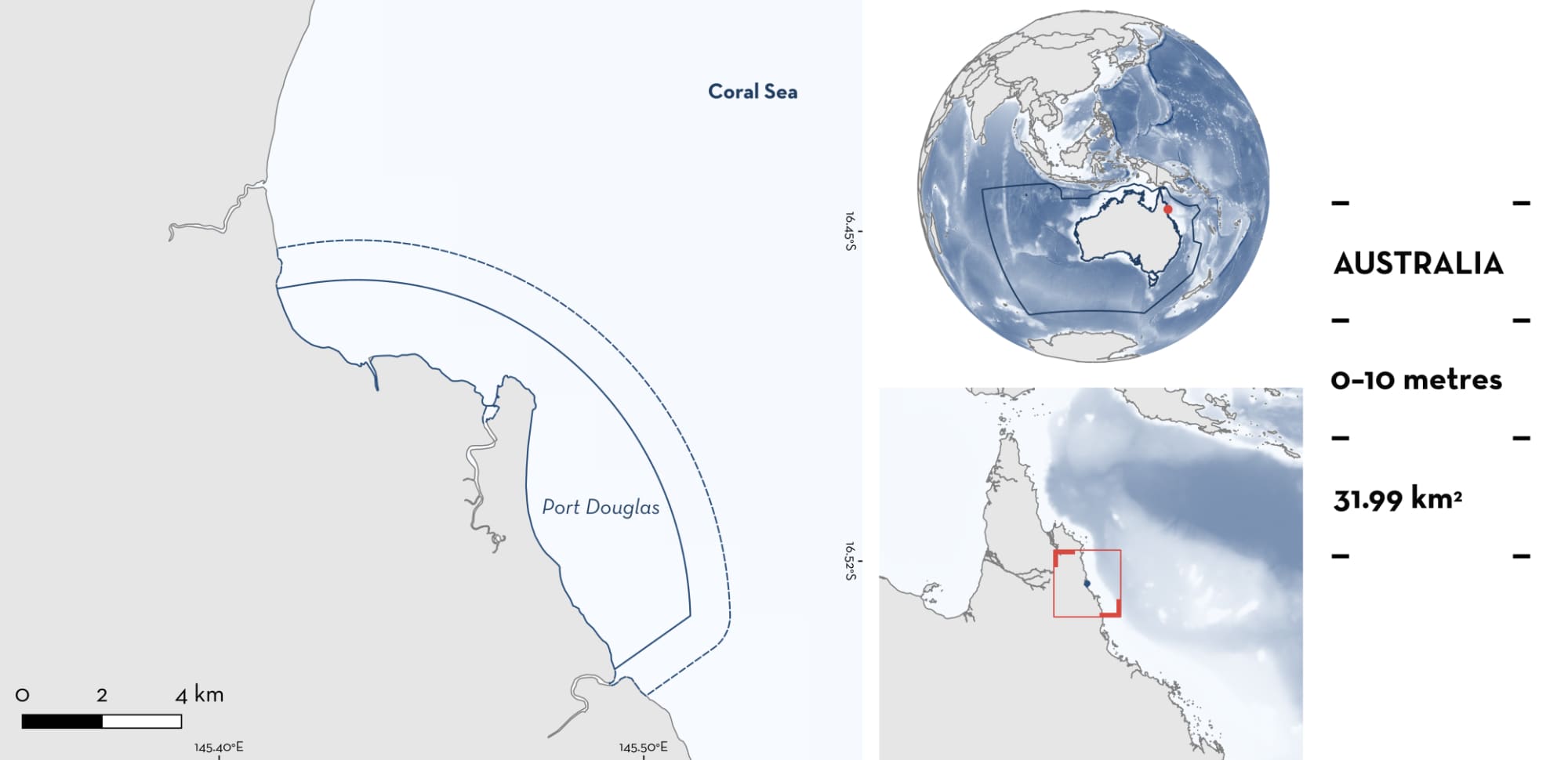
Port Douglas is located in northeast Queensland, Australia. It encompasses the coast around the city of Port Douglas north of the Mowbray River. The area is characterised by inner-shelf reefs, sandy beach ridges, a mangrove-lined estuary, seagrass meadows, and mud and sand substrates. It is influenced by tides, storm waves, and prevailing southeasterly trade winds. The area overlaps with the Great Barrier Reef Marine Park. Within this area there are: threatened species and reproductive areas (Blacktip Reef Shark Carcharhinus melanopterus).
Download factsheet
Port Douglas
DESCRIPTION OF HABITAT
Port Douglas is located in northeast Queensland, Australia. It encompasses the coast around the city of Port Douglas, the Morey Reef, a portion of the estuary Dickson Inlet, and the coast to the north of Mowbray River, including a portion of Alexandra Reef. The area is characterised by inner-shelf reefs, sandy beach ridges, a mangrove-lined estuary, seagrass meadows, and mud and sand substrates (Bird 1971).
The area is influenced by tides, storm waves, and prevailing southeasterly trade winds, which drive a north-westward longshore current (Wolanski & Lambrechts 2020). At Yule Point (just south of this area), the spring tide range reaches ~2.8 m (Bird 1971). During the wet season, heavy downpours are frequent, and large volumes of freshwater are discharged into the coastal zone, temporarily reducing salinity in nearshore waters (Bird 1971).
This area overlaps with the Great Barrier Reef Marine Park – Marine National Park Zone (UNEP-WCMC & IUCN 2025).
This Important Shark and Ray Area is benthic and pelagic and is delineated from inshore and surface waters (0 m) to 10 m based on the bathymetry of the area.
CRITERION A
VULNERABILITY
One Qualifying Species considered threatened with extinction according to the IUCN Red List of Threatened Species regularly occurs in the area. This is the Vulnerable Blacktip Reef Shark (Simpfendorfer et al. 2020).
CRITERION C
SUB-CRITERION C1 – REPRODUCTIVE AREAS
Port Douglas is an important reproductive area for one shark species.
Between 2018–2025, neonate and young-of-the-year (YOY) Blacktip Reef Sharks were captured, documented, geotagged, and uploaded voluntarily with photographic evidence to an online app widely used by recreational fishers in the region (FishBrain 2025). At least 18 neonates or YOY, with a size of <70 cm total length (TL), based on visual size estimates, were captured within the area (FishBrain 2025). Size-at-birth for the species is estimated at 59 cm TL and YOY are up to 70 cm TL based on growth curves (Chin 2013; Chin et al. 2013). Neonates and YOY were captured and posted online in 2018 (n = 1), 2019 (n = 2), 2023 (n = 9), and 2025 (n = 11; FishBrain 2025). In northern Australia, Blacktip Reef Sharks give birth from December to March (Chin 2013). Captures for which the month was available occurred in December 2024, January 2025, and June 2025. Neonates and YOY were captured while fishing from the shore around Port Douglas city and at the entrance of Dickson Inlet estuary. An adult individual was captured and documented close to the outside limits of the area (FishBrain 2025). While no formal or targeted surveys have been conducted in the area, observations over several years indicate the regular presence of early life stage Blacktip Reef Sharks, confirming the area’s consistent use as a reproductive area.
Download factsheet
SUBMIT A REQUEST
ISRA SPATIAL LAYER REQUEST
To make a request to download the ISRA Layer in either a GIS compatible Shapefile (.shp) or Google Earth compatible Keyhole Markup Language Zipped file (.kmz) please complete the following form. We will review your request and send the download details to you. We will endeavor to send you the requested files as soon as we can. However, please note that this is not an automated process, and before requests are responded to, they undergo internal review and authorization. As such, requests normally take 5–10 working days to process.
Should you have questions about the data or process, please do not hesitate to contact us.