ISRA FACTSHEETS
ISRA FACTSHEETS
AUSTRALIA AND SOUTHEAST INDIAN OCEAN
Port Macquarie–Budgewoi Shelf
Summary
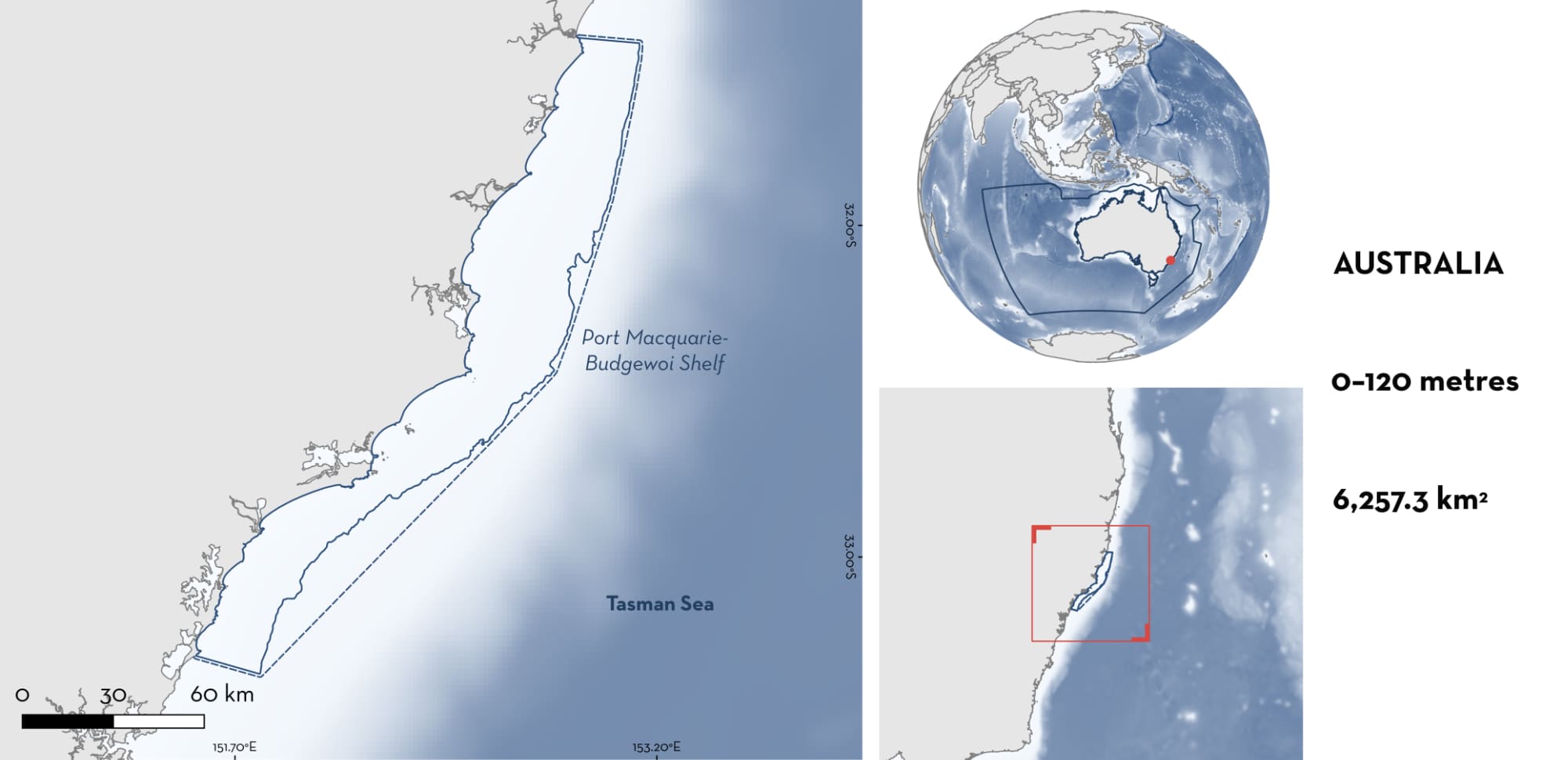
Port Macquarie–Budgewoi Shelf is located on the central New South Wales coast of eastern Australia. The area is a subtropical and temperate inshore coastal zone that is primarily sandy-beach habitat punctuated by small rocky outcrops and headlands. There are several rocky islands in the area, for example Seal Rocks and Broughton Islands. The area is influenced by large estuarine outputs or smaller river outflows, as well as broadscale influences from the East Australian Current. Within this area there are: threatened species (e.g., Sand Tiger Shark Carcharias taurus); reproductive areas (White Shark Carcharodon carcharias); resting areas (Sand Tiger Shark); and undefined aggregations (e.g., Australian Cownose Ray Rhinoptera neglecta).
Download factsheet
Port Macquarie–Budgewoi Shelf
DESCRIPTION OF HABITAT
Port Macquarie–Budgewoi Shelf is located on the central New South Wales coast of eastern Australia. The northern boundary is Port Macquarie and the southern boundary is Lakes Beach at Budgewoi. The area is a subtropical and temperate inshore coastal zone that is primarily sandy-beach habitat punctuated by small rocky outcrops and headlands. There are a number of rocky islands in the area such as Seal Rocks and Broughton Islands (Bruce & Bradford 2012). There are also kelp habitats throughout the area (Jayathilake & Costello 2020).
The waters around Forster are mostly shallow and protected from swells, currents, and surge, creating a calm environment (S Han-de-Beaux pers. obs. 2025). Dive sites around Forster include Hayden’s Rock (a mixture of sandy substrates and rocky boulders with kelp), Latitude Rock (steep rocky outcrops providing shelter and gullies), and The Pinnacle–Forster (a submerged rocky reef with walls and gutters at depth; S Han-de-Beaux pers. obs. 2025). The main dive sites around Seal Rocks include Little Seal (a small rocky outcrop with rocky bommies, gullies, overhangs, and walls surrounded by sandy substrates) and Big Seal (a larger rocky outcrop which includes rocky bommies, gullies, sandy bowls, overhangs, and walls surrounded by sandy substrates; S Han-de-Beaux pers. obs. 2025).
The area is influenced by large estuarine outputs or smaller river outflows (e.g., Manning River, Coolongolook River, Port Stephens Bay, Hunter River, and Lakes Entrance), as well as broadscale influences from the East Australian Current and associated eddies and upwelling events (Archer et al. 2017). Port Macquarie–Budgewoi Shelf is also influenced by the East Australian Current, the poleward flowing western boundary current of the South Pacific Gyre (Suthers et al. 2011). The East Australian Current flow is strongest in the austral summer, and the formation of eddies along this coastline also fluctuates seasonally (Ridgway & Hill 2009).
This area overlaps with Port Stephens – Great Lakes Marine Park (NSW DPIRD 2025) and the Cod Grounds Marine Park (Parks Australia 2025).
This Important Shark and Ray Area is benthic and pelagic and is delineated from inshore and surface waters (0 m) to 10 m based on the bathymetry of the area.
CRITERION A
VULNERABILITY
Two Qualifying Species considered threatened with extinction according to the IUCN Red List of Threatened Species regularly occur in the area. These are the Critically Endangered Sand Tiger Shark (Rigby et al. 2025) and Vulnerable White Shark (Rigby et al. 2022).
CRITERION C
SUB-CRITERION C1 – REPRODUCTIVE AREAS
Port Macquarie–Budgewoi Shelf is an important reproductive area for two shark species.
White Sharks occur throughout the New South Wales coastline and beyond, however, multiple lines of evidence support the importance of this area for young size classes of this species. Between 2008-2015, 39 White Sharks were tagged using acoustic tags in the area (Bruce et al. 2019). Sharks ranged in size from 170–320 cm total length (TL) with a mean of 220 cm TL. The size-at-birth for this species is 120–150 cm TL (Bruce 2008) and young-of-the-year (YOY) are classified as <175 cm TL (Bruce & Bradford 2012). Using an annual growth increase of ~25 cm (Ramos et al. unpubl. data 2025), tagged sharks were all classified as immature (comprising 1 x YOY, 6 x 1-yr, 15 x 2-yr, 15 x 3-yr, 1 x 4-yr, and 1 x 5-yr olds; Bruce et al. 2019). Tagged sharks spent a mean of 62 days in the area and were detected year-round, with a peak between October–January (Bruce et al. 2019). Eighteen of the tagged sharks (46%) made multi-year returns to the area, with a maximum annual return of five consecutive years.
Between 2007–2017, 77 White Sharks were tracked using satellite tags, and revealed high residency and site use to the Port Macquarie–Budgewoi Shelf area (Lee et al. 2021). Of those sharks, 4% were YOY (<175 cm TL), 86% were juveniles (175–300 cm TL), and the remaining 10% were sub-adult (>300 cm TL). Most tracked White Sharks (~66% of presence) favoured water depths between ~50–130 m. White Shark movements were highly correlated to water temperatures, with the highest probability of occurrence peaking at ~20◦C (Lee et al. 2021), supporting their preference for this latitude during the summer months.
Between 2007–2019, 87 White Sharks were dual tagged with acoustic transmitters and satellite-linked radio transmitting (SLRT) SPOT tags (Spaet et al. 2020). Sharks ranged in fork length (FL) from 147–350 cm (mean ± standard deviation = 224.3 cm ± 39.0 cm FL). Analysis suggested broader area use for juvenile White Sharks in New South Wales than was previously reported, extending their important reproductive habitat from the waters around Port Stephens to those covered in this area. However, the study did conclude that some larger (and presumably older) immature individuals were included in their dataset and may represent an ontogenetic range expansion.
Between August–December 2015, Baited Remote Underwater Video Station (BRUVS) surveys were conducted in the area and recorded 34 separate sightings of 22 individual White Sharks, revealing a similar size distribution of immature individuals between 150–246 cm TL, with five of these individuals classified as YOY (22.7%) (Harasti et al. 2016).
Between 2017–2020, aerial surveys conducted by trained observers recorded a total of 55 YOY White Sharks between Seal Rocks and Hallidays Point within the area (E Hunt unpubl. data 2025). White Sharks were observed swimming slowly in shallow waters in the area, assumed a safe resting space for young age classes of this species. Peaks in aerial survey sightings of White Sharks in this area over multiple years highlight the importance of the area for the species.
Between 2021–2025, White Shark captures have been recorded by the New South Wales Shark Smart Drumline Program (NSW Government 2025). During this time, a total of 563 White Sharks were captured within the area, with 45 of these individuals (8.0%) being classified as neonate or YOY based on size measurements (<175 cm TL). Of 73 captures in Lake Macquarie, 16 were <175 cm TL (21.9%), and of 198 captures in Port Macquarie, 16 were <175 cm TL (8.0%) (NSW Government 2025), supporting the boundaries of this area for young age classes of White Sharks.
The combination of high residency rates and annual returns of YOY and immature White Sharks to this area support the importance of this area for young life-stages of this species. There are no other known areas in New South Wales where young White Sharks (including YOY) regularly or predictably aggregate in these numbers along this coastline.
There are regular and predictable seasonal reproductive aggregations of Port Jackson Sharks in the area. Between 2003–2025, recreational dives were conducted around Fingal Island within the area (D Harasti pers. obs. 2025). Large seasonal aggregations of Port Jackson Sharks were observed at the Governor Wharf dive site during winter (peaking in July–August). On average, ~50–100 individuals were observed during a single dive, with aggregations of over 200 sharks observed on occasion (e.g., August 2007; D Harasti pers. obs. 2025). This aggregation is reproductive in nature, with mating observed multiple times during a season and 10+ egg cases observed on a single dive. Recreational dives were conducted in the area with the objective of viewing these regular and predictable reproductive aggregations of Port Jackson Sharks (D Harasti pers. obs. 2025). In addition, acoustic telemetry has shown repeated seasonal migrations to the area (C Brown unpubl. data 2025). In 2017, 20 Port Jackson Sharks (10 males and 10 females) were tagged with 10-year acoustic transmitters. Tagged sharks are absent between January–May and were detected returning to the area annually in June over 6–7 years, supporting the predictable and regular seasonal in-water observations (C Brown unpubl. data 2025).
CRITERION C
SUB-CRITERION C3 – RESTING AREAS
Port Macquarie–Budgewoi Shelf is an important resting area for one shark species.
There are multiple lines of evidence to support Sand Tiger Sharks regularly using sites within this area for resting. Evidence includes scientific surveys and acoustic tracking conducted by the New South Wales Department of Primary Industry and Regional Development (Bradford et al. 2025; Otway & Louden 2025), a citizen science photo-identification database (Sharkbook 2025), and opportunistic sightings from the recreational dive industry (A Clarke pers. obs. 2025). Sand Tiger Shark sightings have been logged from citizen science submissions by SCUBA divers on the online database Sharkbook, with photo-identification used to identify individuals (Spot a Shark unpubl. data 2025). There are three main resting sites within the area where citizen science submissions have been collated from: Forster, Seal Rocks, and Broughton Island.
Nineteen Sand Tiger Shark aggregation sites have been highlighted in eastern Australia (Bradford et al. 2025). These areas were defined as a site where five or more Sand Tiger Sharks are seen aggregating either continuously or on a predictable seasonal cycle, and all were classified as resting areas for the species. Between 2011–2021, 10-year acoustic transmitters were used to track sharks and determine their preferred habitats based on residency rates (Otway & Louden 2025), and this information was used to determine aggregation sites. Five of the aggregation sites are located within this area: Cod Grounds, the Pinnacle–Forster, Big Seal Rocks, Little Seal Rocks, and Broughton Island.
Sand Tiger Sharks were observed at Cod Grounds year-round, but typically larger numbers occurred May–November. Between 2011–2021, 23 of the 31 tagged individuals were detected at Cod Grounds (70,982 detections; Bradford et al. 2025). Observed residence periods lasted up to 18 days. Adult males were most prevalent in autumn/summer, with absences in late spring during the annual northly migration to Queensland waters (Bradford et al. 2025). Females were most prevalent over late autumn to early spring and included juvenile and pregnant individuals migrating south to pup as well as reproductively active females ready to migrate north to mate. Over 50 Sand Tiger Sharks have been recorded on a single dive in this area (B Louden pers. comm. 2025). At the Cod Grounds, Sand Tiger Sharks were observed swimming near the seabed at a mean depth of 28.4 m (range 14.6–32.8 m). Animals exhibited a diurnal usage pattern at the Cod Grounds, spending more time at the site during the day (Otway & Louden 2025).
Sand Tiger Sharks are observed at the Pinnacle–Forster year-round, with numbers peaking between December–May. Between 2011–2021, 18 of the 31 tagged individuals were detected within the area (n = 27,215 detections; Bradford et al. 2025). Observed residence periods lasted up to 12 consecutive days, with male residency shorter (~70% for 1–2 days) than female residency (~90% up to 4 days; Otway & Louden 2025). A mixture of ages and sexes were detected within the area, however, there were differences in the seasonality of their site use. The peak in detections for adult males was the autumn and winter, coinciding with their annual northerly migration. Juvenile and non-reproductively active females were present in autumn and summer, with pregnant females occupying the area in autumn and winter prior to migrating south in late winter to pup. Up to 20 Sand Tiger Sharks have been recorded on a single dive in this area (B Louden pers. comm. 2025). At the Pinnacle–Forster, Sand Tiger Sharks were observed swimming close to the seabed at an average depth of 28.7 m (range 13.6–46.4 m; Bradford et al. 2025) and showed a diel pattern of occupancy to the area with higher detections during the day (Otway & Louden 2025).
Sand Tiger Sharks are observed at Big Seal Rocks and Little Seal Rocks year-round, with numbers peaking between January–June. Between 2011–2021, 24 of the 31 tagged individuals were detected at Big Seal Rocks (n = 200,788 detections; Bradford et al. 2025). Observed residence periods lasted up to 22 consecutive days (Otway & Louden 2025). A mixture of ages and sexes were detected within the area, however, there were differences in the seasonality of their site use. Adult males were most prevalent in autumn and winter, and absent during spring, coinciding with the annual northly migration to Queensland waters. Juvenile and non-reproductively active females were prevalent in autumn and summer, and reproductively active individuals migrate north in late spring to mate. Pregnant Sand Tiger Sharks are also found at the site in autumn and winter and likely pupped in the local vicinity (Bradford et al. 2025). At Big Seal Rocks, over 200 Sand Tiger Sharks were recorded on a single dive in February 2023, with >#100 regularly observed at the site in the first half of the year (B Louden pers. comm. 2025; D Harasti pers. obs. 2025). At Little Seal Rocks, over 30 Sand Tiger Sharks have been observed on several occasions (B Louden pers. comm. 2025; D Harasti pers. obs. 2025). At Big Seal Rocks, Sand Tiger Sharks were observed swimming close to the seabed and in the water column at an average depth of 21.6 m (range 7.3–36.4 m; Bradford et al. 2025) and showed a diel pattern of occupancy to the area with higher detections during the day (Otway & Louden 2025).
Sand Tiger Sharks are observed at sites around Broughton Island year-round, with numbers peaking between January–May. Over time, Sand Tiger Sharks have tended to shift their habitat preference at these sites (Bradford et al. 2025). Before 2012, it was common to observe over 20 Sand Tiger Sharks in resting aggregations around Little Broughton shark gutter, however, since 2012 the sharks have favoured East Head shark gutter (observations of over 50 aggregating individuals) and North Rock (observations of over 80 aggregating individuals) during summer and autumn (Bradford et al. 2025). Adult males were most prevalent resting during winter, coinciding with the northerly migration of Sand Tiger Sharks to Queensland waters, and then again in summer following mating in late spring. Juvenile and non-reproductive females used the site for resting in summer and autumn, while reproductively active individuals migrated north in October/November to mate (Bradford et al. 2025). At Little Broughton Island, Sand Tiger Sharks were observed swimming close to the seabed at an average depth of 18.5 m (range 13.7–25.5 m) and spend more time at the site during the day (Bradford et al. 2025).
The diel patterns in behaviour that the sharks exhibit at these sites is characteristic of Sand Tiger Sharks resting during the day and being active at night, assumed for foraging purposes (D Harasti pers. obs. 2025). Hovering and milling are also characteristic behaviours of resting Sand Tiger Sharks and comprise the majority of swimming behaviours observed at their main aggregation sites on Australia’s east coast (Smith et al. 2015). When hovering, sharks face into the water current and their tail beats allow them to maintain a stationary position, whereas milling involves slow movements and directional changes generally confined to a particular area within a gutter (Smith et al. 2015).
Between 2004–2025, 2,376 submissions of Sand Tiger Shark sightings were received from dive sites within the area (Forster, n = 290; Seal Rocks, n = 1,335; Broughton Island, n = 751; Sharkbook 2025). Using photo-identification, at least 401 individual Sand Tiger Sharks were identified based on left flank images (Sharkbook 2025). Shark sightings in this area are regular and predictable year-round, with seasonal peaks from spring to autumn (S Han-de-Beaux unpubl. data 2025). For example, during the summer months, 20–30 sharks can be observed at the Haydens Rock dive site within the Forster part of the area (S Han-de-Beaux unpubl. data 2025). Sand Tiger Sharks are observed in groups swimming calmly up and down gullies, characteristic resting behaviour for this species (Smith et al. 2015; S Han-de-Beaux unpubl. data 2025). The records reviewed for photo-identification in the Broughton part of the area (n = 312; 42% of the total), indicated that this site is mostly used by adult sharks (87% of sightings) with a fairly equal ratio of male (46%) and female (41%) sightings. Divers have anecdotally reported observations of courtship and mating behaviours at this site (S Han-de-Beaux pers. obs. 2025).
Between 2020–2025, daily to weekly recreational dives were conducted year-round at dive sites around Forster, within this area (A Clarke unpubl. data 2025). Large aggregations of Sand Tiger Sharks are observed on all dives between October–April, with lower numbers observed outside these months. At Haydens Rock dive site, an average of approximately 20 individuals are observed on a single 50-minute dive (ranging between 10–30 individuals, depending on weather conditions and visibility). For one week each year, the numbers at this site peak to approximately 50 individuals, observed daily between Christmas and New Year during the summer (A Clarke pers. obs. 2025). At Latitude Rock dive site, an average of between 30–40 individuals are observed daily on a single 50-minute dive, whereas <10 individuals are seen during dives at this site in the winter months. At both sites, Sand Tiger Sharks are observed docily swimming between the trenches and rocky reefs, characteristic resting behaviour for this species (A Clarke pers. obs. 2025). Aggregations comprise both males and females, and mature individuals.
CRITERION C
SUB-CRITERION C5 – UNDEFINED AGGREGATIONS
Port Macquarie–Budgewoi Shelf is an important area for undefined aggregations of two shark and one ray species.
Between 2020–2025, daily to weekly recreational dives were conducted year-round at dive sites around Forster, within this area (A Clarke unpubl. data 2025). Assemblages of Port Jackson Sharks and Spotted Wobbegongs are observed on every dive year-round resting together in this area (A Clarke unpubl. data 2025). During an average 50-minute dive at Haydens Rock and Latitude Rock dive sites, approximately 4–5 Port Jackson Sharks and over 20 Spotted Wobbegongs are observed in assemblages together on the sandy substrates (A Clarke pers. obs. 2025). Although resting is a commonly observed behaviour in these species, these dive sites have reliable year-round observations of both species forming resting assemblages, which are not observed outside this area. More information is needed to determine whether resting is the primary driver of this assemblage or if the area serves another function for these species.
Between 2020–2025, daily to weekly recreational dives were conducted year-round at dive sites around Forster, within the area (A Clarke unpubl. data 2025). Large aggregations (>100 individuals) of Australian Cownose Rays are observed in the area year-round (A Clarke pers. obs. 2025). Observations of aggregations peak during the summer months, with up to 10 observations of aggregations made each year by recreational divers (A Clarke pers. obs. 2025). Australian Cownose Rays are generally observed cruising past the dive site, making it difficult to determine the exact numbers in each observation.
Australian Cownose Ray aggregations are also regularly observed in this area based on evidence from catch data in bather protection nets and aerial surveys (Chan et al. 2024; Dalton et al. 2024, 2025; A Chan et al. unpubl. data 2025). A decade of catch data (2013–2023) from bather protection gillnets in New South Wales and Queensland indicate gillnets near the southern boundary of the Port Macquarie–Budgewoi Shelf area sees the highest catch of Australian Cownose Rays (A Chan et al. unpubl. data 2025). Of 966 Australian Cownose Rays captured during the study period in the Queensland and New South Wales programs, 47.2% were caught at 11 beaches that lie within the Port Macquarie–Budgewoi Shelf area (A Chan et al. unpubl. data 2025). Furthermore, catch data indicate aggregations containing up to 21 Australian Cownose Rays can be caught together in gillnets in the area (Dalton et al. 2024, 2025; A Chan et al. unpubl. data 2025).
There is evidence from aerial survey sightings of Australian Cownose Rays aggregating predictably throughout the year, but particularly during the summer, in Port Macquarie–Budgewoi Shelf (Chan et al. 2024). Aerial surveys were conducted from January 2017 through June 2019 in seven sections along the New South Wales coastline, two of which overlap with the Port Macquarie–Budgewoi Shelf area. Section 4 of this survey (towards the north of the area) had a high frequency of sightings, with 284 sightings of Australian Cownose Rays from 340 surveys. Sightings comprised an average group size of 91.8 individuals, with the largest aggregation estimated to consist of 1,000 individuals. In comparison to the northern survey sections that had a slightly higher frequency of sightings (highest number of sightings was 367), large groups that consisted of 500–999 individuals occurred more often in this area, suggesting the species occurs slightly less often in this area, but when present they form larger aggregations than other sections. In section 5 of the aerial survey, which overlaps towards the south of the area, there were fewer sightings of Australian Cownose Rays (67 from 144 surveys). The maximum estimated group size was 50 individuals, with an average of 7.5 rays (Chan et al. 2024), however, this section coincides with the highest captures in bather protection gillnets (Dalton et al. 2024; A Chan et al. unpubl. data 2025).
Aggregations of Australian Cownose Rays in the area may be for reproductive purposes as pregnant females have been recorded from a small number of sampled rays. Of eight specimens analysed in this area, five were pregnant females, each carrying a single foetus near full-term. By contrast, all nine specimens collected in northern New South Wales, outside the area, were juveniles or subadults (A Chan unpubl. data 2025). Further information is required to understand the nature and function of these aggregations.
Download factsheet
SUBMIT A REQUEST
ISRA SPATIAL LAYER REQUEST
To make a request to download the ISRA Layer in either a GIS compatible Shapefile (.shp) or Google Earth compatible Keyhole Markup Language Zipped file (.kmz) please complete the following form. We will review your request and send the download details to you. We will endeavor to send you the requested files as soon as we can. However, please note that this is not an automated process, and before requests are responded to, they undergo internal review and authorization. As such, requests normally take 5–10 working days to process.
Should you have questions about the data or process, please do not hesitate to contact us.