ISRA FACTSHEETS
ISRA FACTSHEETS
AUSTRALIA AND SOUTHEAST INDIAN OCEAN
Port Phillip Bay
Summary
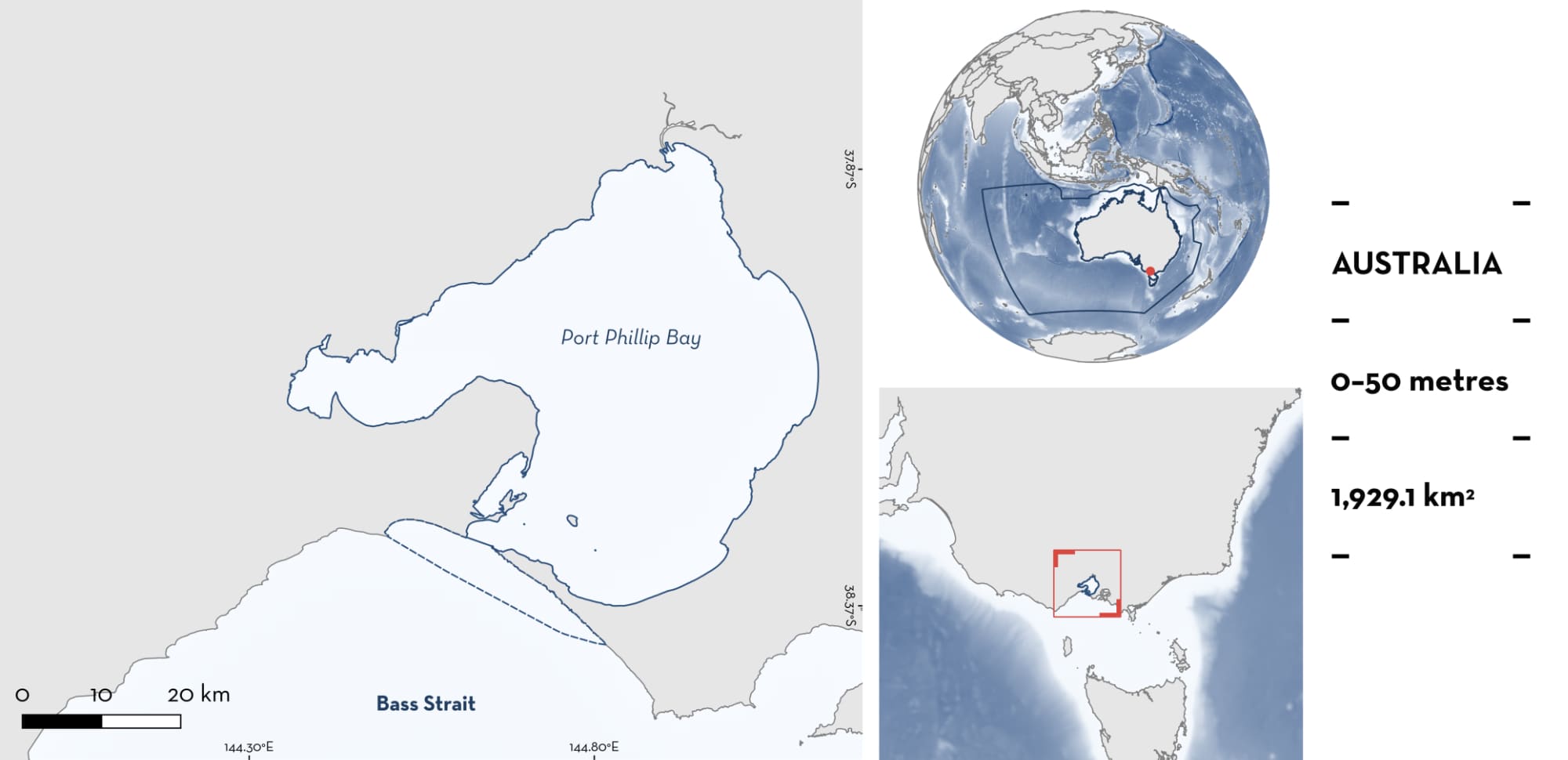
Port Phillip Bay is located in Victoria, southeast Australia. It is the largest bay in Victoria and is connected to Bass Strait by a narrow opening. The area encompasses multiple bays (e.g., Swan Bay) and beaches and is characterised by intertidal flats with seagrasses beds, rocky reefs, and sandy and muddy substrates. It is influenced by freshwater input from multiple rivers. The area overlaps with four Key Biodiversity Areas, a Ramsar Site, a marine national park, and three marine sanctuaries. Within this area there are: threatened species (e.g., Broadnose Sevengill Shark Notorynchus cepedianus); range-restricted species (e.g., Eastern Fiddler Ray Trygonorrhina fasciata); and reproductive areas (e.g., Gummy Shark Mustelus antarcticus).
Download factsheet
Port Phillip Bay
DESCRIPTION OF HABITAT
Port Phillip Bay is located in Victoria, southeast Australia. It is the largest bay in Victoria and is connected to Bass Strait by a 3 km wide opening bounded by the Mornington and Bellarine peninsulas. The area encompasses multiple bays (e.g., Swan Bay) and sandy/rocky beaches. It is characterised by intertidal flats with seagrass beds, rocky reefs, and sandy and muddy substrates (Harris et al. 1996). Seagrass beds are more abundant in the southwest part of the bay and coverage is dominated by the eelgrass Zostera nigricaulus (Jenkins et al. 2015).
Sea surface temperatures range between 9–11°C in the austral winter and 23–24°C in the summer (Lee et al. 2012). The area is influenced by freshwater input from multiple rivers, of which the Yarra River is the largest (Harris et al. 1996). A tidal area forms shallow sand banks near the entrance of the bay which limits the influence of waves and winds (Parry & Hirst 2016). Water exchange with Bass Strait is limited with an average of 12 months for residency time of water inside the bay (Harris et al. 1996).
The area overlaps with four Key Biodiversity Areas (KBAs): Bellarine Wetlands, Cheetham and Altona, Swan Bay and Port Phillip Bay Islands, and Werribee and Avalon (KBA 2025a, 2025b, 2025c, 2025d), the Port Phillip Bay & Bellarine Peninsula Ramsar Site (Wetland of International Importance; Ramsar 2025), and Port Phillip Heads Marine National Park, Point Cooke Marine Sanctuary, Jawbone Marine Sanctuary, and Ricketts Point Marine Sanctuary (Parks Victoria 2025).
This Important Shark and Ray Area is benthic and pelagic and is delineated from inshore and surface waters (0 m) to 50 m based on the bathymetry of the area.
CRITERION A
VULNERABILITY
Two Qualifying Species considered threatened with extinction according to the IUCN Red List of Threatened Species regularly occur in the area. These are the Critically Endangered Tope (Walker et al. 2020) and the Vulnerable Broadnose Sevengill Shark (Finucci et al. 2020).
CRITERION B
RANGE RESTRICTED
This area holds the regular presence of Eastern Shovelnose Stingaree, Eastern Fiddler Ray, and Spotted Stingaree as resident range-restricted species.
Eastern Shovelnose Stingarees have been regularly recorded in the area since the 1990s (Parry & Hirst 2016). This species was captured in demersal trawl net surveys conducted between 1990–2011 in the area and was highlighted as one of the most abundant species in Port Phillip Bay (Parry & Hirst 2016). This species was also recorded in underwater visual census (UVC) surveys conducted between 2017–2019 on restored shellfish reefs in the area (Bayraktarov et al. 2025). In addition, the presence of this species in the area is supported by citizen science, with 2,545 observations recorded between 2016–2025. Citizen science confirmed that Port Phillip Bay is the area with the largest number of individuals recorded in all of southern Australia (iNaturalist 2025b). This species is restricted to the Southeast Australian Shelf Large Marine Ecosystem (LME).
Eastern Fiddler Rays have been recorded in the area by UVC surveys and Baited Remote Underwater Video Stations (BRUVS) since the 1990s (Edgar & Barret 2012; Edgar & Stuart-Smith 2014; Edgar et al. 2020; Cutter 2023; Bayraktarov et al. 2025; Graf et al. 2025; iNaturalist 2025a; RLS 2025). Between 1999–2025, UVC surveys (n = 3,597) were conducted across multiple locations in Victoria as part of the Reef Life Survey program (Edgar & Barret 2012; Edgar & Stuart-Smith 2014; Edgar et al. 2020; RLS 2025). In Port Phillip Bay, 1,607 surveys (50 m transect with fishes counted in two blocks of 50×5 m at each side of the transect) were conducted, and this was the only location where Eastern Fiddler Rays were recorded in Victoria. In these surveys, 61 individuals were observed in 37 surveys between 2004–2025 mostly near the entrance of the bay (Edgar & Barret 2012; Edgar et al. 2014, 2020; RLS 2025). In addition, this species was recorded in BRUVS surveys conducted between 2019–2022 (Cutter 2023; Graf et al. 2025). BRUVS (n = 1,048) were deployed across 17 locations along the coast of Victoria with 127 deployed in Port Phillip Bay in autumn and summer 2022 (Cutter 2023; Graf et al. 2025). Due to morphological similarities between Eastern Fiddler Ray and Southern Fiddler Ray Trygonorrhina dumerilii, observations for both species (n = 388) were combined. Port Phillip Bay was the location with the largest number (n = 251) of combined fiddler rays recorded across all of Victoria. Port Phillip Bay was also the location with the largest recorded abundance. This was measured as the maximum number of individuals of a species observed in a single frame (MaxN = 1–9 individuals). These observations were found associated with sandflats and seagrass beds (Cutter 2023; Graf et al. 2025). Within this area, fiddler rays were recorded in 80.3% (n = 102) of the BRUVS deployed (Cutter 2023). Eastern Fiddler Ray was also recorded in UVC surveys conducted between 2017–2019 on restored shellfish reefs in the area (Bayraktarov et al. 2025). The presence of Eastern Fiddler Ray has been confirmed from citizen science records (iNaturalist 2025a), despite misidentification issues (with Southern Fiddler Ray) and hybrids of the two species being present in this area (Donnellan et al. 2015). Eastern Fiddler Rays are restricted to the Southeast Australian Shelf LME and the East Central Australian Shelf LME.
Spotted Stingarees were recorded in UVC surveys conducted across multiple locations in Victoria as part of the Reef Life Survey program (Edgar & Barret 2012; Edgar & Stuart-Smith 2014; Edgar et al. 2020; RLS 2025). In Port Phillip Bay, 1,607 surveys were conducted, and this was the area with the largest number of Spotted Stingaree recorded across Victoria. In these surveys, 51 individuals were observed in 38 surveys between 2006–2019 mostly near the entrance of the bay (Edgar & Barret 2012; Edgar & Stuart-Smith 2014; Edgar et al. 2020; RLS 2025). In addition, four individuals were recorded in the same BRUVS surveys where Eastern Fiddler Rays were recorded (Cutter 2023; Graf et al. 2025). The presence of this species in the area was supported by citizen science, with 103 observations recorded between 2016–2025. Citizen science confirmed that Port Phillip Bay is the area with the largest number of individuals recorded in all of southern Australia (iNaturalist 2025c). This species is restricted to the Southeast Australian Shelf and South West Australian Shelf LMEs.
CRITERION C
SUB-CRITERION C1 – REPRODUCTIVE AREAS
Port Phillip Bay is an important reproductive area for three shark species.
Fishing surveys and catch data have revealed the regular presence of neonate and young-of-the-year (YOY) Tope in the area since the 1940s (Olsen 1954, 1959; Stevens & West 1997; Walker et al. 2008). In southern Australia, this area was recognised as one of the six major nursery areas across Victoria and Tasmania for the species (Olsen 1954; Stevens & West 1997; Walker et al. 2008).
Between 1947–1953, 11 areas across Victoria and Tasmania were surveyed with handlines and gillnets to look for potential nursery areas for Tope (Olsen 1954). In Port Phillip Bay, 576 Tope measuring 27–50 cm total length (TL) were caught by handline. These individuals were classified as neonate/YOY. Reported size-at-birth for the species is 30–40 cm TL (Ebert et al. 2021) and YOY size in this region was set at 50 cm TL (Olsen 1954; Moulton et al. 1992). Port Phillip Bay was the area with the second largest number of neonate/YOY Tope recorded across all areas. Subsequently, between 1992–1996, three bays were also surveyed in Victoria to explore nursery areas for this species (Stevens & West 1997). In Port Phillip Bay, gillnet (n = 242, 75 m long gillnet) and longline (n = 92, 50 hook longline) sets were deployed in the area and 88 Tope were recorded mostly (81.8%) on longlines. Of these, 75 (85.2%) were classified as neonate/YOY based on their size and the rest were classified as one-year-old sharks (Stevens & West 1997). Port Phillip Bay recorded the second largest number of individuals and catch-per-unit-effort (CPUE) of these life-stages in Victoria after Western Port Bay. Neonate/YOY Tope were recorded mostly in summer, between December–March (Stevens & West 1997). Additional sampling was conducted in South Australia, but no neonate/YOY were recorded (Stevens & West 1997).
Population declines of Tope have been recorded since the 1950s across Australia including reductions of Tope pups in Port Phillip Bay (Walker 1999; Braccini et al. 2009). As part of regulations focused on population recovery, the use of nets has been prohibited in Port Phillip Bay since 2022 with limitations on catching Tope measuring <45 cm partial length (from the rear gill slit to the start of the tail) in this area (VFA 2023). In addition, seagrass degradation in this area following a drought from 1997 to 2010 has reduced the suitable habitat for early life-stage Tope (Jenkins et al. 2015). Existing regulations and the lack of surveys focused on monitoring neonate/YOY Tope are related with the reduction of contemporary records. However, records from recreational fishing forums between 2020–2023 have revealed that these life-stages are still incidentally caught in the area (Fishbrain 2025). These records confirm the contemporary importance of this area for reproductive purposes of this species. Despite the records of neonates and YOY, no pregnant females were recorded across all studies conducted in the area.
In the same monitoring from 1992–1996, 417 Gummy Sharks were caught in the area, mostly (60.2%, n = 251) on longlines (Stevens & West 1997). Of these, 137 (32.8%) were classified as neonate/YOY and 63 (16.1%) as one-year-old individuals. These individuals measured <45 cm TL which is close to the reported size-at-birth (30–35 cm TL; Ebert et al. 2021) and to the size set for YOY Gummy Sharks (50 cm TL) in the region (Moulton et al. 1992; Stevens & West 1997). Port Phillip Bay recorded the largest number of neonate/YOY and CPUE across all bays monitored in Victoria. As with Tope, existing regulations on the use of nets and size limits, and the lack of surveys focused on monitoring neonate/YOY Gummy Sharks are related to the shortage of contemporary records. However, records from recreational fishing forums since 2020 have revealed that these life-stages are still incidentally caught in the area (Fishbrain 2025). These records confirm the contemporary importance of this area for reproductive purposes of this species. Despite the records of neonates and YOY, no pregnant females were recorded across all studies conducted in the area.
Between November 2014–April 2015, 109 Broadnose Sevengill Sharks were caught with benthic longlines and rod-and-line (Schmidt-Roach 2018). Of these, 79 (73.1%) were classified as neonates/YOY (Schmidt-Roach 2018) as their size was smaller than the reported size for YOY in the region (<80 cm TL; Braccini et al. 2010). Almost all neonate/YOY were caught in March–April in the mid part of the bay. Sixty-one individuals were tagged with acoustic transmitters of which 43 were neonates. Broadnose Sevengill Sharks were monitored in an array of 46 receivers deployed across the entire bay between November 2014–January 2017. On average, individuals at early life-stages stayed ~80 days inside the area (3–469 days). Twelve neonates (28.5%) were detected leaving the area between June–July 2015, and 27 (64.3%) were detected after tagging and up to July 2015 but those were not detected leaving the area. Three neonates/YOY (7.1%) remained in Port Phillip Bay between nine months and one year. These individuals at early life-stages were detected mostly in the middle part of the bay at depths >20 m (Schmidt-Roach 2018). Six of the neonate/YOY tagged were detected on acoustic receivers or recaptured outside of this area, in locations around Victoria, New South Wales, and Tasmania, with the largest movement recorded to Maria Island in Tasmania (586 km from Port Phillip Bay) in 129 days. Port Phillip Bay is the only area in southern Australia that has been identified as a potential pupping and nursery area for the species (Schmidt-Roach 2018).
Download factsheet
SUBMIT A REQUEST
ISRA SPATIAL LAYER REQUEST
To make a request to download the ISRA Layer in either a GIS compatible Shapefile (.shp) or Google Earth compatible Keyhole Markup Language Zipped file (.kmz) please complete the following form. We will review your request and send the download details to you. We will endeavor to send you the requested files as soon as we can. However, please note that this is not an automated process, and before requests are responded to, they undergo internal review and authorization. As such, requests normally take 5–10 working days to process.
Should you have questions about the data or process, please do not hesitate to contact us.