ISRA FACTSHEETS
ISRA FACTSHEETS
AUSTRALIA AND SOUTHEAST INDIAN OCEAN
Port Stephens Estuary
Summary
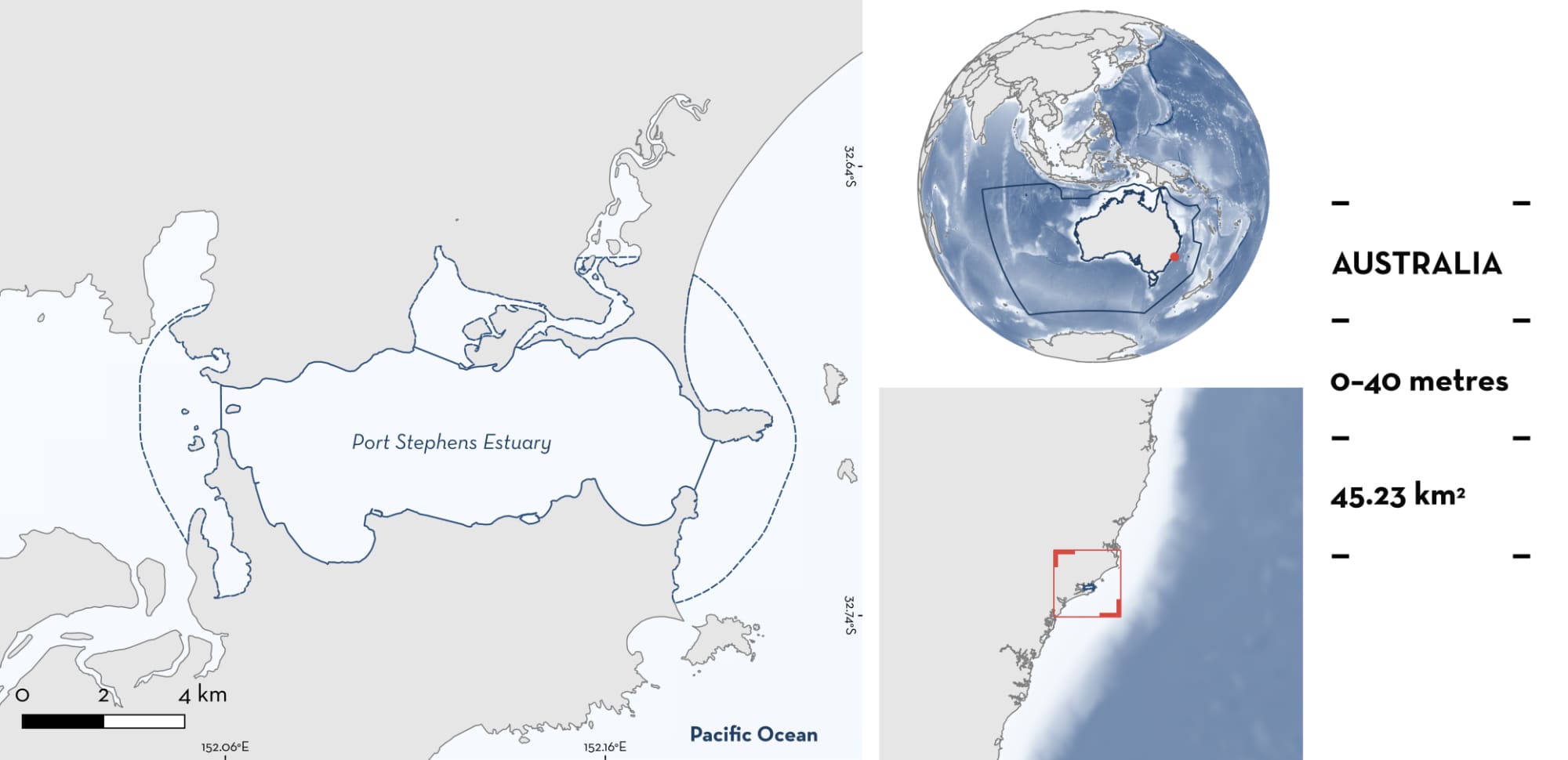
Port Stephens Estuary is located on the mid New South Wales coast of Australia. The area comprises the eastern basin of the Port Stephens Estuary. The habitat is characterised by seagrasses, sponge gardens, mangroves, macroalgal beds, and sandy substrates. The area overlaps with the New South Wales Port Stephens – Great Lakes Marine Park. Within the area there are: range-restricted species (e.g., Blind Shark Brachaelurus waddi); and reproductive areas (e.g., Ornate Wobbegong Orectolobus ornatus).
Download factsheet
Port Stephens Estuary
DESCRIPTION OF HABITAT
Port Stephens Estuary is located on the mid New South Wales coast of Australia. The area comprises the eastern basin of the Port Stephens Estuary. The habitat is characterised by seagrasses, sponge gardens, mangroves, macroalgal beds, and sandy substrates (Davis et al. 2015). The area is approximately 12 km in length and 5 km wide and reaches depths of up to ~40 m.
Port Stephens Estuary experiences large tidal flows, such that the salinity levels within the area are essentially marine (i.e., 35.0–35.5). The area is subject to semidiurnal tidal cycles, with sea temperatures ranging between 18.9–24.0°C (Sea Temperature 2025).
The area overlaps with the New South Wales Port Stephens – Great Lakes Marine Park (NSW DPIRD 2025).
This Important Shark and Ray Area is benthic and inshore and is delineated from surface waters (0 m) to 40 m based on the bathymetry of the area.
CRITERION B
RANGE RESTRICTED
This area holds the regular presence of Blind Shark and Common Stingaree as resident range-restricted species. Between 2009–2025, weekly scientific dive surveys were conducted in the area year-round (~52 surveys per year; T Davis & D Harasti unpubl. data 2025). In addition, between 2008–2025, Reef Life Surveys (RLS; similar to underwater visual census [UVC] surveys) were conducted in the area ~13 times year-round. RLS included two divers surveying and recording all cryptic fish (including sharks and rays) within 2 m of each side of the transect along a 50 m transect in shallow sections of the area (<18 m depth).
Blind Sharks were observed on ~30% of scientific dive surveys despite the cryptic nature of their habitat use, whereby they are usually observed as single individuals sheltering under overhangs or in crevices (T Davis pers. obs. 2025). Blind Sharks were observed on 32% of RLS, with an average of 1.4 individuals seen per survey (range 1–3; RLS unpubl. data 2025). This species has been observed mating on numerous occasions in the area. Anecdotal observations of mating were reported by recreational scuba divers in 2024 (in February, May, and October) and in 2025 (in February and May; M Knobbs pers. comm. 2025), and a further five observations of mating were made during scientific dive surveys between 2015–2025 (D Harasti pers. obs. 2025). Blind Sharks are found resting in crevices and wreckage during the daytime, however, they are observed to be active at night at the dive sites along the southern shoreline within the area when they are presumed to be feeding (D Harasti pers. obs. 2025).
Common Stingarees are resident to the area and observed on 100% of dives, with an average of ~2-3 individuals seen per scientific dive survey. They are the most commonly observed ray in the area and are usually observed on flat sandy substrates (T Davis pers. obs. 2025). Common Stingarees were observed on 83% of RLS, with an average of 2.5 individuals seen (range 1–10; RLS unpubl. data 2025). Neonate Common Stingarees, measuring <15 cm total length (TL), are often seen in the shallows of the area, particularly over sand (D Harasti pers. obs. 2025). Size-at-birth for this species is ~12 cm TL (Last et al. 2016).
While both species are observed on rocky reefs and sandy substrates along adjacent coastlines, their year-round presence in this area, coupled with observations supporting reproductive activities or early life-stages, highlights the importance of this habitat for these species. Blind Sharks are restricted to the East Central Australian Shelf Large Marine Ecosystem (LME). Common Stingarees occur primarily in the East Central Australian Shelf LME and marginally in the Northeast Australian Shelf and Southeast Australian Shelf LMEs.
CRITERION C
SUB-CRITERION C1 – REPRODUCTIVE AREAS
Port Stephens Estuary is an important reproductive area for two shark species.
Between 2009–2025, weekly scientific dive surveys were conducted in the area year-round (T Davis & D Harasti unpubl. data 2025). In addition, between 2008–2025, Reef Life Surveys (RLS; similar to UVC surveys) were conducted in the area ~13 times year-round. RLS included two divers surveying and recording all cryptic fish (including sharks and rays) within 2 m of each side of the transect along a 50 m transect in shallow sections of the area (<18 m depth).
Crested Hornsharks are regular but seasonal visitors to the area. Crested Hornshark are a cryptic shark and generally found on flat, sandy substrates (T Davis pers. obs. 2025). They were seen on ~6% of RLS dives, with an average of 1.3 individuals recorded per dive, ranging between 1–3 (RLS unpubl. data 2025). According to RLS, sightings are higher during the austral summer and spring (50% and 36% of sightings, respectively) and lowest in winter (7% of sightings; RLS unpubl. data 2025). There are no formal records maintained to confirm numbers recorded over time (D Harasti pers. obs. 2025), but egg cases from this species are regularly observed at scuba diving sites in the area, suggesting an important reproductive element to their habitat use in the area. The tendrils of the egg cases are seen tangled up in soft corals and algae, and newly hatched neonates observed close to egg casings have been sighted in June (e.g., in 2024; M Nobbs pers comms 2025).
Ornate Wobbegongs are resident to the area and observed on ~80% of scientific dive surveys, with an average of ~1–2 individuals seen per dive (T Davis pers. obs. 2025). However, it is common to see up to four individuals on a single dive at dive sites such as Fly Point and Little Beach within the area (D Harasti pers. obs. 2025). Ornate Wobbegongs are frequently found in crevices and in sponge gardens/kelp beds in the area (T Davie pers. obs. 2025). During RLS, Ornate Wobbegongs were observed on 83% of surveys with an average of 2.5 individuals sighted per dive (range 1–12; RLS unpubl. data 2025). This is the only known area where direct observations of mating, pregnancy, and neonate/young-of-the-year (YOY) Ornate Wobbegongs are known to occur throughout their range (D Harasti pers. obs. 2025). Ornate Wobbegongs have been observed mating at several locations in the Port Stephens Estuary, at dive sites locally known as Halifax Park and Pipeline within the area. There are no formal records maintained to confirm numbers, but mating has been observed at least three times during winter and recorded once on video in August 2022 at Pipeline (D Harasti pers. obs. 2025). Pregnant females have been observed in August and October, identified with visibly extended abdomens (D Harasti pers. obs. 2025). Neonate and YOY Ornate Wobbegongs (<20 cm TL) are regularly sighted at numerous sites within the area, particularly along the southern shoreline, with YOY observed in the months of January, March, September, and October. Size-at-birth for Ornate Wobbegongs is ~20 cm TL (Huveneers et al. 2007), supporting the importance of this area for young age classes of this species.
Download factsheet
SUBMIT A REQUEST
ISRA SPATIAL LAYER REQUEST
To make a request to download the ISRA Layer in either a GIS compatible Shapefile (.shp) or Google Earth compatible Keyhole Markup Language Zipped file (.kmz) please complete the following form. We will review your request and send the download details to you. We will endeavor to send you the requested files as soon as we can. However, please note that this is not an automated process, and before requests are responded to, they undergo internal review and authorization. As such, requests normally take 5–10 working days to process.
Should you have questions about the data or process, please do not hesitate to contact us.