ISRA FACTSHEETS
ISRA FACTSHEETS
NORTH AMERICAN PACIFIC
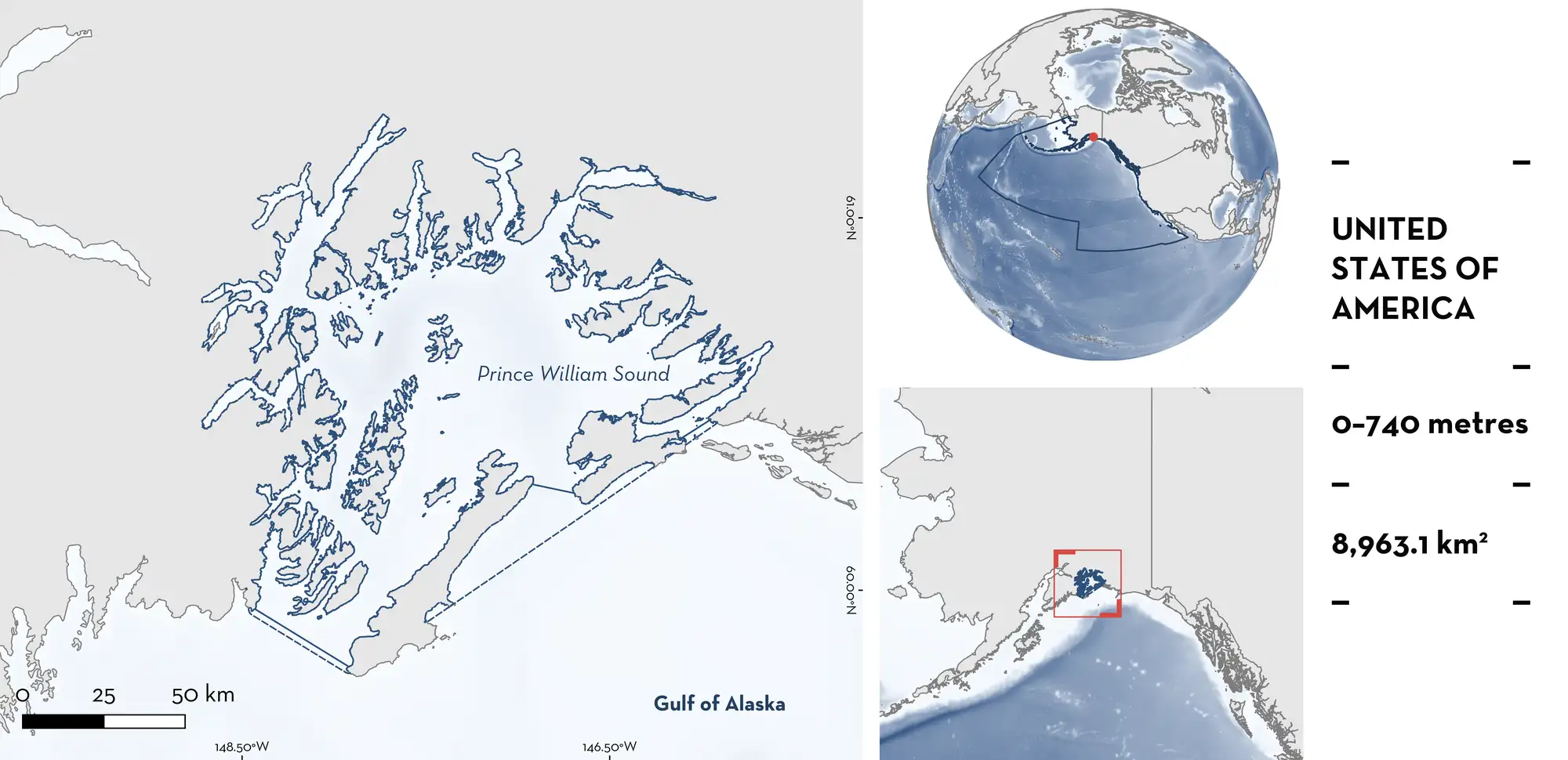
Prince William Sound
Summary
Prince William Sound is located in southern Alaska, United States of America. This semi-enclosed subarctic embayment is situated in the Gulf of Alaska. It is characterised by deep fjords with tidewater glaciers, a central basin flanked by numerous inlets, rocky substrates, and kelp forests. This area is influenced by strong seasonal oceanographic variability driven by interactions between freshwater input, coastal upwelling, and exchanges with the Gulf of Alaska. Within this area there are: undefined aggregations (e.g., Salmon Shark Lamna ditropis).
Download factsheet
Prince William Sound
DESCRIPTION OF HABITAT
Prince William Sound is located in southern Alaska, United States of America. This area is situated in the Gulf of Alaska. This semi-enclosed subarctic embayment is characterised by deep fjords with tidewater glaciers, a central basin flanked by numerous inlets, rocky substrates, and kelp forests, providing extensive nearshore habitats protected from more exposed outer coastal conditions (Laur et al. 1996; Halverson et al. 2013).
The area experiences strong seasonal oceanographic variability driven by interactions between freshwater input, coastal upwelling, and exchange with the Gulf of Alaska continental shelf. The sound receives copious freshwater from precipitation (up to 8,000 mm annually), snowmelt, and glacial discharge, with peak freshwater input occurring June–October (Halverson et al. 2013; Simmons 1996). This freshwater discharge supports high nutrient availability and primary productivity. Water exchange with the Gulf of Alaska occurs primarily through two major passages: Hinchinbrook Entrance and Montague Strait. Between October–March, strong downwelling favourable easterly winds drive barotropic inflow through Hinchinbrook Entrance and outflow through Montague Strait, resulting in complete flushing of the sound in as little as three months. During the boreal summer (April–September), weaker and more variable winds result in reduced barotropic exchange but significant baroclinic flow, including deepwater renewal events that can flush deep regions (###g###400 m) in approximately 23 days (Halverson et al. 2013). Sea surface temperatures range from ~4–6°C in winter to 12–14°C in summer.
The sound supports major runs of Pacific salmon, including Pink Salmon Oncorhynchus gorbuscha, Chum Salmon O. keta, Coho Salmon O. kisutch, Sockeye Salmon O. nerja, and Chinook O. tshawytscha, which utilise numerous rivers and streams throughout the sound for spawning (ADFG 2025). These salmon runs, representing annual migrations where adult salmon leave the ocean and swim upstream through freshwater rivers to return to the exact birthplace where they hatched, occur primarily from June through September (ADFG 2025).
This Important Shark and Ray Area is benthic and pelagic and is delineated from inshore and surface waters (0 m) to 740 m based on the bathymetry of the area.
CRITERION C
SUB-CRITERION C5 – UNDEFINED AGGREGATIONS
Prince William Sound is important for undefined aggregations of two shark species.
Fishing surveys, satellite and acoustic telemetry, and aerial surveys have revealed the regular and predictable occurrence of Salmon Shark aggregations in the area. Aerial surveys conducted in 1998–1999 documenting Pacific Herring Clupea pallasii spawning events recorded up to 100 Salmon Sharks at single events inside the area (A Carlisle et al. unpubl. data 2026). Aggregations have also been recorded through capture and tagging efforts, and tourism activities in the region. During tagging experiments, up to 13 individuals were recorded in a single day in Port Gravina (inside the area; A Carlisle et al. unpubl. data 2026) and tourism efforts have reported groups of 4–5 individuals hunting in the same area or swimming at the surface (Alaska Sharks pers. comm. 2026; Big Fish Expeditions pers. comm. 2026). Between 2002–2024, 128 adult female Salmon Sharks were tagged in this area with satellite transmitters to study their habitat use in Prince William Sound and the surrounding Gulf of Alaska region (Weng et al. 2008; Arnoldi et al. 2024). Tagged individuals spent the summer and autumn months of their migration cycle in the area likely foraging on Pacific salmon, Alaska Pollock Gadus chalcogrammus, and Pacific Herring (Weng et al. 2005; Carlisle et al. 2015; Coffey et al. 2017), with a particular focus on adult salmon which return to the streams, rivers, and hatcheries in July and August (Hulbert & Rice 2002). While most mature females migrate south out of the Gulf of Alaska into the California Current system in autumn months (86%; 88 of 102 individuals tracked for >1 month), some individuals were documented overwintering in the area (Weng et al. 2005; Coffey et al. 2017). Kernel utilization density (KUD) estimates from satellite tags show high density of detections in the area further confirming habitat use, with long-term tagged and tracked individuals showing repeated returns to the area across multiple years of migration (Arnoldi et al. 2024; S Daley et al. unpubl. data 2026). Acoustic telemetry of 24 individuals monitored between 2008–2009 showed that Salmon Sharks aggregate in the area with a higher residency in August when 20 individuals (83.3%) were continuously recorded.
Aggregations of Pacific Sleeper Sharks have been regularly recorded in the area. Between 1998–2025, the International Pacific Halibut Commission (IPHC) conducted annual longline surveys during summer (June–August) across nearshore and offshore waters from Southern California to Alaskan waters (Gulf of Alaska, Aleutian Islands, and Bering Sea; IPHC 2026a). Surveys were conducted at ~1,200 stations each year at depths of 15–503 m. Longlines consisted of 4–8 skates (longline units) with 96–104 hooks per skate with soak times between 5–24 hours (IPHC 2026b). Non-halibut species were counted either as subsample counts (20% of observations, where the majority for sharks are considered) and whole-haul counts (100% observations). Nominal catch-per-unit-effort (CPUE) was estimated as the number of individuals caught per 100 hooks per hour.
During this period, Pacific Sleeper Sharks were recorded in 3,455 sets during longline surveys, of which 196 (5.7%) sets were recorded inside the area during the months of June–August across all surveyed years and at depths of 32–263 m (IPHC 2026a). Individuals were counted in subsamples (20% of the observations) in 3,292 sets (95.3% of total) suggesting that abundances reported reflect an underestimate of the total catches for this species in this fishery. The highest mean CPUE of Pacific Sleeper Sharks in the region was reported from this area (mean = 0.09 individuals/100 hooks/hour; 0.008–0.390) compared to adjacent areas in the region (mean CPUE outside the area = 0.05 individuals/100 hooks/hour; 0.004–0.450). Multiple individuals (>10) were recorded in 32 sets (16.3% of the sets with the species captured inside this area) with 29 individuals being the maximum number recorded in a single set (mean = 5.5 individuals/set). In addition, this area has been highlighted as important to Pacific Sleeper Sharks due to the large catches (biomass) of individuals, according to commercial fisheries data collated from non-pelagic trawl gears (Tribuzio et al. 2022). High abundances for Pacific Sleeper Sharks have been associated with aggregations of the species, here and elsewhere (Matta et al. 2024). In addition, 14 individuals were tagged with satellite transmitters in the southern end of the fjord system near Whittier, Alaska, and Cochrane Bay within the area between June–August 2022. All mark-report tags popped up inside the area suggesting that tracked Pacific Sleeper Sharks remained in the fjord system year-round (Bishop et al. 2026). The horizontal and vertical seasonal movements of tracked Pacific Sleeper Sharks suggest that they may shift from pelagic foraging to benthic scavenging and also balance foraging with resting (Bishop et al. 2026).
Further information is required to understand the nature and function of these aggregations.
Download factsheet
SUBMIT A REQUEST
ISRA SPATIAL LAYER REQUEST
To make a request to download the ISRA Layer in either a GIS compatible Shapefile (.shp) or Google Earth compatible Keyhole Markup Language Zipped file (.kmz) please complete the following form. We will review your request and send the download details to you. We will endeavor to send you the requested files as soon as we can. However, please note that this is not an automated process, and before requests are responded to, they undergo internal review and authorization. As such, requests normally take 5–10 working days to process.
Should you have questions about the data or process, please do not hesitate to contact us.