ISRA FACTSHEETS
ISRA FACTSHEETS
EUROPEAN ATLANTIC
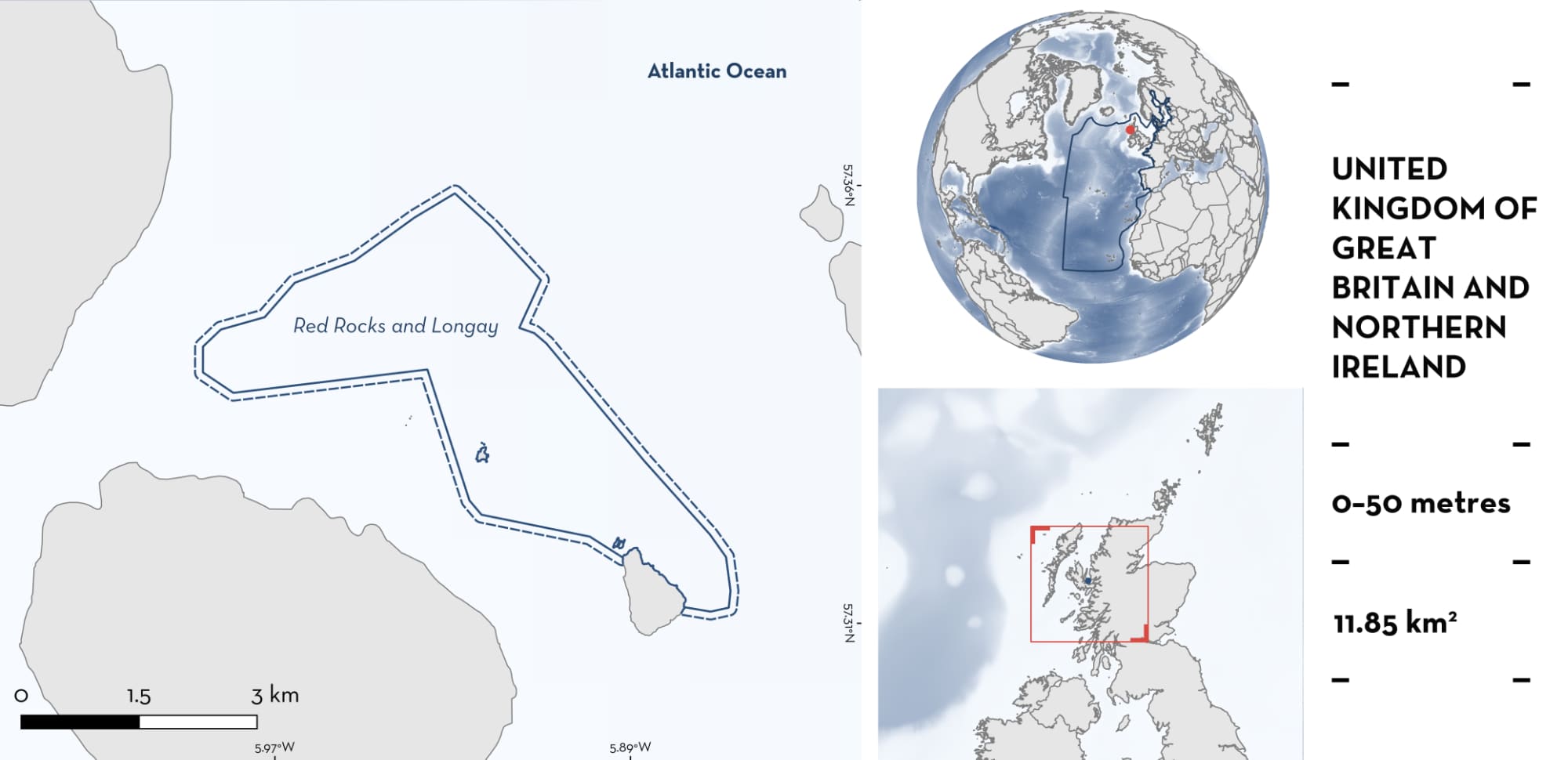
Red Rocks and Longay
Summary
Red Rocks and Longay is situated in the Inner Sound of Skye in Scotland, the United Kingdom of Great Britain and Northern Ireland. The geology of the area is unique, with the raised rock platform a remnant from glacial times when the movement of powerful, fast-flowing ice sheets created a range of seabed landforms, characterised here by moraines, crags and tails, and rock drumlins. The area sits within the Red Rocks and Longay marine protected area. Within this area there are: threatened species and reproductive areas (Flapper Skate Dipturus intermedius).
Download factsheet
Red Rocks and Longay
DESCRIPTION OF HABITAT
Red Rocks and Longay is situated in the Inner Sound of Skye in Scotland, the United Kingdom of Great Britain and Northern Ireland. The area is characterised by mixed coarse sediments, some boulders, cobbles, pebbles, and gravel mixed with sand substrates (C Rickard pers. obs. 2025). The geology of the area is unique, with the raised rock platform a remnant from glacial times when the movement of powerful, fast-flowing ice sheets created a range of seabed landforms, characterised here by moraines, crags and tails, and rock drumlins (NatureScot 2025). The areas of large boulders and cobbles associated with each of the seabed landforms serve a key functional role in supporting Flapper Skate egg-laying activities (NatureScot 2025). The bottom temperatures in the area range from a minimum of 9°C in April to a maximum of 12°C in September (Dodd et al. 2022).
This area overlaps the Red Rocks and Longay marine protected area (UNEP-WCMC & IUCN 2025).
This Important Shark and Ray Area is benthic and is delineated from inshore and surface waters (0 m) to 50 m based on the depth range of Qualifying Species in the area.
CRITERION A
VULNERABILITY
One Qualifying Species considered threatened with extinction according to the IUCN Red List of Threatened Species regularly occurs in the area. This is the Critically Endangered Flapper Skate (Ellis et al. 2024).
CRITERION C
SUB-CRITERION C1 – REPRODUCTIVE AREAS
Red Rocks and Longay is an important reproductive area for one ray species.
This is one of the only areas in Scotland where large numbers of Flapper Skate egg cases are found on the seabed. Flapper Skate egg cases were first reported by local scallop divers in the area in October 2019 (NatureScot 2025). Between 2018–2021, various surveys for Flapper Skate egg cases were conducted in the Inner Sound on the west coast of Scotland (Dodd et al. 2022). During these surveys, 1,395 Flapper Skate egg cases were recorded (accounting for overlapping surveys) using a variety of methods: two egg case collection dives (n = 67 egg cases); one photogrammetry dive (n = 10 egg cases); 509 drop-down video camera drifts (n = 510 egg cases); and 18 remote operated vehicle (ROV) flights (n = 1,031 egg cases). All egg cases were found on the shallow bedrock plateau between the Isle of Scalpay and a relatively deep (>100 m) water channel between the Isle of Longay and the Crowlin Islands, within the area (Dodd et al. 2022). Red Rocks and Longay has the highest known concentration of Flapper Skate egg cases found anywhere in the world.
SCUBA and ROV have thus far only revealed egg cases in the area, however, the site is silty so it is possible that neonates occur in the area but are not readily observed. Given the deposited egg cases, it is assumed they at least hatch on site, so at a minimum will be present making their way from the area. In addition, adult females are visiting the site to deposit egg cases but have not been observed. Extensive banks of large boulders and cobbles deposited during the last ice age provide a suitably rugged and protective habitat for egg laying species (NatureScot 2025). There are deeper channels running like fingers across the area and the hypothesis is that the adults use these deeper channels to move and then swim up onto the shallower shelves, find the boulder outcrops, and lay their egg cases.
Download factsheet
SUBMIT A REQUEST
ISRA SPATIAL LAYER REQUEST
To make a request to download the ISRA Layer in either a GIS compatible Shapefile (.shp) or Google Earth compatible Keyhole Markup Language Zipped file (.kmz) please complete the following form. We will review your request and send the download details to you. We will endeavor to send you the requested files as soon as we can. However, please note that this is not an automated process, and before requests are responded to, they undergo internal review and authorization. As such, requests normally take 5–10 working days to process.
Should you have questions about the data or process, please do not hesitate to contact us.