ISRA FACTSHEETS
ISRA FACTSHEETS
NEW ZEALAND & PACIFIC ISLANDS REGION
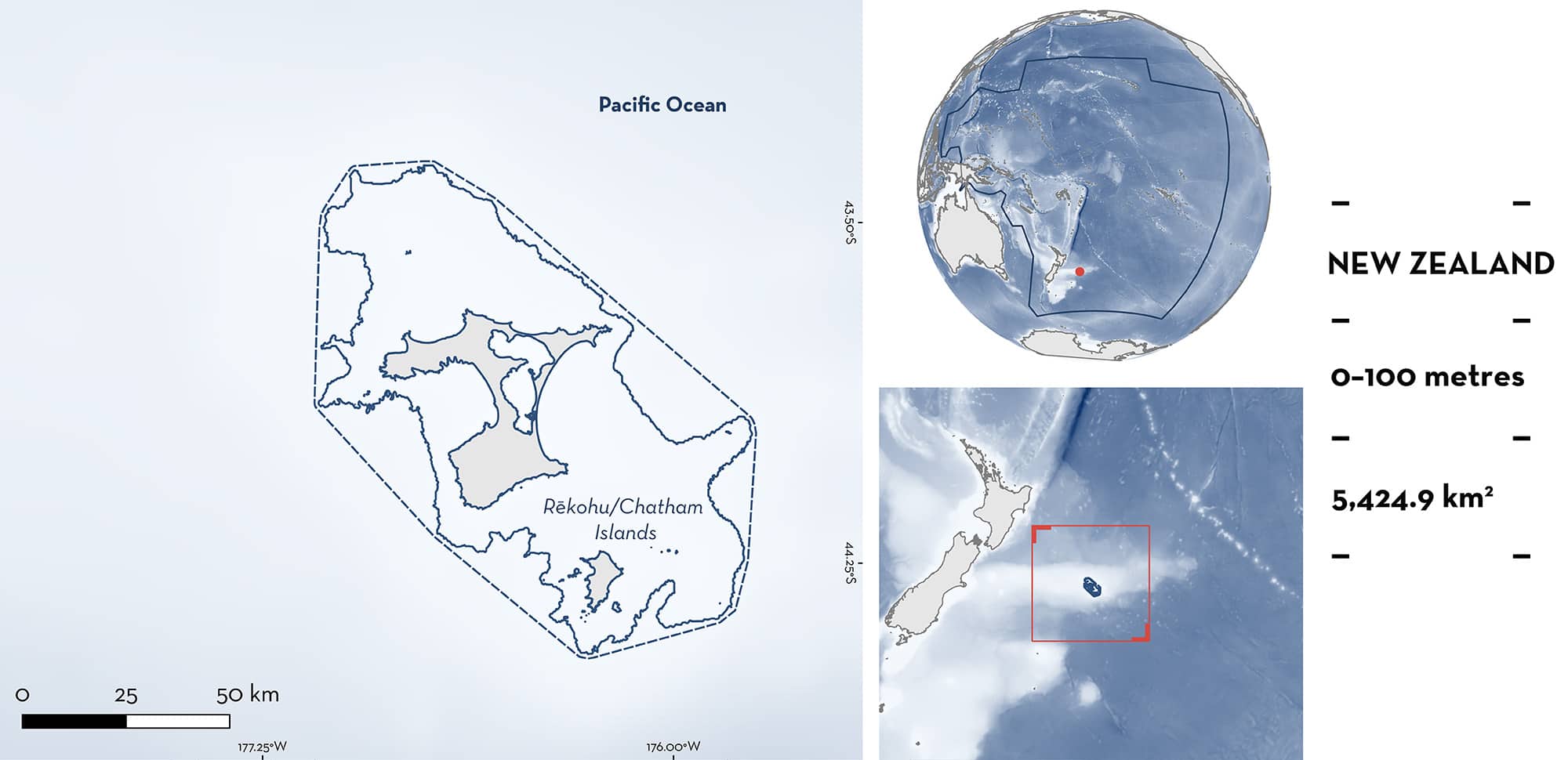
Rēkohu/Chatham Islands
Summary
Rēkohu/Chatham Islands is located east of the South Island of New Zealand. This isolated archipelago is characterised by an irregularly shaped shelf with carbonate gravel and sand substrates along subtidal rocky reefs that support predominantly kelp-dominated communities. The area overlaps with the Chatham Islands (nearshore) and the Chatham (offshore) Key Biodiversity Areas. Within this area there are: threatened species and feeding areas (White Shark Carcharodon carcharias).
Download factsheet
Rēkohu/Chatham Islands
DESCRIPTION OF HABITAT
Rēkohu/Chatham Islands is an isolated archipelago, located 800 km east of Bank’s Peninsula in the South Island of New Zealand. It is situated near the eastern end of the Chatham Rise, a linear submarine ridge extending about 1,100 km due east from the continental shelf off Banks Peninsula, South Island. The area includes ten islands that rise from the top of a shallow, irregularly shaped shelf that is roughly defined by the 100 m isobath. Sediments on this shelf are largely carbonate gravel and sand. More than a third of the coastline is composed of sandy beaches with gentle slopes and tend to be more than 500 m wide at low water. In addition, subtidal rocky reefs at the Chatham Islands support predominantly kelp-dominated communities down to 20–25 m with many of them giving way to sand substrates. Large giant kelp Macrocystis pyrifera forests occur in sheltered locations (Andrew & Francis 2003).
The area is mainly influenced by the Subtropical Front which is displaced northward and is located along the crest of the Chatham Rise, dipping south again east of the Chatham Islands. Consequently, strong latitudinal gradients in sea surface temperature and salinity occur over the Rise. The mixing of subtropical and subantarctic waters over the northern Chatham Rise results in high planktonic productivity (Sutton 2001; Tilburg et al. 2002; Nodder et al. 2003).
The area overlaps with the Chatham Islands (nearshore) and the Chatham (offshore) Key Biodiversity Areas (KBA 2024a, 2024b).
This Important Shark and Ray Area is benthic and pelagic and is delineated from inshore and surface waters (0 m) to 100 m based on the bathymetry of the area.
CRITERION A
VULNERABILITY
One Qualifying Species considered threatened with extinction according to the IUCN Red List of Threatened Species regularly occurs in the area. This is the Vulnerable White Shark (Rigby et al. 2022).
CRITERION C
SUB-CRITERION C2 – FEEDING AREAS
Rēkohu/Chatham Islands is an important feeding area for one shark species.
The regular and predictable presence of White Sharks in this area is driven by seasonal aggregations of multiple prey species. White Sharks seasonally feed on aggregations of New Zealand Fur Seals Arctocephalus forsteri and whale carcasses during austral spring and summer (Bonfil et al. 2010; Duffy et al. 2012; Francis et al. 2012). White Sharks spend most of the time around Rēkohu/Chatham Islands in waters <50 m which is consistent with the feeding behaviour around pinniped colonies observed in other sites around the globe (Hammerschlag et al. 2006; Duffy et al. 2012). White Shark aggregations have been reported regularly in the area since the 1980s (Ayling & Cox 1982; Bhana 1999; Natural History New Zealand 2000; Bonfil et al. 2010; Duffy et al. 2012; Francis et al. 2012, 2015; CAJ Duffy unpubl. data 2024). Three White Sharks measuring 320–450 cm total length (TL) were tagged in the area in April 2005 with pop-up archival tags. These individuals showed residency for 2.6–5 months in the area before departing (Bonfil et al. 2010). Between 2005–2009, ten White Sharks (seven females and three males) were tagged with pop-up archival tags (Duffy et al. 2012). These White Sharks ranged from 250–450 cm TL and all were either subadults males and females and mature males. Only one mature female was observed suggesting that the aggregations are not driven by reproductive processes. Tagged individuals showed seasonal residency to the area for three to five months before moving to tropical and subtropical waters in other jurisdictions (New Caledonia, Tonga, Vanuatu, Norfolk Island; Duffy et al. 2012). Individuals were in Rēkohu/Chatham Islands between April–September with some sharks returning to the area around December–January.
Rēkohu/Chatham Islands is a known breeding area for New Zealand Fur Seal (Baird 2011) and the seasonal presence of colonies matches the presence of White Sharks. This is consistent with the overlap in other known areas in New Zealand where White Sharks predate on pinnipeds such as Titi Islands (Duffy et al. 2012; Francis et al. 2015). In New Zealand waters, New Zealand Fur Seal pups are born from November–January and start swimming in exposed tide pools between February and March. Pups start to move offshore as they start foraging in the following months (Baylis et al. 2005). In addition, female seals make periodical trips to feed and come back to nurse the pups making them susceptible to predation by White Sharks. Further, Rēkohu/Chatham Islands are a hotspot for mass strandings of Long-finned Pilot Whale Globicephala melas edwardii (Betty et al. 2020) and False Killer Whales Pseudorca crassidens (Tezanos-Pinto et al. 2024). Anecdotally, White Sharks have been observed patrolling beaches at stranding sites, as well as feeding on whale carcasses at sea (Hill 2016; iTraveller 2020; CAJD unpub. data 2024). Whale strandings peak between October–February which matches the presence of White Sharks in the area and with the months where some of the sharks return to Rēkohu/Chatham Islands from their oceanic migrations (Duffy et al. 2012). Commercial fishers have also regularly encountered White Sharks in this area for the past 30 years, (CAJ Duffy unpubl. data 2024). Recent observations by commercial fishers since 2016 confirm the contemporary presence of aggregation in Rēkohu/Chatham Islands (Hill 2016; iTraveller 2020; Rova 2024; CAJ Duffy unpubl. data 2024).
Download factsheet
SUBMIT A REQUEST
ISRA SPATIAL LAYER REQUEST
To make a request to download the ISRA Layer in either a GIS compatible Shapefile (.shp) or Google Earth compatible Keyhole Markup Language Zipped file (.kmz) please complete the following form. We will review your request and send the download details to you. We will endeavor to send you the requested files as soon as we can. However, please note that this is not an automated process, and before requests are responded to, they undergo internal review and authorization. As such, requests normally take 5–10 working days to process.
Should you have questions about the data or process, please do not hesitate to contact us.