ISRA FACTSHEETS
ISRA FACTSHEETS
POLAR WATERS REGION
Reykjanes Ridge
Summary
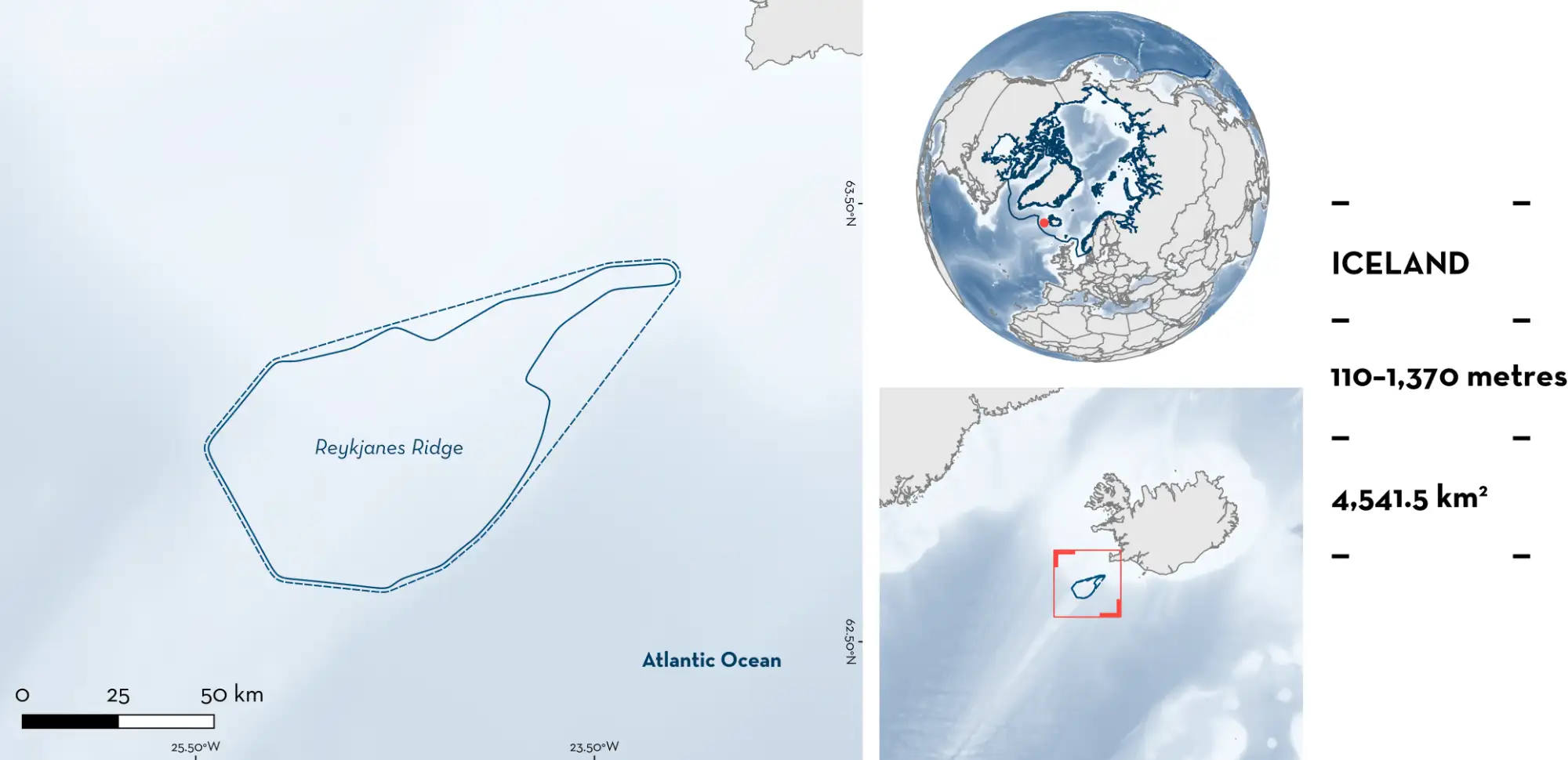
Reykjanes Ridge is located off the southern coast of Iceland. The area is situated in the northern part of the ridge, extending within the Reykjanes Peninsula. It is influenced by the Atlantic Water Current, and the warm and saline Irminger Current, which has strong seasonal variation in the inflow of Atlantic Water. Within this area there are: threatened species (e.g., Velvet Belly Lanternshark Etmopterus spinax); and reproductive areas (e.g., Longnose Velvet Dogfish Centroselachus crepidater).
Download factsheet
Reykjanes Ridge
DESCRIPTION OF HABITAT
Reykjanes Ridge is located off the southern coast of Iceland. It is the longest oblique spreading ridge in the world (Höskuldsson et al. 2007). The area includes the northern tip of the ridge, and extends into Reyjkanes Peninsula. It is characterised by numerous volcanic ridges, seamounts, and fault-bounded basins (Höskuldsson et al. 2007).
The area is influenced by the Atlantic Current and the Irminger Current (Oskarsson et al. 2009). The Irminger Current is a warm and saline (Logemann & Harms 2006) component of the Atlantic Water inflow in the Nordic Sea (Zhao et al. 2018). There is seasonal variation in the Atlantic Water transport, with a minimum in the late boreal spring and a maximum in summer (Zhao et al. 2018).
This Important Shark and Ray Area is benthopelagic and subsurface and is delineated from 110 m to 1,370 m based on the depth range of Qualifying Species in the area.
CRITERION A
VULNERABILITY
Two Qualifying Species considered threatened with extinction according to the IUCN Red List of Threatened Species regularly occur in the area. These are the Vulnerable Velvet Belly Lanternshark (Finucci et al. 2021) and Rabbitfish (Finucci 2020).
CRITERION C
SUB-CRITERION C1 – REPRODUCTIVE AREAS
Reykjanes Ridge is an important reproductive area for two shark species and one chimaera species.
Icelandic demersal trawl surveys were undertaken between 1969–2019 around the coast of Iceland in September, October, and November at depths between 109–1,372 m (ICES 2020). Surveys were carried out across International Council for the Exploration of the Sea (ICES) statistical area 27.5.a.
Between 2009–2019, 1,885 Longnose Velvet Dogfish were recorded around Iceland: more than half (55.1%; n = 1,039 individuals) were caught in this area. Of these, 61 individuals (5.9%) were determined to be neonates/young-of-the-year (YOY) measuring <36 cm total length (TL) (ICES 2020). The species has an estimated size-at-birth of 28–35 cm TL (Ebert et al. 2021).
Between 2018–2021, 2,381 Velvet Belly Lanternshark were collected by the Marine and Freshwater Research Institute (MFRI) during benthic trawl surveys in the boreal spring (March–May) and autumn (September–November) all around Iceland (Mattína et al. 2024). Of these, 136 were determined to be neonates/YOY measuring 12–20 cm TL (KB Jakobsdóttir unpubl. data 2024). In this area, 1,095 individuals were recorded from ten surveys undertaken in this area. Of these, 114 were determined to be neonates/YOY, which represents 84% of neonates recorded in the MFRI surveys across Iceland. Individuals in this size range were recorded in 2018 (n = 24), 2019 (n = 33), 2020 (n = 37), and 2021 (n = 20). These catches were made in March and October (Mattína et al. 2024). The observations of neonate/YOY animals overlap with the observations of mature females in the final stage of embryo release in warm, southerly waters of Iceland (Mattína et al. 2024).
Catch data for Rabbitfish recorded in Icelandic demersal trawl surveys are available for 2010–2025 (ICES unpubl. data 2026). Overall, 11,458 Rabbitfish were caught across the entire survey area. Of these, 2,093 (18.3%) were neonate/YOY. Neonate/YOY Rabbitfish measured up to 25 cm pre-supra caudal fin length (ICES unpubl. data 2026). One quarter of all recorded neonate/YOY (n = 567, 27%) individuals were recorded from this area. Therefore, this area hosts the largest known hotspot of Rabbitfish at early life-stages in Iceland. This species has a reported size-at-birth of ~11 cm pre-supra caudal fin length (Calis et al. 2005). Neonate/YOY Rabbitfish were caught in 2010 (n = 104), 2011 (n = 24), 2012 (n = 23), 2013 (n = 32), 2014 (n = 34), 2015 (n = 17), 2016 (n = 19), 2017 (n = 13), 2018 (n = 20), 2019 (n = 46), 2020 (n = 19), 2021 (n = 21), 2022 (n = 54), 2023 (n = 30), 2024 (n = 45), and 2025 (n = 66) (ICES unpubl. data 2026). Most of the neonate/YOY Rabbitfish were caught in March, with others being recorded in October, November, September, and February.
Download factsheet
SUBMIT A REQUEST
ISRA SPATIAL LAYER REQUEST
To make a request to download the ISRA Layer in either a GIS compatible Shapefile (.shp) or Google Earth compatible Keyhole Markup Language Zipped file (.kmz) please complete the following form. We will review your request and send the download details to you. We will endeavor to send you the requested files as soon as we can. However, please note that this is not an automated process, and before requests are responded to, they undergo internal review and authorization. As such, requests normally take 5–10 working days to process.
Should you have questions about the data or process, please do not hesitate to contact us.