ISRA FACTSHEETS
ISRA FACTSHEETS
AUSTRALIA AND SOUTHEAST INDIAN OCEAN
Rottnest Island
Summary
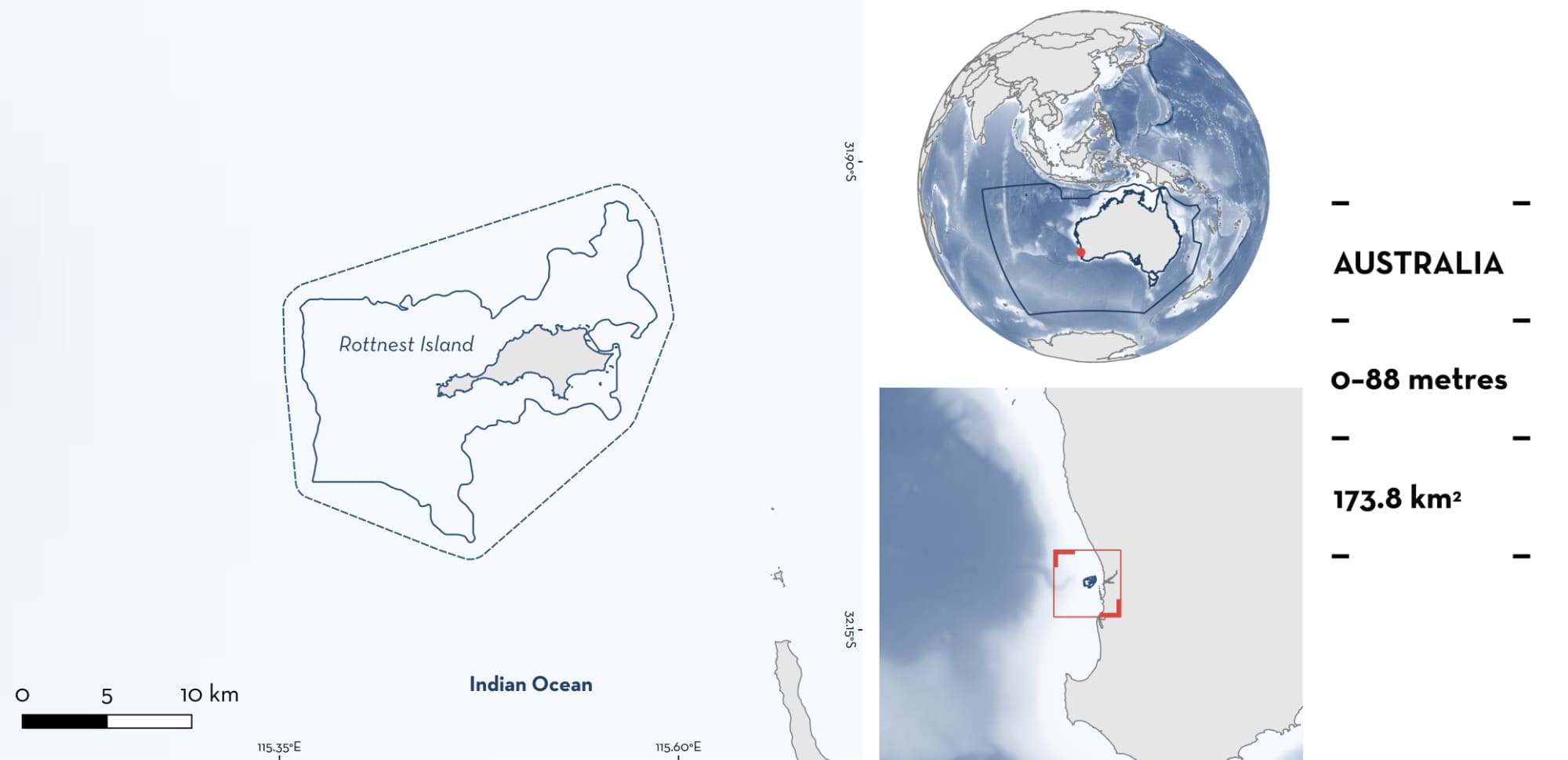
Rottnest Island is located in Western Australia, Australia. This area is situated ~18 km off the coast of Perth and is the only mid-shelf island on the lower west coast of Australia. The habitat is characterised by caves and limestone reefs dominated by kelp and includes macroalgae, seagrass meadows, and corals. Within the area there are: threatened species (e.g., Sand Tiger Shark Carcharias taurus); range-restricted species (Striped Stingaree Trygonoptera ovalis); and undefined aggregations (Sand Tiger Shark).
Download factsheet
Rottnest Island
DESCRIPTION OF HABITAT
Rottnest Island is located in Western Australia, Australia. This area is situated ~18 km off the coast of Perth and is the only mid-shelf island on the lower west coast of Australia (Wellington et al. 2018). The habitat is characterised by caves and limestone reefs dominated by kelp and includes macroalgae, seagrass meadows, and corals (Giraldo-Ospina et al. 2020).
Localised upwelling of nutrient-rich water occurs at the continental shelf break, west of this area, influenced by the Leeuwin Current, which transports warm, oligotrophic water from northern Australia. A seasonal nutrient peak is observed in the austral winter, primarily due to surface water runoff (Gaynor 2014). Sea surface temperature ranges between 18–24°C (Hoschke et al. 2023).
This Important Shark and Ray Area is benthic and pelagic and is delineated from inshore and surface waters (0 m) to 88 m based on the bathymetry of the area.
CRITERION A
VULNERABILITY
One Qualifying Species considered threatened with extinction according to the IUCN Red List of Threatened Species regularly occurs in the area. This is the Critically Endangered Sand Tiger Shark (Rigby et al. 2025).
CRITERION B
RANGE RESTRICTED
This area holds the regular presence of Striped Stingaree as a resident range-restricted species.
Between 2006–2024, sharks and rays were recorded using benthic stereo Baited Remote Underwater Video Stations (BRUVS) between Abrolhos Bank and the Recherche Archipelago in southwest Western Australia. Kernel Density Analysis (KDA) per species was extracted from the database of deployments where at least one shark or ray was recorded (Marine Futures Lab unpubl. data 2006–2024). As absence data were not available, results reflect areas of higher occurrence of records. Of 3,618 deployments in 10 main regions of southwest Australia (~362 deployments per region ranging 154–749), 472 were within this area (2007 = 2, 2008 = 158, 2009 = 113, and 2010 = 199). Benthic surveys after 2010 were only conducted outside this area, in the Recherche Archipelago (2019, 2021, 2022, 2023, 2024) and Cockburn Sound (2020, 2021). The analysis showed that this area had the highest occurrence of Striped Stingaree, recorded between 1.5–50.0 m depth (Marine Futures Lab unpubl. data 2006–2024).
Between 2008–2019, a total of 399 deployments recorded Striped Stingaree in nine of the 11 main regions from Abrolhos Bank to the Recherche Archipelago (2006–2024). Of these, 148 (37.1%) were from this area (2008–2010; Marine Futures Lab unpubl. data 2007–2010). Based on the KDA, this is the only area in southwest Australia with Striped Stingaree density values of >50% (Marine Futures Lab unpubl. data 2006–2024). Striped Stingaree were recorded in 31.4% (148 of 472) of deployments in this area, while in the remaining regions it was recorded in 0.6–17.8% of deployments. Contemporary records from iNaturalist (n = 33; 2013–2023) (iNaturalist 2025) confirm the species’ ongoing occurrence in the area. Striped Stingaree is restricted to the South West Australia Shelf Large Marine Ecosystem (LME) and in the West Central Australian Shelf LME.
CRITERION C
SUB-CRITERION C5 – UNDEFINED AGGREGATIONS
Rottnest Island is an important area for undefined aggregations of one shark species.
Aggregations of Sand Tiger Sharks are regularly and predictably recorded through the Community Monitoring Program established in 2014 to observe and document marine species across Western Australia (Hoschke et al. 2023). The program was promoted through a combination of social media, information and education sessions with local dive and fishing organisations, and presentations to marine scientists and the general public. The Community Monitoring Program involved the submission of photographs and videos of Sand Tiger Sharks from 2006–2021. All data (photographs, videos, and accompanying information) were recorded in a database, including date, location, number of sharks, water temperature, and data source. The number of sharks recorded on each dive was determined either as the maximum number visible in a single photograph or video frame (MaxN), or, if no footage was available, as the maximum number observed by the diver at any one time. Only one MaxN value was recorded per location per day to avoid duplication. Between 2006–2021, 2,219 Sand Tiger Sharks were recorded from video footage taken from 838 dives at six dive sites across Western Australia: 132 animals were identified through photo-identification using left flank spot patterns (Hoschke et al. 2023). MaxN ranged between 2 and 30, with mean MaxN (cumulative MaxN divided by the number of dives) per site ranging 1–8. Within this area, there are two dive sites with regular occurrence of Sand Tiger Shark aggregations: Shark Cave and Opera House.
At Shark Cave, the Community Monitoring Program documented 41 dives between 2014–2021, and 78 dives between 2014–2021. Within this area, 777 Sand Tiger Sharks were sighted across 119 dives, with a maximum MaxN of 22 (mean ~7), representing the second highest MaxN and mean MaxN in Western Australia. Sightings-per-unit-effort (SPUE) was calculated as the cumulative MaxN per month divided by the number of dives (aggregated by month). This normalisation accounted for the variation in dive effort between months. Sand Tiger Sharks were observed year-round, although SPUE showed seasonal variation, increasing during the warmer months at the beginning of the year (between March and June, peaking in April) and decreasing (lowest around September) as water temperatures cooled (18–24°C). Sex and maturity could be determined from photographs in 227 of the 777 sightings at Shark Cave. From these, 66 sharks (left flank only) were photo-identified, comprising 40 females and 26 males.
At the Opera House site, between February 2012 and November 2021 (except in 2014 when no dive records were received), the Community Monitoring Program documented 28 dives (average = 3 dives per yr; range = 0–5). Within this area, 111 Sand Tiger Sharks were sighted, with a maximum MaxN of 10 (mean ~4), representing the third highest MaxN and mean MaxN in Western Australia. Sand Tiger Sharks were photographed in all months except March, June, and August (when no dives occurred). During this time, aggregations of five or more individuals were recorded on 11 dives (39.3%), in six of the nine years (66.6%).
At the Shark Cave site, of the 66 photo-identified Sand Tiger Sharks at Shark Cave, 20 individuals were resighted in more than one year. One female was recorded 11 times across nine different months between November 2015 and October 2017. The longest resighting record was a female photographed seven times across six years (2006–2017). Four females photographed in April or May showed old scarring around the pectoral fins and gills (indicative of mating behaviour), and two of these had enlarged abdomens (suggesting possible pregnancy). Two additional females exhibited more recent signs of mating: one with a severely damaged pectoral fin and scratches in May 2010 and another with fresh flank scars in November 2016. At the Opera House Site, one female with possible mating scars was photographed in August 2012, and aggregation peaks were also recorded in November 2015 and 2016, suggesting a potential seasonality. Additional information is required to understand the nature and function of these aggregations.
Download factsheet
SUBMIT A REQUEST
ISRA SPATIAL LAYER REQUEST
To make a request to download the ISRA Layer in either a GIS compatible Shapefile (.shp) or Google Earth compatible Keyhole Markup Language Zipped file (.kmz) please complete the following form. We will review your request and send the download details to you. We will endeavor to send you the requested files as soon as we can. However, please note that this is not an automated process, and before requests are responded to, they undergo internal review and authorization. As such, requests normally take 5–10 working days to process.
Should you have questions about the data or process, please do not hesitate to contact us.