ISRA FACTSHEETS
ISRA FACTSHEETS
CENTRAL AND SOUTH AMERICAN PACIFIC REGION
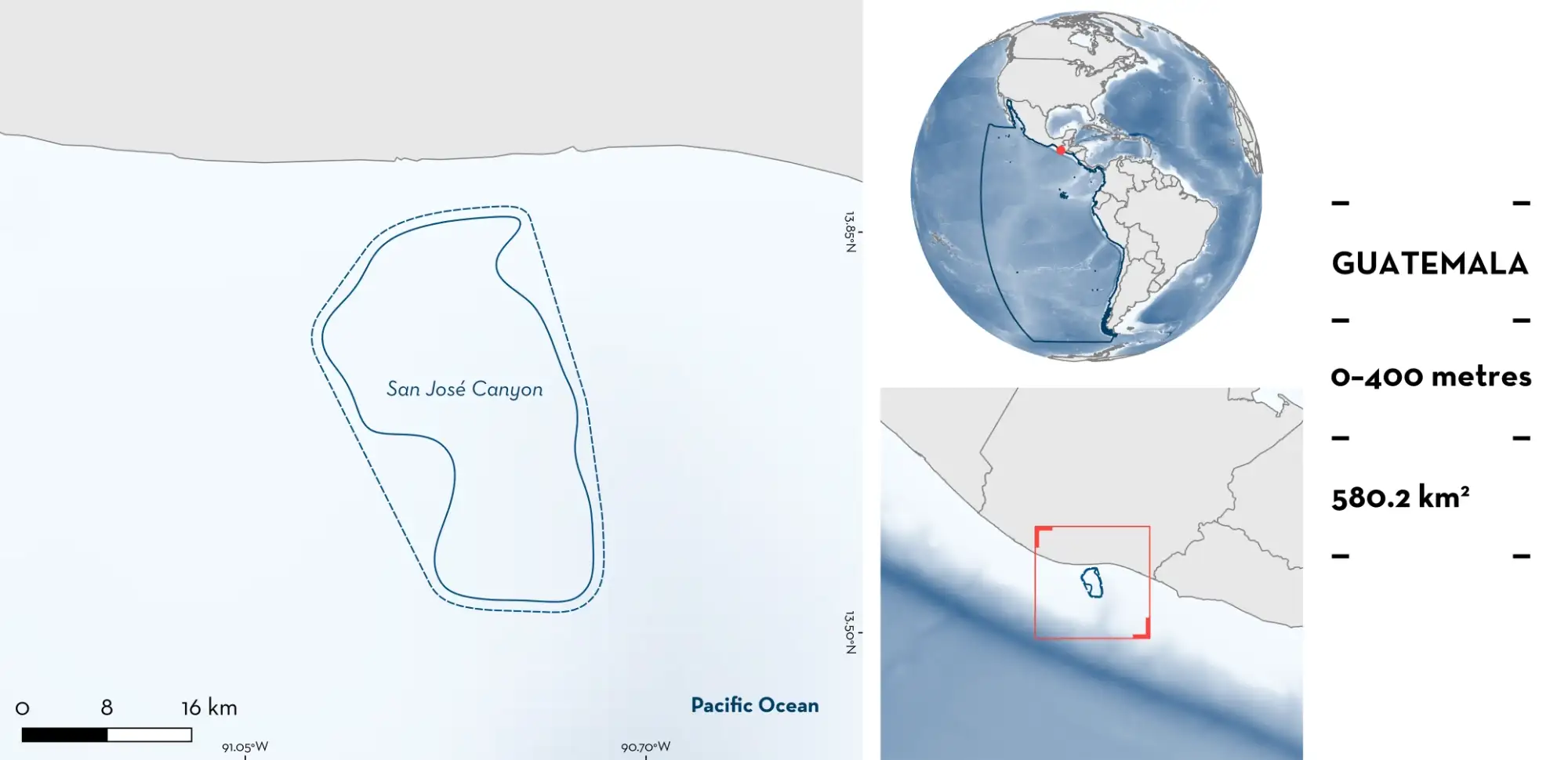
San José Canyon
Summary
San José Canyon is located on the southwest Pacific coast of Guatemala. It sits on the continental shelf break and slope and is characterised by seasonal eddies that result in high productivity. This area overlaps with the Ecosistema Marino Sipacate-Cañón, San José Ecologically or Biologically Significant Marine Area. Within this area there are: threatened species (e.g., Bentfin Devil Ray Mobula thurstoni); reproductive areas (Pelagic Thresher Alopias pelagicus); and undefined aggregations (e.g., Munk’s Pygmy Devil Ray Mobula munkiana).
Download factsheet
San José Canyon
DESCRIPTION OF HABITAT
San José Canyon is located on the southwest Pacific coast of Guatemala. It is a major topographic feature on the continental shelf break and slope and is found ~30 km from the coast. The canyon drops quickly to depths >1,000 m and extends into the Middle America Trench (Ladd & Schroder 1985; von Huene et al. 1985; CONAP & WCS 2025). This area is characterised by pelagic waters. It is influenced by seasonal eddies that result in upwelling and high productivity waters where several predatory species concentrate to feed (Carey & Robinson 1981; Carey 1983; Quintana-Rizzo et al. 2021).
This area overlaps with the Ecosistema Marino Sipacate-Cañón, San José Ecologically or Biologically Significant Marine Area (EBSA; CBD 2025).
This Important Shark and Ray Area is pelagic and is delineated from inshore and surface waters (0 m) to a depth of 400 m based on the bathymetry of the area.
CRITERION A
VULNERABILITY
Three Qualifying Species considered threatened with extinction according to the IUCN Red List of Threatened Species regularly occur in the area. These are the Critically Endangered Bentfin Devil Ray (Jabado et al. 2025), the Endangered Pelagic Thresher (Rigby et al. 2019), and the Vulnerable Munk’s Pygmy Devil Ray (Marshall et al. 2022).
CRITERION C
SUB-CRITERION C1 – REPRODUCTIVE AREAS
San José Canyon is an important reproductive area for one shark species.
Neonate and young-of-the-year (YOY) Pelagic Threshers are regularly recorded in the area (Haconen-Domené et al. unpubl. data 2025). Between 2022–2025, artisanal fisheries operating in the area targeting large pelagic fishes (e.g., Sailfish Istiophorus platypterus) and incidentally capturing sharks were monitored. These fisheries use pelagic trammel nets that are 500 m in length with a 10-inch mesh size, 50 mesh drops, and soak times between 12–18 hours and 24–48 hours. Landing surveys recorded interdorsal lengths for sharks because individuals are landed without heads and the upper lobe of the caudal fin. Interdorsal length was converted to total length (TL) based on conversion factors (Mejía & Briones-Mendoza 2024).
In 117 monitored fishing trips, 705 Pelagic Threshers were recorded with estimated sizes for females (n = 389) ranging between 103–304 cm TL (average ± standard deviation = 197.3 ± 52.6 cm TL) and for males (n = 306) between 106–395 cm TL (217.7 ± 59.2 cm TL) (Haconen-Domené et al. unpubl. data 2025). Of these, 321 (198 females and 123 males; 45.5%) were classified as neonate/YOY as they measured <200 cm TL which is close to the reported size-at-birth for the species (158–190 cm TL; Ebert et al. 2021). On average, seven Pelagic Threshers were recorded per fishing trip with a maximum of 32 individuals. Neonate/YOY were recorded mostly between October–February although this seasonal trend may be influenced by a higher fishing effort due to higher demand for meat in February. While fishing activities have been monitored in other areas of the Pacific coast of Guatemala like Champerico, San José, Las Lisas, and Sipacaté (Ixquiac et al. 2009; Ávalos-Castillo & Santana-Morales 2021), this is the only location in Guatemala where early life-stages of this species have been recorded (Haconen-Domené et al. unpubl. data 2025). In the other locations, only sporadic catches of adults have been recorded (Ixquiac et al. 2009; Ávalos-Castillo & Santana-Morales 2021). No pregnant females were recorded in this area during the monitoring period.
CRITERION C
SUB-CRITERION C5 – UNDEFINED AGGREGATIONS
San José Canyon is an important area for undefined aggregations of two ray species.
Between 2019–2024, aggregations of Munk’s Pygmy Devil Rays and Bentfin Devil Rays were recorded from landings of artisanal fisheries operating in the area and targeting large pelagic fishes (A Hacohen-Domené et al. unpubl. data 2025). Fishing gears consists of pelagic trammel nets that are ~500 m in length with a 10-inch mesh size and 50 mesh drops, and soak times between 12–18 hours and 24–48 hours.
Between 2019–2024, landings of 246 fishing trips were monitored and 242 Munk’s Pygmy Devil Rays and 208 Bentfin Devil Rays were recorded. Munk’s Pygmy Devil Rays ranged between 39–120 cm disc width (DW) and Bentfin Devil Rays between 34–180 cm DW. Groups ranging in size between 4–26 individuals were incidentally caught in individual fishing trips for both species and according to the fishers, rays were caught together, indicating that aggregations were caught. Aggregations were recorded between October–February although this can be influenced by a higher demand for meat during those months. Both species are known to aggregate for feeding purposes in high productivity areas (Palacios et al. 2023), like San José Canyon that serves as a feeding ground for large pelagic fishes and marine mammals, suggesting that devil rays may also be feeding in the area (Quintana-Rizzo et al. 2021). While fishing activities have been monitored in other areas of the Pacific coast of Guatemala (Ávalos-Castillo & Santana-Morales 2021), catches of both species are very rare (28 individuals for both species between 2017–2020) confirming San José Canyon is more important for these rays. Additional information is required to confirm the nature and function of these aggregations.
Download factsheet
SUBMIT A REQUEST
ISRA SPATIAL LAYER REQUEST
To make a request to download the ISRA Layer in either a GIS compatible Shapefile (.shp) or Google Earth compatible Keyhole Markup Language Zipped file (.kmz) please complete the following form. We will review your request and send the download details to you. We will endeavor to send you the requested files as soon as we can. However, please note that this is not an automated process, and before requests are responded to, they undergo internal review and authorization. As such, requests normally take 5–10 working days to process.
Should you have questions about the data or process, please do not hesitate to contact us.