ISRA FACTSHEETS
ISRA FACTSHEETS
EUROPEAN ATLANTIC
Santa Luzia
Summary
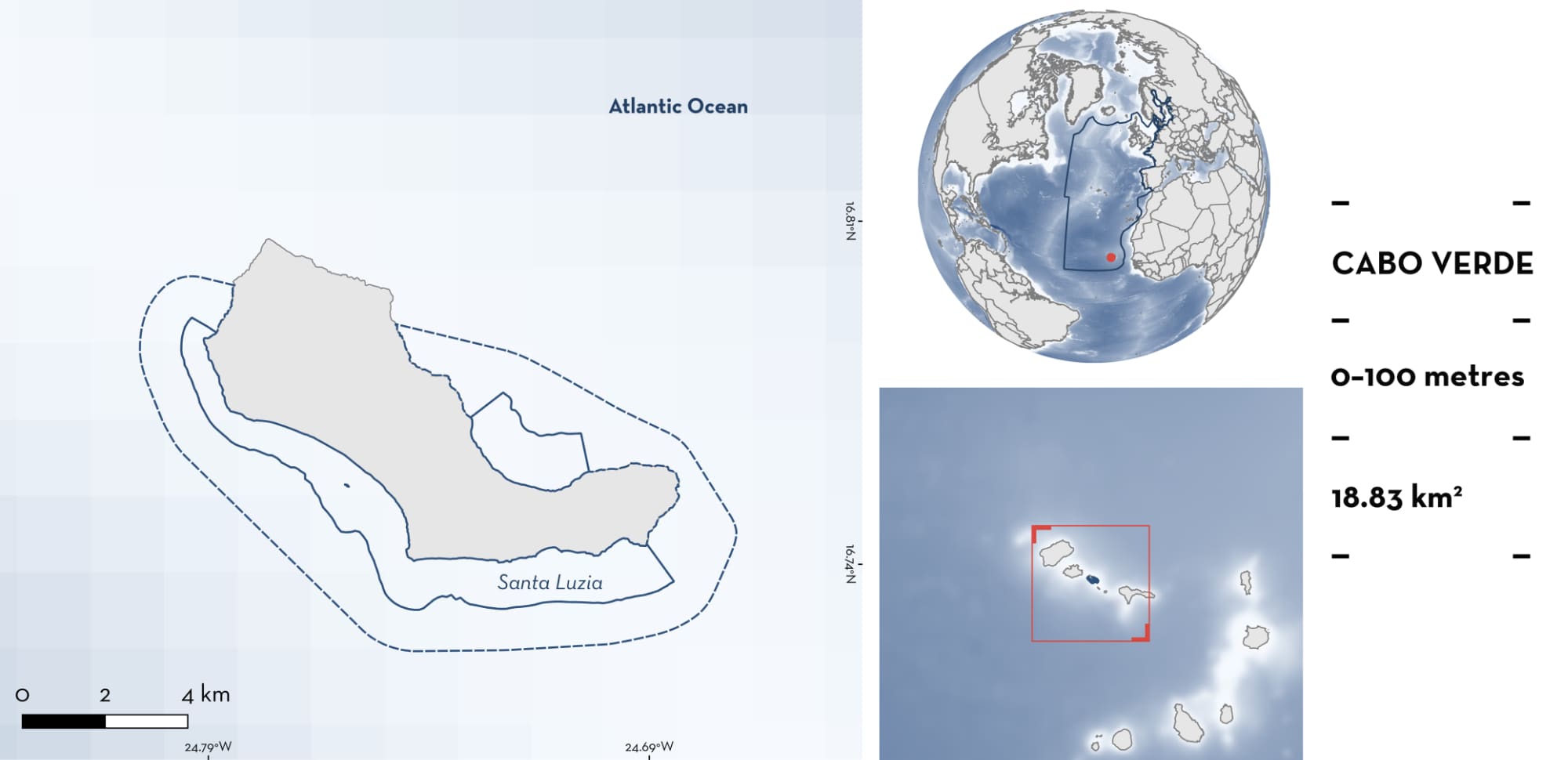
Santa Luzia is located between the islands of São Nicolau and São Vicente in Cabo Verde. It is situated on the second largest insular shelf of Cabo Verde. The area encompasses sandy beaches and rhodolith beds that are partially covered in the subtidal zone. Within this area there are: threatened species (e.g., Blackchin Guitarfish Glaucostegus cemiculus); reproductive areas (e.g., Blacktip Shark Carcharhinus limbatus); and undefined aggregations (Atlantic Weasel Shark Paragaleus pectoralis).
Download factsheet
Santa Luzia
DESCRIPTION OF HABITAT
Santa Luzia is located between the islands of São Nicolau and São Vicente in Cabo Verde. It is the only national uninhabited island and is situated on the second largest insular shelf of Cabo Verde. This southern part of the island is flatter than the northern part (exposed to constant wave action), and has beaches with sandy substrates, as well as rhodolith beds that are partially covered in the subtidal zone (Freitas et al. 2015).
To the north of Cabo Verde, the Cabo Verde Front separates two major water masses within the North Atlantic Subtropical Gyre (Pelegrí & Peña-Izquierdo 2015). Overall, the region is shaped by the interaction of major oceanographic systems (Canary Current, North Equatorial Current, North Equatorial Counter-Current) and is strongly influenced by the seasonal meridional migration of the Intertropical Convergence Zone (Stramma & Schott 1999). Sea surface temperatures around Santa Luzia vary between 20–27°C. The archipelago experiences two main climatic seasons: a cooler season (December–June), and a warmer season (July–November; Peña-Izquierdo et al. 2012).
This Important Shark and Ray Area is benthic and pelagic and is delineated from inshore and surface waters (0 m) to 100 m based on the depth range of the Qualifying Species globally.
CRITERION A
VULNERABILITY
Three Qualifying Species considered threatened with extinction according to the IUCN Red List of Threatened Species regularly occur in the area. These are the Critically Endangered Blackchin Guitarfish (Kyne & Jabado 2019), the Endangered Atlantic Weasel Shark (Jabado et al. 2021), and the Vulnerable Blacktip Shark (Rigby et al. 2021).
CRITERION C
SUB-CRITERION C1 – REPRODUCTIVE AREAS
Santa Luzia is an important reproductive area for one shark and one ray species.
Between 2021–2024, 161 scientific tagging expeditions occurred year-round (except in January) within the area (SJD Pires unpubl. data 2021–2024). Each expedition lasted three nights (one sampling per night), using 1–4 rods, each with one baited hook. A sampling event lasted on average 240 to 360 minutes (SJD Pires unpubl. data 2021–2024). Chumming was not used during tagging expeditions. The catch-per-unit-effort (CPUE) was calculated for each species per sampling event.
A total of 247 Blacktip Sharks were captured (1–12 m depth), of which 213 (86.2%) were 51–91 cm total length (TL; SJD Pires unpubl. data 2021–2024). The size-at-birth for Blacktip Sharks is 28–72 cm TL (Ebert et al. 2021) indicating animals were neonates or young-of-the-year (YOY). The smaller individuals (n = 60 individuals, <65 cm TL) were all captured between July–November (SJD Pires unpubl. data 2021–2024). Overall, the mean CPUE was 4.94 (maximum = 9) but increased to 5.6 between July–November.
Blackchin Guitarfish occur year-round in Santa Luzia, with 239 individuals captured (n = 235, 58–214 cm TL; mean CPUE = 1.48, max CPUE = 16) (SJD Pires unpubl. data 2019–2024). Size-at-birth is ~34 cm TL (Last et al. 2016), and YOY in the Mediterranean Sea measure ~60–80 cm TL (Enajjar et al. 2012; Başusta et al. 2020), suggesting that at least three captured individuals were YOY. Hook size used during surveys may explain the underrepresentation of smaller individuals in the dataset (M Dureuil & SJD Pires pers. obs. 2019–2024). Of the captured individuals, sex was determined for 226 specimens: 82 males (58–172 cm TL), of which 15 were mature (>138 cm TL), and 154 females (92–214 cm TL), of which 29 were mature (>153 cm TL). Length-at-maturity in Mauritania is 138 cm TL for males and 153 cm TL for females (Valadou et al. 2006). All mature males and 79% of mature females were caught between July–November. The highest mean monthly CPUE occurred between September–October (mean CPUE = 2.5) (SJD Pires unpubl. data 2019–2024). Blackchin Guitarfish are known to aggregate seasonally to reproduce, with females visiting protected shallow waters to give birth (Capape & Zaouali 1994). Four females captured between June–September were considered pregnant based on distended abdomens (SJD Pires unpubl. data 2019–2024). Additionally, local ecological knowledge has documented the occurrence of 1–3 individuals <40 cm TL nearshore between June–October during turtle nest monitoring surveys from shore (SJD Pires pers. obs. 2019–2024). During surveys, the maximum number of neonates/YOY observed was three resting nearshore and during an opportunistic sighting of purse seine activity, six individuals <120 cm TL were captured and released (SJD Pires pers. obs. 2019–2024). Santa Luzia is the main area in Cabo Verde where this species can be easily and regularly observed.
CRITERION C
SUB-CRITERION C5 – UNDEFINED AGGREGATIONS
Santa Luzia is an important area for undefined aggregations of one shark species.
Aggregations of Atlantic Weasel Sharks within this area are evidenced by acoustic telemetry, fishery-independent surveys, and local ecological knowledge. Acoustic tagging took place within this area after local fishers identified the area as a prime spot to catch large numbers of Atlantic Weasel Shark (M Dureuil unpubl. data 2015). Local fishers report catching up to seven individuals in a single purse seine haul (~30 m x 4 m, 4 x 4 cm mesh) (SJD Pires unpubl. data 2025). During an exploratory tagging event in October 2015, nine individuals were captured and externally tagged within ~ 4.5 hours, using only a single hand reel and no chumming (M Dureuil unpubl. data 2015). Acoustic telemetry showed detections of tagged individuals within this area on the same day. Of the 20 Atlantic Weasel Sharks tagged in November 2016 (n = 14) and May 2017 (n = 6), eight were detected on receivers within this area over a period of up to nine months before the receivers were removed (in November 2017). Of these, 37.5% (n = 3) were detected together from the date they were tagged in May 2017 until the receivers were removed (M Dureuil unpubl. data 2016–2017). Additionally, 4–6 individuals (50–75%) were detected on receivers on the same day in three occasions between June–August.
Between 2021–2024, 83 Atlantic Weasel Sharks (56–131 cm TL) were captured in 57 of 161 fishery-independent tagging expeditions (mean CPUE = 0.52, max CPUE = 7), targeting Blackchin Guitarfish (SJD Pires unpubl. data 2021–2024). No individuals were captured in February, November, or December. The mean CPUE was higher between April–July (0.69) compared to March, August, September, and October (0.37). There is no evidence for other aggregation areas of Atlantic Weasel Sharks in Cabo Verde (SJD Pires pers. obs. 2019–2024). The adjacent Island (São Vicente) was sampled using the same method, but mean CPUE (0.3, max CPUE = 3) was lower than in this area (0.43 in April–July) (SJD Pires unpubl. data 2019–2024).
Evidence of seasonal concentration of Atlantic Weasel Sharks related to reproduction are available for Senegal and Boa Vista Island (Cabo Verde). Off the Senegalese coast, it is suggested that Atlantic Weasel Sharks are seasonally concentrated for mating between March–May when the sex ratio is equal and for parturition between May–June when the number of pregnant females increase (Capapé et al. 2005). In Boa Vista Island (Cabo Verde), neonates and YOY accounted for ~97% of Atlantic Weasel Sharks (n = 91 out of 93) captured mostly in spring and summer (Rosa et al. 2023). Within this area, 88% of the captured individuals (n = 73), were mature individuals (<75 cm TL). Size-at-maturity is between 75–90 cm TL (Ebert et al. 2021). Between August–March, the sex ratio of mature Atlantic Weasel Sharks was 1:4.8 (male: female), and between April–July, it was 1:1.4. During sampling events, one pregnant Atlantic Weasel Shark was captured and released (not measured and tagged) and one stranded neonate ~45 cm TL was found in June 2025 (SJD Pires unpubl. data 2019–2024). All this evidence suggest that this area might be used for mating, however, further information is required to understand the nature and function of these aggregations.
Download factsheet
SUBMIT A REQUEST
ISRA SPATIAL LAYER REQUEST
To make a request to download the ISRA Layer in either a GIS compatible Shapefile (.shp) or Google Earth compatible Keyhole Markup Language Zipped file (.kmz) please complete the following form. We will review your request and send the download details to you. We will endeavor to send you the requested files as soon as we can. However, please note that this is not an automated process, and before requests are responded to, they undergo internal review and authorization. As such, requests normally take 5–10 working days to process.
Should you have questions about the data or process, please do not hesitate to contact us.