ISRA FACTSHEETS
ISRA FACTSHEETS
EUROPEAN ATLANTIC
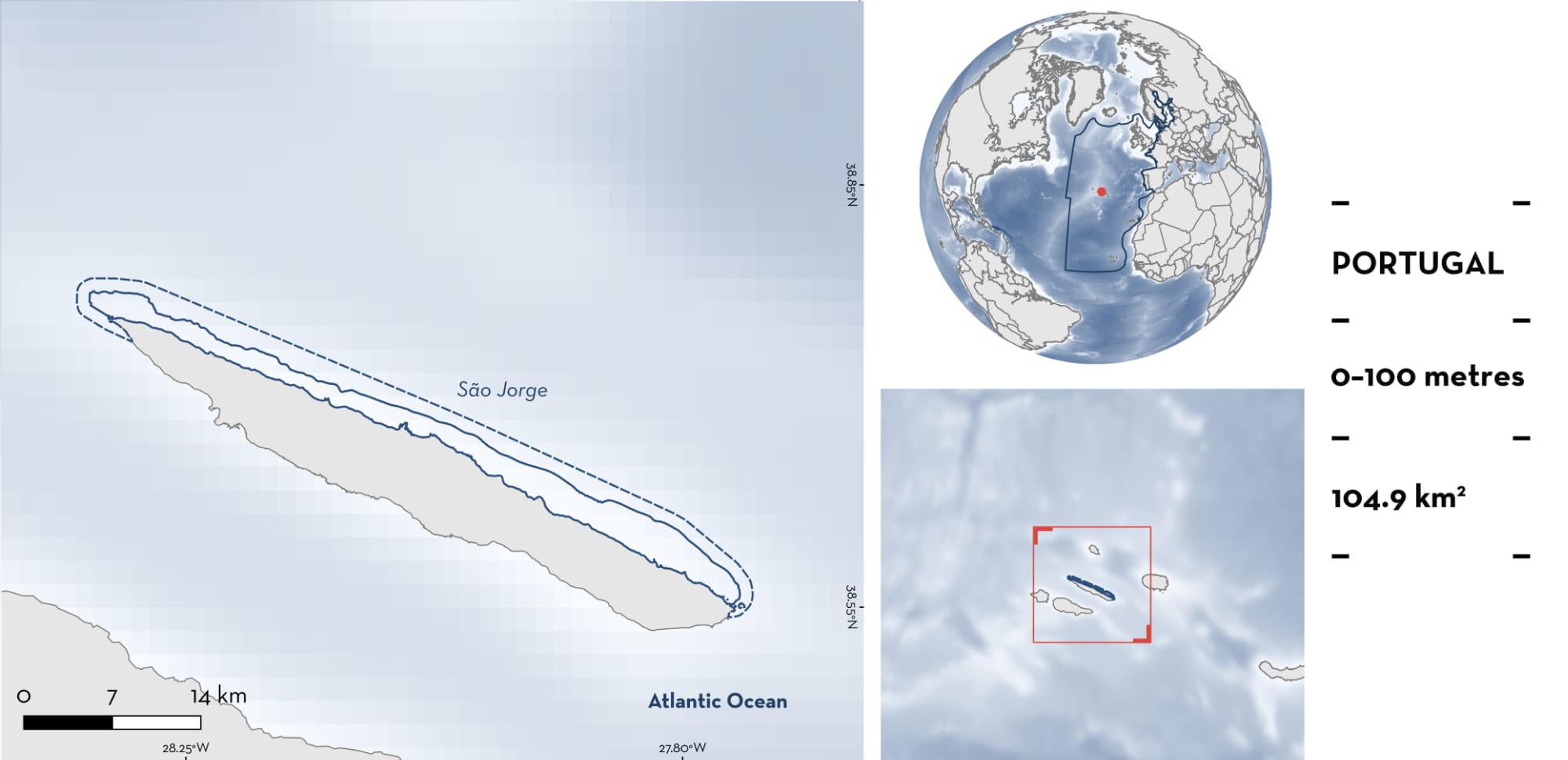
São Jorge
Summary
São Jorge is situated on the north coast of São Jorge Island in the Azores Archipelago, Portugal. It is characterised by a comparatively wide insular shelf and one of the largest continuous coastal sandy habitats in this archipelago. Within this area there are: threatened species and undefined aggregations (Smooth Hammerhead Sphyrna zygaena).
Download factsheet
São Jorge
DESCRIPTION OF HABITAT
São Jorge is situated on the north coast of São Jorge Island in the Azores Archipelago, Portugal. São Jorge Island is exclusively formed by fissured volcanic systems. The area is located on its northern side which is characterised by a comparatively wide insular shelf (1.5–6 km) and one of the largest continuous coastal sandy habitats in the archipelago which is generally dominated by rocky shores with a narrow shelf (often <1 km; Quartau et al. 2018).
The North Atlantic Subtropical Gyre through the Azores Current along with its associated mesoscale eddies, transports warmer and saltier subtropical waters into the southern part of the archipelago, making this region an ecotone where temperate and subtropical water masses meet (Afonso et al. 2020).
This Important Shark and Ray Area is benthic and pelagic and is delineated from inshore and surface waters (0 m) to 100 m based on the bathymetry of the area.
CRITERION A
VULNERABILITY
One Qualifying Species considered threatened with extinction according to the IUCN Red List of Threatened Species regularly occurs in the area. This is the Vulnerable Smooth Hammerhead (Rigby et al. 2019).
CRITERION C
SUB-CRITERION C5 – UNDEFINED AGGREGATIONS
São Jorge is an important area for undefined aggregations of one shark species.
Based on Baited Remote Underwater Video Stations (BRUVS) and local ecological knowledge (LEK) interviews, juvenile and young-of-the-year (YOY) Smooth Hammerheads aggregate in this area, mostly during the boreal summer (P Afonso unpubl. data 2018–2022). Aggregations were defined as BRUVS recording at least three individuals in a single video frame (i.e., MaxN =>3).
Between 2018–2022, 589 benthic and pelagic stereo-BRUVS (169 were mono-BRUVs and used only at Faial Island in 2018) were deployed around eight of the nine islands of the Azores Archipelago (all except Terceira Island) at 5–60 m depth (P Afonso unpubl. data 2018–2022). Around São Jorge Island, 64 stereo-BRUVS (31 pelagic and 33 benthic) were deployed during August–September 2019 and 2020, 42 of which were inside this area (24 pelagic and 18 benthic). Smooth Hammerheads were recorded in almost all islands (except Corvo Island) but aggregations were only observed at Faial Island (n = 9 deployments; 3.6% of the total deployments at this island; mean MaxN = 4.9 individuals), São Jorge Island (n = 3; 4.7%; mean MaxN = 4.3), Flores Island (n = 1; 1.4%; MaxN = 3), Pico Island (n = 1; 1.9%; MaxN = 4), and São Miguel Island (n = 1; 1.5%; MaxN = 3). All three deployments from São Jorge Island were within this area, representing 7.1% of the 42 deployments in this area. Of the eight individuals with total length (TL) estimated in São Jorge, four were considered YOY (61.3–66.6 cm TL), two juveniles (~131 cm TL), and two adults (209.5–246.2 cm TL). Size-at birth for Smooth Hammerhead is 49–63 cm TL (Ebert et al. 2021).
Additionally, between 2018 and 2022, 163 LEK interviews were conducted with fishers, maritime tourism companies, and other ocean-users on all nine islands of the Azores Archipelago (P Afonso unpubl. data 2018–2022). Of these, 14 LEK interviews were conducted on São Jorge Island, of which 10 (n = 70%) interviewees noted that this area was important for Smooth Hammerhead sightings and aggregations. Of the 14 interviewees, three reported having seen large groups of 10–50+ individuals on sunny warm days (some seen repeatedly on different days). Six of the eight interviewees that mentioned the size of Smooth Hammerheads reported the occurrence of individuals <2 m TL. Both BRUVS and LEK indicate that aggregations are mostly formed by juveniles and YOY. Of the five interviewees that reported seasonality, summer was mentioned by four, matching the occurrence of juvenile Smooth Hammerheads aggregations at Faial Island (Afonso et al. 2022). Additionally, São Jorge was the only island mentioned by interviewees of different islands for aggregations of Smooth Hammerheads (one from Pico Island and one from São Miguel Island). Further information is required to understand the nature and function of these aggregations.
Download factsheet
SUBMIT A REQUEST
ISRA SPATIAL LAYER REQUEST
To make a request to download the ISRA Layer in either a GIS compatible Shapefile (.shp) or Google Earth compatible Keyhole Markup Language Zipped file (.kmz) please complete the following form. We will review your request and send the download details to you. We will endeavor to send you the requested files as soon as we can. However, please note that this is not an automated process, and before requests are responded to, they undergo internal review and authorization. As such, requests normally take 5–10 working days to process.
Should you have questions about the data or process, please do not hesitate to contact us.