ISRA FACTSHEETS
ISRA FACTSHEETS
EUROPEAN ATLANTIC
Setúbal Peninsula
Summary
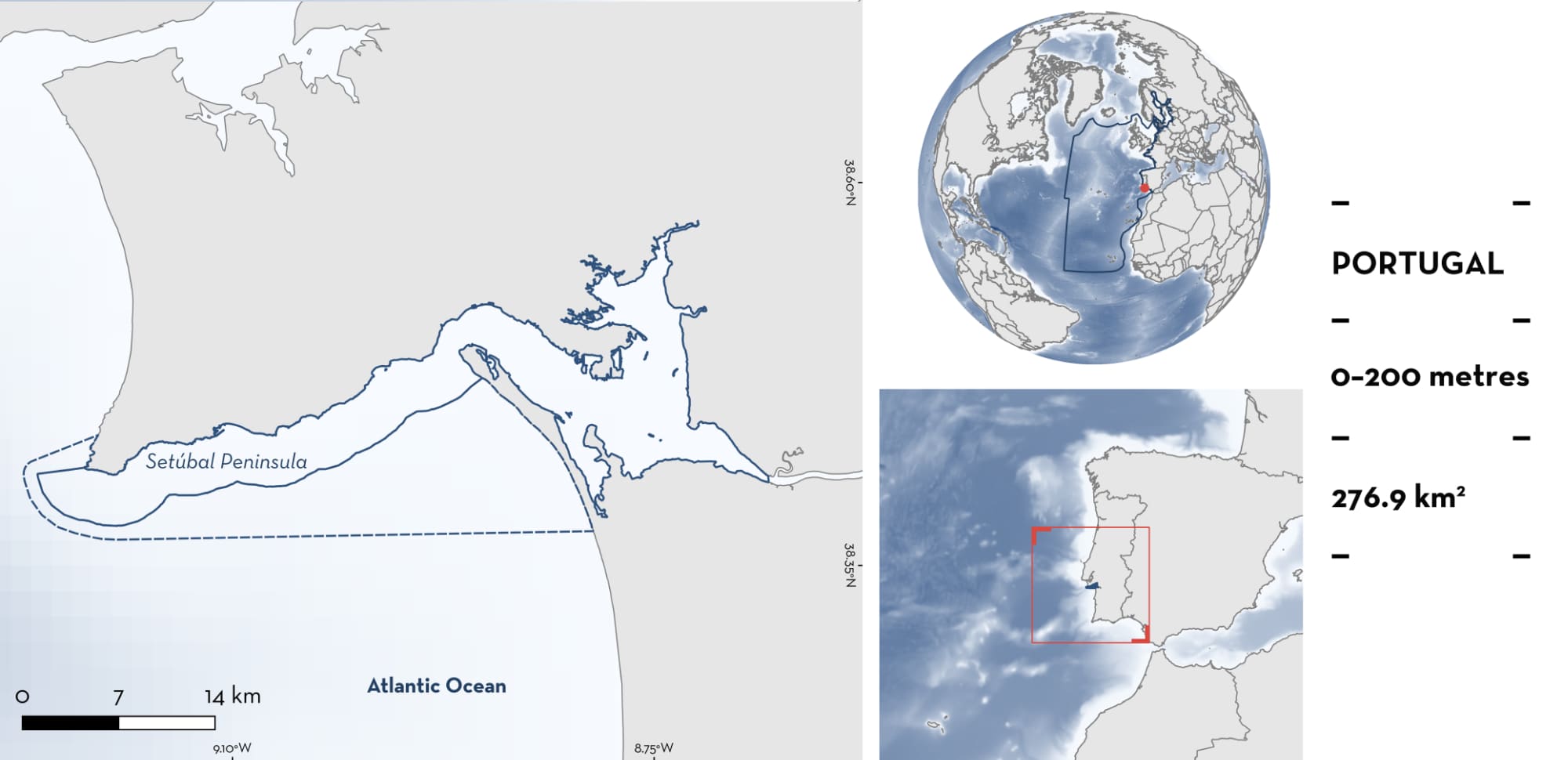
Setúbal Peninsula is located on the west coast of Portugal. The area extends from Arrábida in the west to the Sado Estuary in the east. It is characterised by rocky reefs, extensive algae patches, and sandy and muddy substrates. Its southern coastline is protected from the predominant north/northwest winds, creating sheltered low energy environments with nutrient-rich waters transported to the area via upwelling. The area overlaps with one Ecologically or Biologically Significant Marine Area, one Key Biodiversity Area, one protected area, and one Ramsar site. Within this area there are: threatened species and areas important for movement (Common Stingray Dasyatis pastinaca).
Download factsheet
Setúbal Peninsula
DESCRIPTION OF HABITAT
Setúbal Peninsula is located in the west coast of Portugal. The area extends from Arrábida in the west to the Sado Estuary, the second largest estuary in Portugal, in the east. Multiple benthic habitats are found in the area. Rocky reefs are found bordering the southern coastline at shallow depths, with a high presence of macroalgae of different morphology (crustose, filamentous, thalliform). The exposed western end of the peninsula and the central part is dominated by rocky substrates and coarse sediments. Beyond the rocky reefs, fine and medium-grain sandy substrates dominate shallower waters, with scattered coarse sediment patches. This is replaced by a mix of sand and mud sediments with increasing depth, after which these are replaced by muddy sediments as the dominant substrate type (Henriques et al. 2015).
The area is found in a transition zone between colder environments further north and warmer environments from the south (Cunha et al. 2014). The west/southwest orientation of the peninsula protects the southern coast from the prevailing north and northwest winds and provides these waters with mostly low-energy environments. Because of this and the steep depth profile that ends in the underwater canyon, upwelling events regularly occur (Cunha et al. 2014). The waters near Sado estuary are more energetic and dynamic. The estuary has large areas of salt marshes and intertidal flats and is greatly influenced by the Sado River discharges during the boreal winter, when the river input is at its highest. This changes in spring and summer, when the river input decreases significantly, and the estuary becomes more influenced by the entering of the tides (Gonçalves et al. 2015).
The area overlaps with the West Iberia Canyons and Banks Ecologically or Biologically Significant Marine Areas (EBSA; CBD 2025), the Cabo Espichel Key Biodiversity Area (KBA 2025), the Luiz Saldanha Marine Park (UNEP-WCMC & IUCN 2025), and the Estuário do Sado Ramsar site (Wetland of International Importance; Ramsar 2025).
This Important Shark and Ray Area is benthic and is delineated from inshore and surface waters (0 m) to 200 m based on the bathymetry of the area.
CRITERION A
VULNERABILITY
One Qualifying Species considered threatened with extinction according to the IUCN Red List of Threatened Species regularly occurs in the area. This is the Vulnerable Common Stingray (Jabado et al. 2021).
CRITERION C
SUB-CRITERION C4 – MOVEMENT AREAS
Setúbal Peninsula is important for the movement of one ray species.
Passive acoustic telemetry revealed the regular and seasonal movements of Common Stingray between Arrábida in the western side of the area and the Sado Estuary in the east (Kraft et al. 2023, 2024). In April and October 2019 and 2021, Common Stingray were tagged with acoustic transmitters. Individuals were monitored between May 2019–May 2022 with an array of 33 acoustic receivers deployed along the western and central coast of the Setúbal peninsula and four in the Sado Estuary (Kraft et al. 2023, 2024). Of the 30 individuals tagged, 25 provided enough detections to explore seasonal movements. Individuals (15 females and 15 males) ranged between 25–42 cm disc width (DW) and the majority (n = 18; 58%) were adults. Residence index in the southwest side of the area was highest between October/November–March/April. After this period, Common Stingrays were virtually absent from that side of the area and were detected in receivers in the central part and closer to the estuary as the months passed. Between March/April–October/November, 23 individuals (92%) were detected at least once in Sado Estuary in the eastern part of the area (with the estuary mouth ~20–40 km from the southwest and central side of the area) with 18 individuals making back and forth movements in two or more years (Kraft et al. 2023). Seasonal movements of the Common Stingray in the Setúbal Peninsula may be related to feeding and reproductive purposes. Arrábida seems to be an area where individuals aggregate (Kraft et al. 2024; S Kraft pers. obs. 2025) while the period they travel to Sado Estuary matches the reproductive season (from mating to pupping) reported for the species in other areas in the Levant Sea (Mediterranean Basin) and the Gulf of Gabès (Tunisia) (Saadoui et al. 2015; Chaikin et al. 2020). Sado Estuary may function as a parturition site as it provides protection from predators to early life stages.
Download factsheet
SUBMIT A REQUEST
ISRA SPATIAL LAYER REQUEST
To make a request to download the ISRA Layer in either a GIS compatible Shapefile (.shp) or Google Earth compatible Keyhole Markup Language Zipped file (.kmz) please complete the following form. We will review your request and send the download details to you. We will endeavor to send you the requested files as soon as we can. However, please note that this is not an automated process, and before requests are responded to, they undergo internal review and authorization. As such, requests normally take 5–10 working days to process.
Should you have questions about the data or process, please do not hesitate to contact us.