ISRA FACTSHEETS
ISRA FACTSHEETS
NEW ZEALAND & PACIFIC ISLANDS REGION
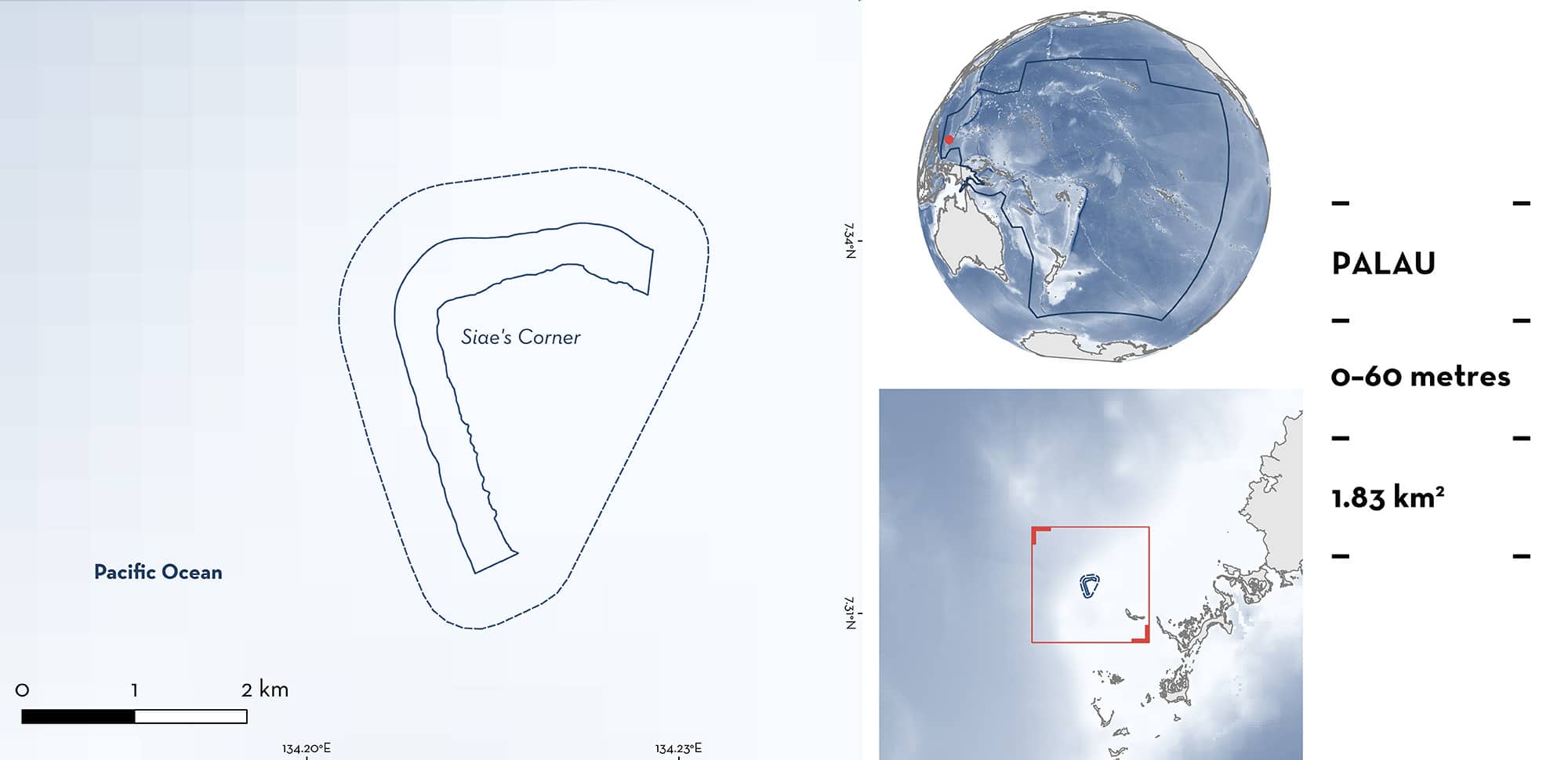
Siae’s Corner
Summary
Siae’s Corner is located north-northwest of Ulong Island and west of Koror in Palau. This vertical reef drops vertically to 40–53 m where it merges with a plateau of broken coral and sand. Within this area there are: threatened species (e.g., Whitetip Reef Shark Triaenodon obesus); reproductive areas (Grey Reef Shark Carcharhinus amblyrhynchos); feeding areas (Grey Reef Shark); and undefined aggregations (e.g., Whitetip Reef Shark).
Download factsheet
Siae’s Corner
DESCRIPTION OF HABITAT
Siae’s Corner is located north-northwest of Ulong Island and west of Koror in Palau. This vertical reef drop-off area starts at 3–5 m below the surface and drops vertically to 40–53 m where it merges with a plateau of broken coral and sand, sloping into the open ocean floor (Harel-Bornovski & Bornovski 2015). Water temperature (measured at 57 m) is ~29ºC throughout the year except from January–March when it is lower (~23–25ºC) (Vianna et al. 2013).
This Important Shark and Ray Area is benthic and pelagic and is delineated from surface waters (0 m) to 60 m based on the bathymetry of the area.
CRITERION A
VULNERABILITY
Two Qualifying Species considered threatened with extinction according to the IUCN Red List of Threatened Species regularly occur in the area. These are the Endangered Grey Reef Shark (Simpfendorfer et al. 2020a) and the Vulnerable Whitetip Reef Shark (Simpfendorfer et al. 2020b).
CRITERION C
SUB-CRITERION C1 – REPRODUCTIVE AREAS
Siae’s Corner is an important reproductive area for one shark species.
Between 2009–2024, ~10 neonates or young-of-the-year (YOY) Grey Reef Sharks were recorded during 90% of twice-weekly dives in the area. Visual estimates of their total length (TL) ranged between 60–80 cm. The size-at-birth of this species is 45–60 cm TL (Ebert et al. 2021), indicating that most were YOY individuals (T Harel-Bornovski pers. obs. 2024).
During this period, and in the same frequency of dives, between 2–10 female Grey Reef Sharks with fresh mating scars were observed, generally between the months of January–April. However, since the early 2000s, females with mating scars were observed and recorded as late as July (T Harel-Bornovski pers. obs. 2024). Males are recorded in the area from December–February suggesting that mating likely occurs in January or February (T Harel-Bornovski pers. obs. 2024).
CRITERION C
SUB-CRITERION C2 – FEEDING AREAS
Siae’s Corner is an important feeding area for one shark species.
Observations of Grey Reef Sharks feeding on the Moorish Idol Zanclus cornutus were described in 2016 and 2017 from the area (Etpison & Colin 2018). Over 100 Grey Reef Sharks were recorded gathering in the Moorish Idol spawning area in January 2016. In January 2017, there were over 200 at the peak of the aggregation. The spawning aggregation is formed during morning incoming tides on the forereef. Over 50 Grey Reef Sharks are seen trailing the Moorish Idol aggregation, swimming in an unhurried manner, but occasionally attacking the schools. When the Moorish Idol school gathers to ascend from the reef, the sharks become extremely agitated and aggressive, following the school in a tight cluster (Etpison & Colin 2018). Close to 100 Grey Reef Sharks were recorded daily along the reef for several days, but when the Moorish Idol school ascended off the reef, they were joined by an additional 100 Grey Reef Sharks which had been present in open water off the reef just beyond the limits of visibility (~30 m) (Etpison & Colin 2018). Interactions are recorded yearly during spawning events. When spawning and shark predation are high during December–January, the Moorish Idols often do not aggregate and delay further spawning to February–March, suggesting a critical mass needed to spawn is no longer present after the shark predation in January. In years when aggregations and/or spawning does not start until January, it can continue into March (Etpison & Colin 2018). In the days following spawning, most sharks disperse and are not seen at the sites in high numbers, suggesting they are gathered specifically to target the spawning (J Alpert & T Harel-Bornovski pers. obs. 2024).
CRITERION C
SUB-CRITERION C5 – UNDEFINED AGGREGATIONS
Siae’s Corner is important for undefined aggregations of two shark species.
Twice weekly dives between 2009–2024 have recorded aggregations of 10-70 Grey Reef Sharks, mostly between 25–45 m depths (T Harel-Bornowski pers. obs. 2024). However, fewer dives to deeper waters (35–60 m) recorded more than 100 Grey Reef Sharks gliding in the current (T Harel-Bornowski pers. obs. 2024). When visibility allows, the higher abundance in deeper waters can also be seen on dives within recreational dive limits (T Harel-Bornowski pers. obs. 2024). An acoustic tagging study showed that Grey Reef Sharks displayed diel patterns of vertical movement in this area. The shallowest depths (30 m) were occupied at dawn and dusk, with sharks using progressively deeper waters (40–60 m) until noon. Grey Reef Sharks in Palau displayed high levels of inter-annual residency, with tagged sharks detected at the same sites along the outer reef slopes for over two years (Vianna et al. 2013). Current strength was positively correlated with the abundance of Grey Reef Sharks (Vianna et al. 2014). However, further information is required to understand the regularity and function of this aggregation.
Whitetip Reef Sharks are commonly observed resting on the reef plateau and sandy substrate, or swimming in groups gliding through the currents at the edge of the wall. Between 2009–2024, 2–6 individual sharks were recorded resting between 15–25 m depth on 90% of dives (conducted twice weekly in the area year-round) (T Harel-Bornowski pers. obs. 2024).
Between October 2007 and November 2012, 62 dive guides recorded counts of individual sharks sighted across 2,360 dives at 52 dive sites in Palau (Vianna et al. 2014). The total number of dives at Siae’s Corner was 118. Grey Reef Sharks were seen on 94% of dives and the mean daily relative abundance (mean value of all dives on a given day at the same site) was 10.9 individuals (0.9 SE). Whitetip Reef Sharks were seen in 76% of dives and the mean daily relative abundance was 2.7 individuals (0.3 SE), supporting the number of individuals seen in aggregations.
Download factsheet
SUBMIT A REQUEST
ISRA SPATIAL LAYER REQUEST
To make a request to download the ISRA Layer in either a GIS compatible Shapefile (.shp) or Google Earth compatible Keyhole Markup Language Zipped file (.kmz) please complete the following form. We will review your request and send the download details to you. We will endeavor to send you the requested files as soon as we can. However, please note that this is not an automated process, and before requests are responded to, they undergo internal review and authorization. As such, requests normally take 5–10 working days to process.
Should you have questions about the data or process, please do not hesitate to contact us.