ISRA FACTSHEETS
ISRA FACTSHEETS
ASIA REGION
Similan-Surin Archipelago
Summary
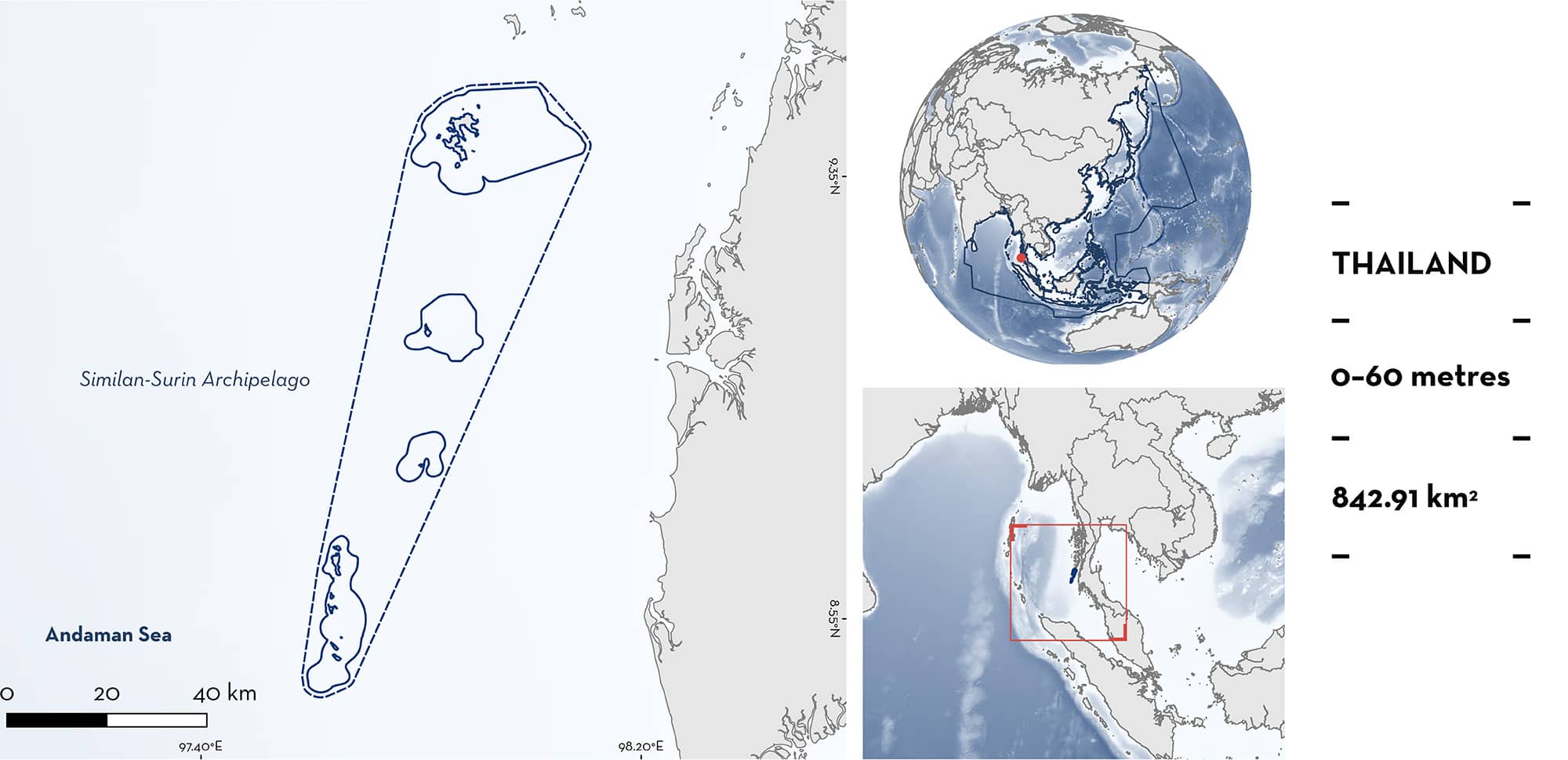
Similan-Surin Archipelago is located in the Andaman Sea off the coast of Thailand. The Similan Islands are a series of granite formations including Koh Tachai and Koh Bon. The Surin Islands are limestone formations with fringing reefs and include the pinnacle structure of Richelieu Rock. The area encompasses two marine protected areas, Mu Koh Similan National Marine Park and Mu Koh Surin National Park, and two Key Biodiversity Areas, Mu Ko Similan and Mu Koh Surin. Within this area there are: threatened species (e.g., Blacktip Reef Shark Carcharhinus melanopterus); reproductive areas (e.g., Tiger Shark Galeocerdo cuvier); resting areas (Indo-Pacific Leopard Shark Stegostoma tigrinum); and undefined aggregations (e.g., Oceanic Manta Ray Mobula birostris).
Download factsheet
Similan-Surin Archipelago
DESCRIPTION OF HABITAT
Similan-Surin Archipelago is located in the Andaman Sea off the coast of Thailand. The Similan Islands are an archipelago of nine granite islands. These islands are surrounded by large granite boulders covered in soft and hard corals to a depth of 40 m (Schmidt et al. 2012). To the north are two additional islands included in the Mu Koh Similan National Marine Park: Koh Tachai and Koh Bon. Koh Tachai is a limestone island with fringing reef and an adjacent pinnacle that attracts large pelagic species (Scaps 2011). Koh Bon is a granite island with fringing reef and a pinnacle formation. The Surin Islands are north of the Similan Islands and form the southernmost extent of the Myeik Archipelago in bordering Myanmar. The five Surin Islands are limestone formations with fringing reefs, and there is an offshore limestone pinnacle called Richelieu Rock (Scaps 2011).
Similan-Surin Archipelago is subject to large amplitude internal waves common in the Andaman Sea. Alongside the seasonal monsoon, these internal waves contribute to nutrient and temperature mixing (Wall et al. 2012). The region is subject to frequent and abrupt changes to conditions, particularly during the dry season (January–April) and to an intense monsoon season with strong surface wave action (May–October; Schmidt et al. 2012).
The area encompasses two marine protected areas (Mu Koh Similan National Marine Park and Mu Koh Surin National Park), and two Key Biodiversity Areas (KBAs; Mu Ko Similan KBA and Mu Koh Surin KBA; KBA 2024a, 2024b).
This Important Shark and Ray Area is benthopelagic and is delineated from inshore and surface waters (0 m) to 60 m based on the bathymetry of the area.
CRITERION A
VULNERABILITY
Five Qualifying Species considered threatened with extinction according to the IUCN Red List of Threatened Species regularly occur in the area. Threatened sharks comprise one Endangered species and one Vulnerable species; threatened rays comprise one Critically Endangered species, one Endangered species, and one Vulnerable species (IUCN 2024).
CRITERION C
SUB-CRITERION C1 – REPRODUCTIVE AREAS
Similan-Surin Archipelago is an important reproductive area for two shark and one ray species.
Between January and May each year, neonate and young-of-the-year (YOY) Blacktip Reef Sharks (visually estimated size, 30–60 cm total length [TL]) are reported to use the shallow water mangrove areas around Surin Islands (Thai Sharks and Rays [TSAR] unpubl. data 2024). Size-at-birth for this species is 30–52 cm TL (Ebert et al. 2021). Information was gathered via crowd-sourcing and social media mining, but there is no information available during the southwest monsoon (May–October) as the island is closed to visitors. Anecdotal reports suggest Blacktip Reef Sharks have been using this area since at least the 1990s, but photographic evidence is available to support the reproductive nature of their aggregations here since 2010 to the present (TSAR unpubl. data 2024). Neonates were also regularly sighted in groups swimming over shallow sandy substrates (>5 individuals per instance) by tourists and citizen scientists around Koh Tachai. However, the island was strictly closed to tourism in 2016, so the only recent records are anecdotal reports of neonates using the mangrove areas between February and March from Department of National Park Officers who monitor the area (TSAR unpubl. data 2024).
Between 2019–2024, there were 23 sightings of YOY Tiger Sharks around Surin Island, especially at the Torinla dive site (TSAR unpubl. data 2024). Sightings were reported in every year, and across all months between November and April when the area is accessible (it is closed during the southwest monsoon, May–October). Sightings were acquired through social media data mining, with all records accompanied by photographic evidence. Sizes were estimated through visual comparison of the shark to the surrounding environment, and YOY assumed based on the combination of size (in the range of ~100 cm TL) and the animals’ bold stripes and spots characteristic of younger individuals (Ritter 1999). Size-at-birth for this species is 51–76 cm TL (Ebert et al. 2021), and they are fast-growing with size estimates >118 cm TL by their second year (Emmons et al. 2021). Based on fisheries-dependent information, it is estimated that the birthing period for Tiger Sharks in the Andaman Sea is between May–July (Arunrugstichai et al. 2018). Protection from fishing pressure due to the national park has resulted in an abundance of reef fishes in the area. This prey availability may provide an explanation for the site preference of early life stages of Tiger Sharks in the area (M Chuangcharoendee pers. obs. 2024).
Between 2017–2024, there were 19 opportunistic reports of Bottlenose Wedgefish exhibiting courtship behaviour at Koh Bon, Koh Tachai, and Koh Surin (TSAR unpubl. data 2024). Sightings were obtained via crowd-sourcing and social media data mining. The activity appears to be seasonal, with most observations reported between November and February, and more common during the positive phase of the Indian Ocean Dipole. There are no other locations in the region where this behaviour has been regularly recorded, supporting the importance of this area to this species’ reproduction. A historical record of courting behaviour in Bottlenose Wedgefish from a diver at Richelieu Rock in 1995, suggests this area has been used for this purpose for many decades (TSAR unpubl. data 2024).
CRITERION C
SUB-CRITERION C3 – RESTING AREAS
Similan-Surin Archipelago is an important resting area for one shark species.
Since 2004, Indo-Pacific Leopard Sharks have been commonly seen resting throughout the Similan Islands during the October–May dive season (R Parker pers. comm. 2023). Unless the sharks are disturbed by divers, the vast majority of observations are of animals resting on the sand. This species is known to seek refuge and rest during the day, and likely forage at dusk and night (Dudgeon et al. 2013). The main locations of sightings are Similan Island 9 and Koh Tachai, where they were seen on every dive prior to the 2010 coral bleaching event, and in groups of up to eight individuals (R Parker pers. comm. 2023). They are also commonly seen at Similan Island 3, resting in groups of up to three individuals, with single sharks occasionally seen at Similan Island 8 and Koh Bon (R Parker pers. comm. 2023). The reefs in the area where Indo-Pacific Leopard Sharks are frequently seen resting are soft coral dominated, and there are also sandy areas between 10–30 m depth adjacent to the reef which comprise suitable resting habitat for this species. These habitat features are also observed around Phi Phi Islands (Thailand) and off Mozambique where Indo-Pacific Leopard Sharks are also observed aggregating to rest (MMF unpubl. data 2024). A study that collected 9,524 diver observations at 153 sites between 2012 and 2016 ranked the Similan Archipelago in the top 3% of sites to protect Indo-Pacific Leopard Sharks (Ward-Paige et al. 2018). An average group size of three sharks has been recorded at Koh Tachai, Similan Island 9, and two reefs at Similan Island 3 (Ward-Paige et al. 2018). Reports of Indo-Pacific Leopard Sharks in the area have increased since 2018 (S Arunrugstichai pers. obs. 2023).
CRITERION C
SUB-CRITERION C5 – UNDEFINED AGGREGATIONS
Similan-Surin Archipelago is an important area for undefined aggregations of two ray species.
Since 1995, photo-identification has been used to record 390 encounters of 313 individual Oceanic Manta Rays in the Similan-Surin Archipelago (MantaMatcher.org 2023). This area is only accessible between October and May, and Oceanic Manta Rays have been recorded across all these months and every year between 2006 and 2023, however sightings tend to peak between February and April (77% of records; MantaMatcher.org 2023). These sites likely function as an important socialisation hub, with up to 12 individuals identified on a single day at Koh Bon and up to six individuals at Koh Tachai (mean group size = 3). Pre-copulatory behaviour, such as courtship trains or chasing has been observed in 14% of sightings (A Flam pers. obs 2023). Overall, 81% of the Oceanic Manta Rays recorded by trained observers at these sites were classified as mature based on clasper development, mating scars, or pregnancy (as defined by Marshall & Bennett 2010; MantaMatcher.org 2023). Pregnant Oceanic Manta Rays have been observed twice at Koh Bon and once at Koh Tachai (MantaMatcher.org 2023). The Similan Islands also contains a number of cleaning stations where small cleaner fish remove dead tissue and parasites from other fish. Oceanic Manta Rays were cleaning on 21% of encounters recorded by a trained observer (A Flam pers. obs 2023). Between 3–10 Oceanic Manta Rays can be observed during a single dive at these sites, but the rays are often spread out across the cleaning station habitats (A Flam pers. obs 2024). Koh Bon and Koh Tachai account for 70% of Oceanic Manta Ray sightings in Thailand (MantaMatcher.org 2023), demonstrating the importance of this area to the species. In addition, data collected by the Thai government between 1997–2021, confirmed 405 sightings of Oceanic Manta Rays from the Andaman Sea and only nine from the Gulf of Thailand, supporting the importance of this region for this species (MCRRDI 2021). Further information is needed to understand the nature and function of this aggregation.
Between 2014–2024, Blotched Fantail Rays have been observed aggregating in the area, with the main concentration of sightings around Koh Bon and Richelieu Rock (TSAR unpubl. data 2024). Data sourced through social media mining include 28 observations of these rays, with 11 of these (39%) having at least two individuals (maximum group size of five). In addition, a professional photographer that regularly dives the area has reported aggregations since 2014 (N Sumanatemeya pers. com 2024). Aggregations of Blotched Fantail Rays have been observed between November to April, however the park is closed for the southwest monsoon (May–October) so it is unknown whether the aggregation is year-round. The rays are observed moving across the substrate and resting in groups, however further information is needed to understand the nature and function of this aggregation.
Download factsheet
SUBMIT A REQUEST
ISRA SPATIAL LAYER REQUEST
To make a request to download the ISRA Layer in either a GIS compatible Shapefile (.shp) or Google Earth compatible Keyhole Markup Language Zipped file (.kmz) please complete the following form. We will review your request and send the download details to you. We will endeavor to send you the requested files as soon as we can. However, please note that this is not an automated process, and before requests are responded to, they undergo internal review and authorization. As such, requests normally take 5–10 working days to process.
Should you have questions about the data or process, please do not hesitate to contact us.