ISRA FACTSHEETS
ISRA FACTSHEETS
AUSTRALIA AND SOUTHEAST INDIAN OCEAN
South Flinders Reefs
Summary
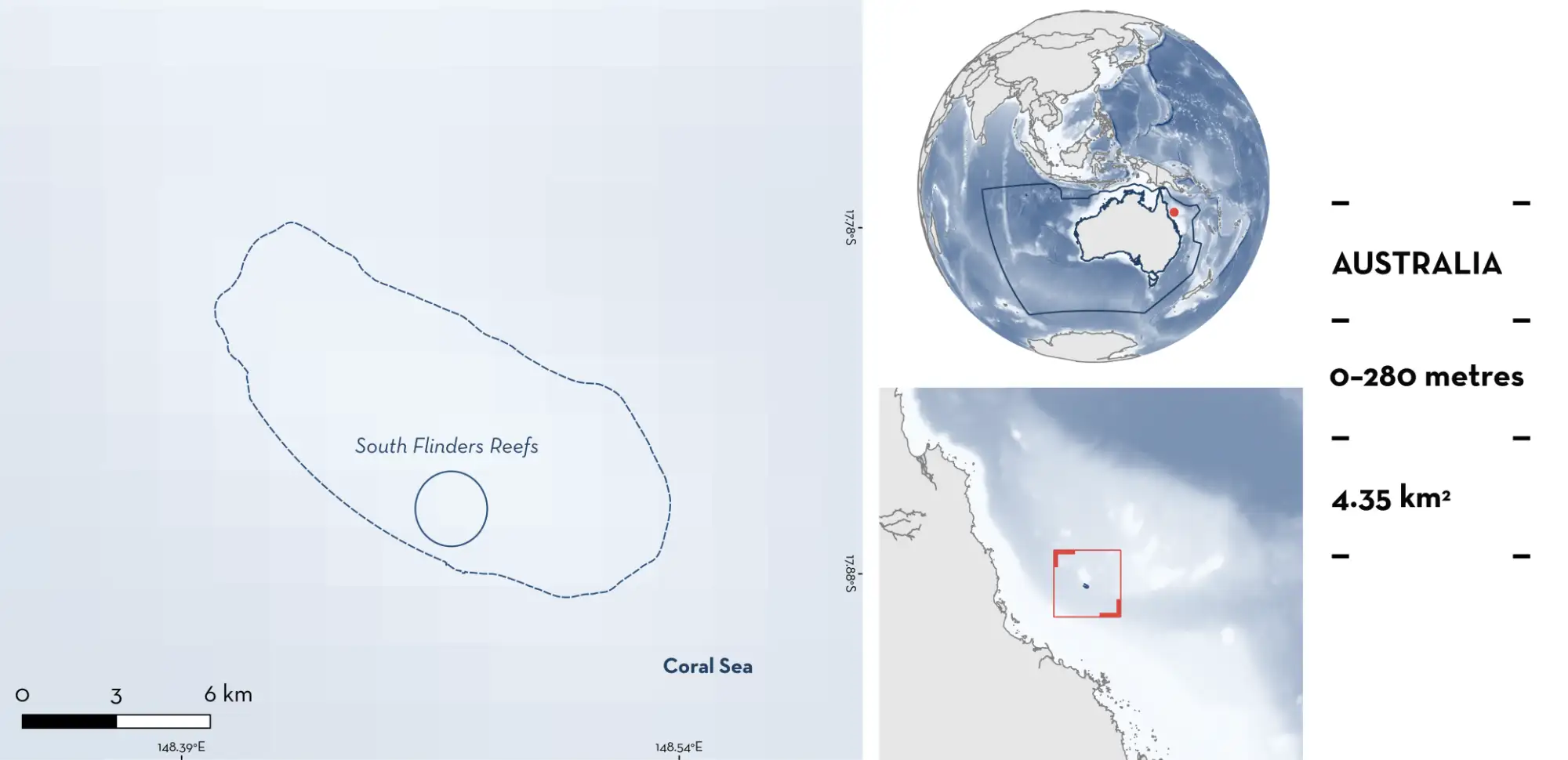
South Flinders Reefs is located in the Coral Sea off Queensland, Australia. The area is situated ~230 km northeast of Townsville. It comprises a coral reef pass at the southern end of Horseshoe Reef which forms part of the South Flinders Reefs atoll. The habitat is characterised by pelagic waters, coral reef slopes, and insular shelf slopes. The area is influenced by the South Equatorial Current and the East Australian Current, by seasonal trade winds, and by tidal currents through the reef channel. Within this area there are: threatened species and undefined aggregations (Grey Reef Shark Carcharhinus amblyrhynchos).
Download factsheet
South Flinders Reefs
DESCRIPTION OF HABITAT
South Flinders Reefs is located in the Coral Sea off Queensland, Australia. It is situated ~230 km northeast of Townsville. The area comprises one small part of a larger reef system that rises as an escarpment from the >1,000 m deep western Queensland Plateau. South Flinders Reefs is part of an atoll that is separated from the larger North Flinders Reefs atoll by a >600 m deep channel. The atoll spans ~15 km by 5 km with a large lagoon and a continuous near-surface reef (Horseshoe Reef) along the southeastern side. This area is located at the southern corner of Horseshoe Reef at a pass. The habitat is characterised by pelagic waters, a shallow coral reef slope, and insular shelf slopes (Bridge et al. 2019).
Similar to other reefs on the Queensland Plateau in the Coral Sea, the area is influenced by tides and wind (Leis 1994). Strong southeast trade winds drive a northerly surface flow during the austral winter from June to September, while in summer, winds are relatively weak (Choukroun et al. 2010). The area is also influenced by the westward South Equatorial Current and the southward flowing East Australian Current (Choukroun et al. 2010). Tides influence the local flow within the area.
This Important Shark and Ray Area is benthic and pelagic and is delineated from inshore and surface waters (0 m) to 280 m based on the global depth range of Qualifying Species.
CRITERION A
VULNERABILITY
One Qualifying Species considered threatened with extinction according to the IUCN Red List of Threatened Species regularly occurs in the area. This is the Endangered Grey Reef Shark (Simpfendorfer et al. 2020).
CRITERION C
SUB-CRITERION C5 – UNDEFINED AGGREGATIONS
South Flinders Reefs is an important area for undefined aggregations of one shark species.
Passive acoustic telemetry data show that Grey Reef Sharks regularly aggregate in this area (N Lubitz et al. unpubl. data 2025). A total of 27 Grey Reef Sharks tagged with acoustic transmitters were detected in the broader Flinders Reefs array (including locations outside of this area), with 19 individuals recorded on the receivers within this area between February 2021 and February 2022. Aggregations were defined as three or more tagged individuals detected on a receiver within five minutes. The approximate range in which receivers detect tagged sharks 100% of the time on Coral Sea reefs is ~400 m (Barnett et al. 2012). Aggregations in consecutive five-minute bins were grouped into an event and its duration was calculated.
There were ~165,000 detections recorded in the broader Flinders Reefs. However, four receivers had few detections (0.1–3.8%), and one receiver had 11.7% of total detections but recorded only sporadic aggregations. These were excluded, and the remaining receiver location on South Flinders Reefs was used to define the boundary of the area. There were 3,987 five-minute bins with aggregations recorded within the area, grouped into 3,007 aggregation events that lasted between 0.3–58 min (mean = 4.8 min). Aggregations comprised 3–7 individuals (mean = 3.2 individuals) or 16–37% of the 19 tagged Grey Reef Sharks that were detected in this area. There was a seasonal signal, with more aggregations, aggregations persisting longer, and more individuals in aggregations during November–December. Most aggregations were recorded during the day (72%), with a peak from 06:00–10:00 (N Lubitz et al. unpubl. data 2025). Aggregations occurred on almost all days (350 days; 94% of study duration). Combined, the data show that one specific location (i.e., this area) at this offshore reef regularly hosts aggregations of Grey Reef Sharks that last up to ~1 h. Only 6 of 81 Grey Reef Sharks tagged in the broader Coral Sea region (Flinders Reefs, Osprey Reef, Holmes Reefs, Bougainville Reef) were detected at multiple reefs, highlighting their high residency and site fidelity, and the individual importance of each reef (N Lubitz et al. unpubl. data 2025). More information is required to understand the nature and function of these aggregations.
Download factsheet
SUBMIT A REQUEST
ISRA SPATIAL LAYER REQUEST
To make a request to download the ISRA Layer in either a GIS compatible Shapefile (.shp) or Google Earth compatible Keyhole Markup Language Zipped file (.kmz) please complete the following form. We will review your request and send the download details to you. We will endeavor to send you the requested files as soon as we can. However, please note that this is not an automated process, and before requests are responded to, they undergo internal review and authorization. As such, requests normally take 5–10 working days to process.
Should you have questions about the data or process, please do not hesitate to contact us.