ISRA FACTSHEETS
ISRA FACTSHEETS
AUSTRALIA AND SOUTHEAST INDIAN OCEAN
South Passage
Summary
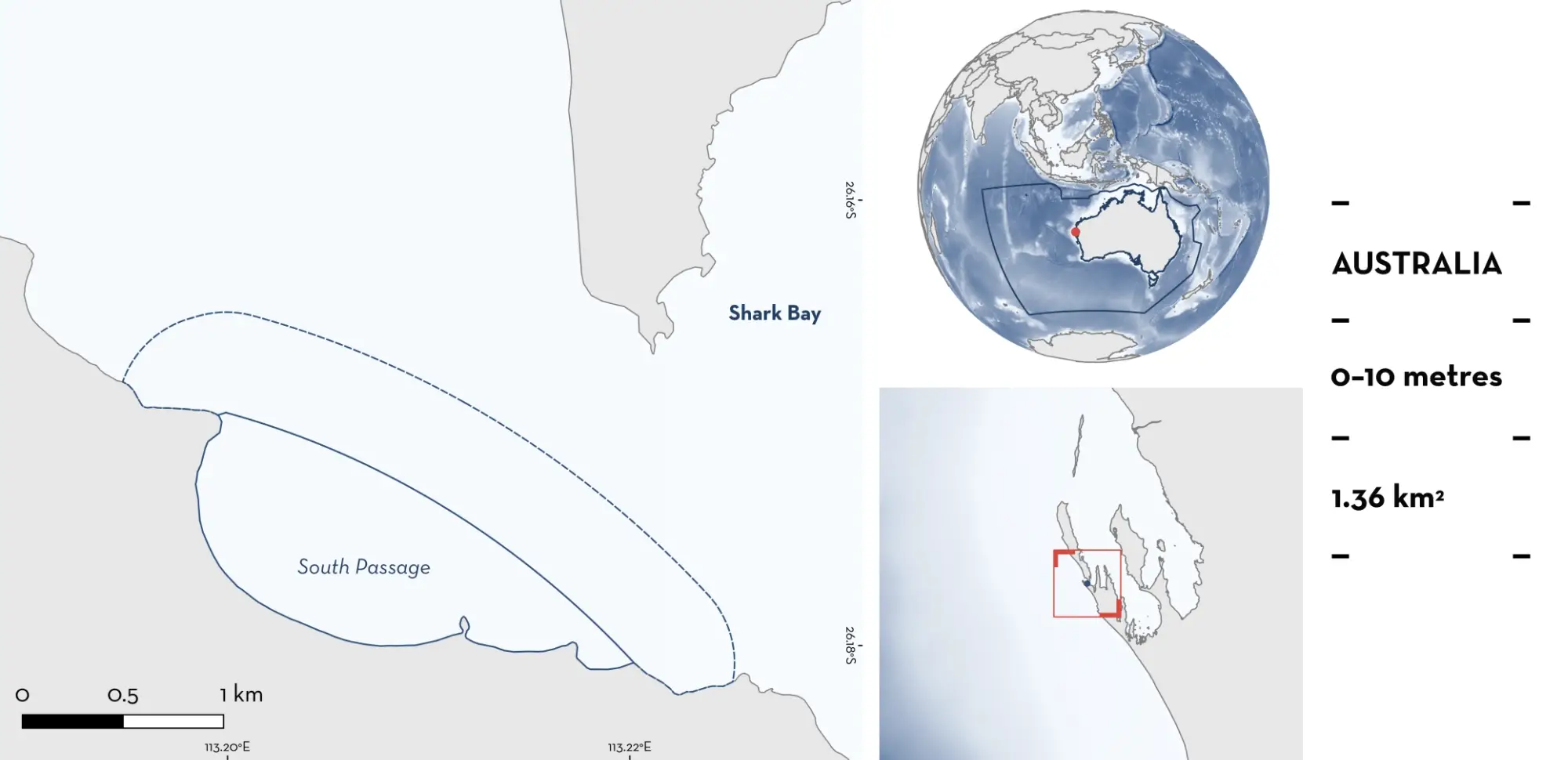
South Passage is located in Shelter Bay, western Shark Bay, Western Australia, Australia. This area sits in South Passage which serves as one of the main conduits for oceanic water exchange between the open Indian Ocean and the semi-enclosed Shark Bay. This area lies within a shallow, sheltered bay characterised by sandy substrates and scattered hard corals. Within this area there are: threatened species (Broad Cowtail Ray Pastinachus ater); undefined aggregations (Broad Cowtail Ray); and distinctive attributes (Australian Bluespotted Maskray Neotrygon australiae).
Download factsheet
South Passage
DESCRIPTION OF HABITAT
South Passage is located in Shelter Bay, western Shark Bay, Western Australia, Australia. This area sits in Shelter Bay within the South Passage which is a deep, narrow, high-energy channel bordered by rugged limestone cliffs and rocky shores (Sutton & Shaw 2020). It serves as one of the main conduits for oceanic water exchange between the open Indian Ocean and the semi-enclosed Shark Bay (Sutton & Shaw 2020). This area lies within a shallow bay characterised by sandy substrates and scattered hard and soft corals representing more than 30 species. Large bommies and patches of Turbinaria and Pocillopora occur throughout the bay. Scattered seagrass is also present, ranging from small Halophila to larger Amphibolis species. Within this area, the cleaning station is known by divers by ‘the Cabbage Patch’ and is characterised by ~60m long Turbinaria corals.
This area has a semi-arid climate characterised by two main seasons: warm to hot austral summers (October–March) and mild winters (April–September). The waters of the bay are warmer than adjacent oceanic waters in summer and cooler in winter (Nahas et al. 2005). Average sea surface temperatures are higher in summer (mean = 24.6 ± 1.0°C) than in winter (mean = 20.8 ± 1.7°C). This area is protected from swell but is subject to tidal currents and wind-driven surface currents.
This area overlaps with Shark Bay Marine Park (WA DBCA 2025).
This Important Shark and Ray Area is benthic and pelagic and is delineated from inshore and surface waters (0 m) to 10 m based on the bathymetry of the area.
CRITERION A
VULNERABILITY
One Qualifying Species considered threatened with extinction according to the IUCN Red List of Threatened Species regularly occurs in the area. This is the Vulnerable Broad Cowtail Ray (Sherman et al. 2021).
CRITERION C
SUB-CRITERION C5 – UNDEFINED AGGREGATIONS
South Passage is important for undefined aggregations of one ray species.
Based on observations gathered between 2020–2025, Broad Cowtail Rays are regularly and predictably seen resting in groups in this area. Sightings have been made during seasonal visits from ~July–August when this area is snorkelled 6–7 days per week (E Gosden pers. obs. 2020–2025). There is an estimated 70% chance of encountering Broad Cowtail Rays. Sightings typically involve 1–5 animals. The individuals observed are mainly mature animals of both sexes including potentially pregnant females, based on visual observations of distended abdomens. Estimated body size range is 100–200 cm disc width (DW). Size-at-birth is ~18 cm DW, and animals reach a maximum size of 200 cm DW (Last et al. 2016). Further information is required to understand the nature and function of these aggregations.
CRITERION D
SUB-CRITERION D1 – DISTINCTIVENESS
South Passage is an important area for the distinct behaviour of one ray species.
Australian Bluespotted Maskray regularly visit a cleaning station within this area called ‘The Cabbage Patch’ (E Gosden pers. obs. 2020–2025). Snorkelers report this species being regularly observed being cleaned by small cleaner wrasses. Rays are seen year-round, either individually or in groups of up to five individuals. There is an estimated 70% chance of encountering Australian Bluespotted Maskrays at this cleaning station. During cleaning interactions, rays position themselves motionless with their backs curved and only the extreme of their pectoral fins are in contact with the substrate while cleaner wrasses remove parasites and dead tissue their body surfaces. This area is especially important as it is the only known cleaning station for the Australian Bluespotted Maskray.
Download factsheet
SUBMIT A REQUEST
ISRA SPATIAL LAYER REQUEST
To make a request to download the ISRA Layer in either a GIS compatible Shapefile (.shp) or Google Earth compatible Keyhole Markup Language Zipped file (.kmz) please complete the following form. We will review your request and send the download details to you. We will endeavor to send you the requested files as soon as we can. However, please note that this is not an automated process, and before requests are responded to, they undergo internal review and authorization. As such, requests normally take 5–10 working days to process.
Should you have questions about the data or process, please do not hesitate to contact us.