ISRA FACTSHEETS
ISRA FACTSHEETS
MEDITERRANEAN AND BLACK SEAS REGION
Southern Adriatic Pit
Summary
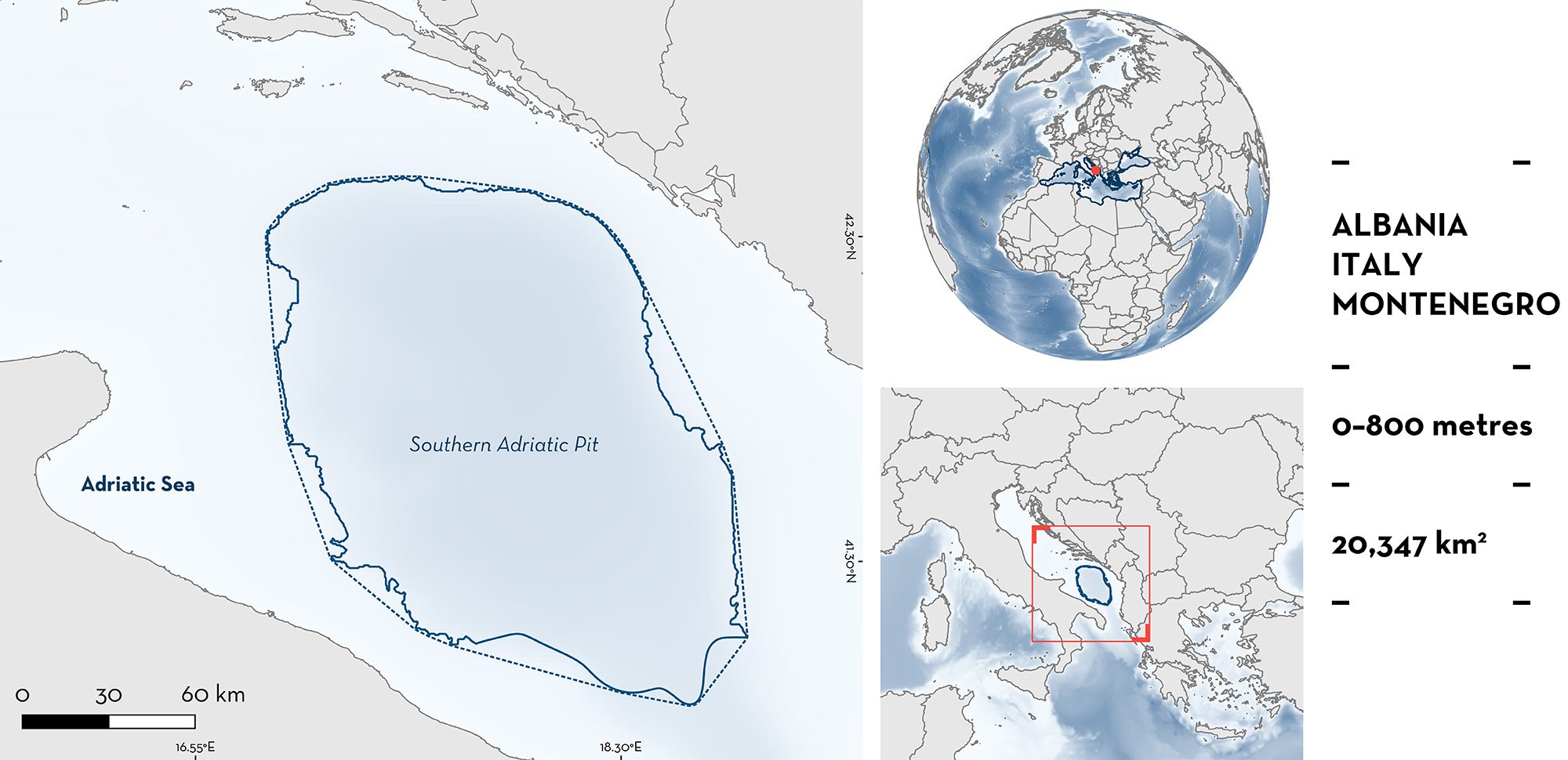
Southern Adriatic Pit is located in the southern Adriatic Sea, a sub-basin of the Mediterranean Sea. It is characterised by steep slopes reaching a maximum depth >1,000 m. Water exchange with the Mediterranean Sea takes place through the Strait of Otranto. This area covers the epipelagic and mesopelagic zones of the water column from the surface to a depth of 800 m. The area overlaps with the South Adriatic Ionian Straight Ecologically or Biologically Significant Marine Area (EBSA). Within the area there are: threatened species; reproductive areas; and areas important for movement (Blue Shark Prionace glauca).
Download factsheet
Southern Adriatic Pit
DESCRIPTION OF HABITAT
Southern Adriatic Pit is located in the southern Adriatic Sea, a sub-basin of the Mediterranean Sea. The Mediterranean climate dominates the southern Adriatic Sea, with warm, dry summers and mild, wet winters. The oceanography of the southern Adriatic is complex, with a range of dynamic habitat features. Fronts and eddies are common in the area, creating areas of upwelling that are rich in nutrients and support high levels of primary productivity (Ljubimir et al. 2017; Jasprica et al. 2022). Water masses circulating through the southern Adriatic are the Adriatic surface water, Ionian surface water, Levantine intermediate water, and Adriatic deep water (McKinney 2007).
Southern Adriatic Pit occupies the southern-central area of the Adriatic Sea. Open sea zooplankton (i.e., krill), mesopelagic zooplankton, and deep zooplankton (Hure et al. 2018; Guglielmo et al. 2019) support the marine food web.
The area overlaps with the South Adriatic Ionian Straight Ecologically or Biologically Significant Marine Area (EBSA; CBD 2023).
This Important Shark and Ray Area is pelagic and is delineated from surface waters (0 m) to 800 m based on distribution of the Qualifying Species in this area. Although the Southern Adriatic Pit includes epipelagic, mesopelagic, and bathypelagic waters, only the epipelagic and mesopelagic zones are considered here given the ecological preferences of the Qualifying Species.
CRITERION A
VULNERABILITY
The one Qualifying Species within the area is considered threatened with extinction according to the IUCN Red List of Threatened SpeciesTM. The Blue Shark is assessed as Critically Endangered in a Mediterranean regional assessment (Sims et al. 2016) and Near Threatened globally (Rigby et al. 2019).
CRITERION C
SUB-CRITERION C1 – REPRODUCTIVE AREAS
Southern Adriatic Pit is an important reproductive area for one shark species.
Blue Sharks have a regular and predictable seasonal presence in the area, based on tracking data and captures in fisheries where it represents the most frequently captured pelagic shark in the southern Adriatic Sea (Ćetković et al. 2022; Carbonara et al. 2023; Coispa unpubl. data 2023).
Six young-of-the-year individuals, with sizes <100 cm total length (TL), were recorded in the area during surveys conducted in 2019, 2020, and 2022, during September and October (Coispa unpubl. data 2023). Additionally, the area is located next to documented reproductive areas for Blue Shark in southeast Adriatic waters, where records of >20 neonate Blue Sharks of ~50 cm TL and young-of-the-year (<100 cm TL) have been recorded over the past decade (Ćetković et al. 2019, 2022). The known size-at-birth of the species is 35–50 cm TL (Ebert & Dando 2021).
CRITERION C
SUB-CRITERION C4 – MOVEMENT
Southern Adriatic Pit is an important movement area for one shark species. Blue Shark is a highly migratory species and regularly or predictably uses specific areas in the southern Adriatic during movements, contributing to the connectivity of important areas. Blue Shark tagging through the WWF Safeshark and Medbycatch projects has shown that individuals utilise the Southern Adriatic Pit and migrate through the Strait of Otranto reaching the Strait of Sicily and eastern Ionian waters. Tagging data of 26 Blue Sharks (10 juveniles <160 cm TL and 16 sub-adults and adults >160 cm TL) show horizontal and vertical movements within the area, and diurnal movement between the surface down to a maximum of 800 m depth (Coispa unpubl. data 2023). Within the southern Adriatic, tagged Blue Sharks showed an affinity for the pelagic waters of the Southern Adriatic Pit, with several animals moving extensively in the area before undertaking their southward migrations (Coispa unpubl. data 2023).
Download factsheet
SUBMIT A REQUEST
ISRA SPATIAL LAYER REQUEST
To make a request to download the ISRA Layer in either a GIS compatible Shapefile (.shp) or Google Earth compatible Keyhole Markup Language Zipped file (.kmz) please complete the following form. We will review your request and send the download details to you. We will endeavor to send you the requested files as soon as we can. However, please note that this is not an automated process, and before requests are responded to, they undergo internal review and authorization. As such, requests normally take 5–10 working days to process.
Should you have questions about the data or process, please do not hesitate to contact us.