
ISRA FACTSHEETS
ISRA FACTSHEETS
EUROPEAN ATLANTIC
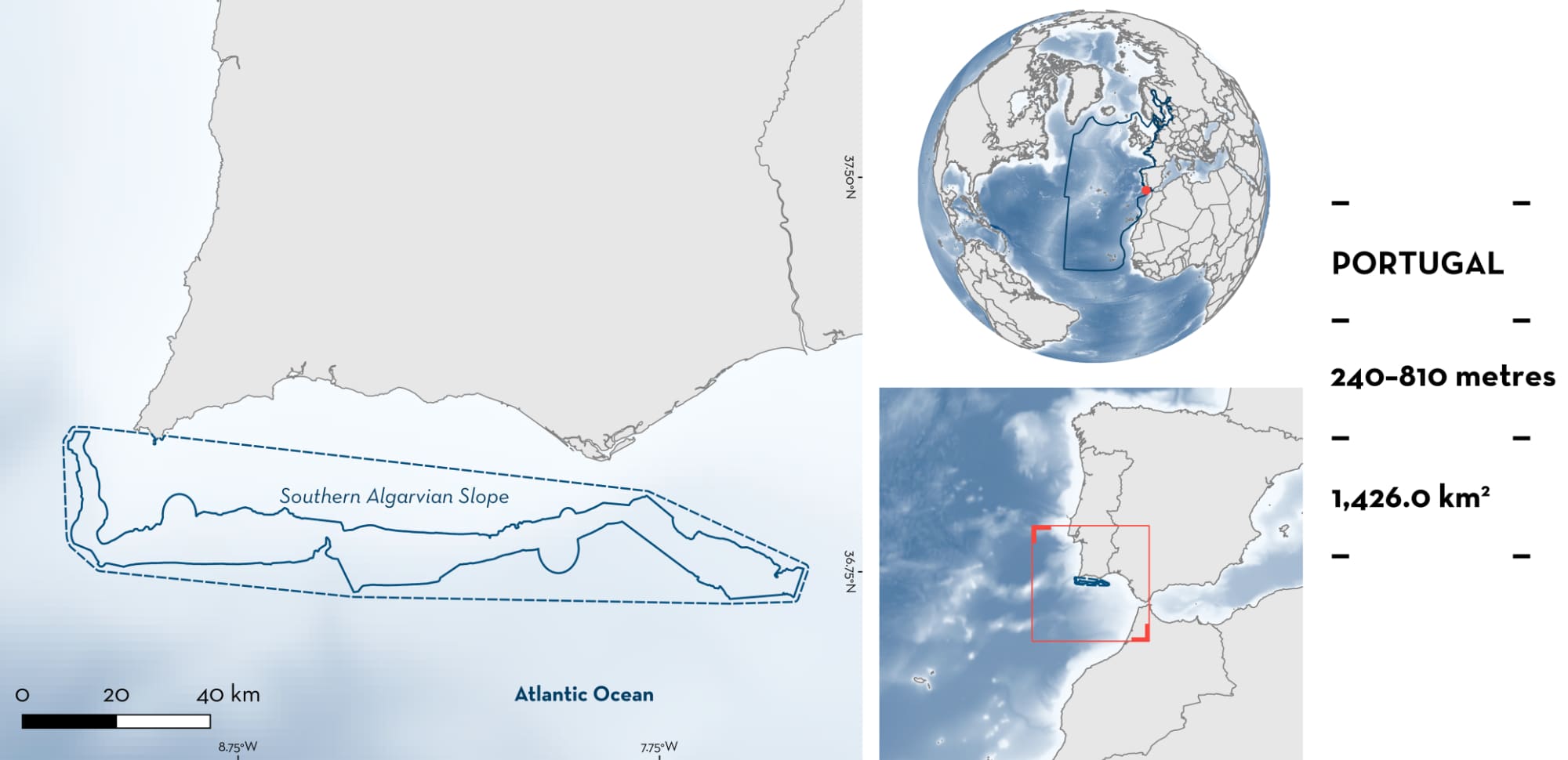
Southern Algarvian Slope
Summary
Southern Algarvian Slope is located off the coast of the Algarve region of southern Portugal. The area is characterised by submarine canyons, rocky reefs, and sandy substrates. It overlaps with the West Iberia Canyons and Banks Ecologically or Biologically Significant Marine Area. Within this area there are: threatened species (e.g., Knifetooth Dogfish Scymnodon ringens); range-restricted species (e.g., Iberian Pygmy Skate Neoraja iberica); reproductive areas (Portuguese Dogfish Centroscymnus coelolepis); feeding areas (e.g., Smooth Lanternshark Etmopterus pusillus); and the area sustains a high diversity of sharks (14 species).
Download factsheet
Southern Algarvian Slope
DESCRIPTION OF HABITAT
Southern Algarvian Slope is located off the coast of the Algarve region of southern Portugal. The area extends from Cabo de São Vicente in the west to the Guadiana River bordering Spain in the east. The area is characterised by the presence of submarine canyons with cold-water corals and rocky and sandy substrates (Cunha et al. 2013). The Portimão and Lagos canyons incise the slope, acting as conduits for sediment transport and hotspots for deep-sea biodiversity (de Stigter et al. 2011; Gomes et al. 2018).
The area lies along the Gulf of Cádiz, where Atlantic and Mediterranean-influenced currents create dynamic oceanographic conditions (Relvas et al. 2007; Sánchez & Relvas 2003). Oceanographically, it experiences seasonal upwelling (strongest in the boreal summer), driven by northerly winds (Fiúza 1983; Moita et al. 2003). Submarine canyons enhance vertical nutrient mixing, further supporting productivity (Arístegui et al. 2009). Thermal fronts and eddies concentrate plankton, influencing predator distributions (Teodósio et al. 2017) and canyon-driven upwelling delivers organic matter to the deep sea, supporting benthic communities (Arístegui et al. 2009).
The area overlaps with the West Iberia Canyons and Banks Ecologically or Biologically Significant Marine Area (EBSA; CBD 2025).
This Important Shark and Ray Area is benthic, pelagic, and subsurface and is delineated from 240–810 m based on the depth range of Qualifying Species in the area.
CRITERION A
VULNERABILITY
Nine Qualifying Species considered threatened with extinction according to the IUCN Red List of Threatened Species regularly occur in the area. Threatened sharks comprise two Endangered species and three Vulnerable species; threatened rays comprise two Endangered species and one Vulnerable species; threatened chimaeras comprise one Vulnerable species (IUCN 2025).
CRITERION B
RANGE RESTRICTED
This area holds the regular presence of Atlantic Sawtail Catshark and Iberian Pygmy Skate as range-restricted species. These species were regularly encountered in research surveys and commercial benthic trawlers operating off south and southwest Portugal (Graça Aranha 2025; Graça Aranha et al. 2025). Catch data were collected between June 2020–May 2022 from 12 fishing trips on a commercial trawler and a research vessel targeting shrimps (Aristaeomorpha foliacea, Aristeus antennatus, and Aristaeopsis edwardsiana), prawns (Parapenaeus longirostris and Penaeus monodon), and Norway Lobster (Nephrops norvegicus) (Graça Aranha 2025; Graça Aranha et al. 2025).
The second largest number of Atlantic Sawtail Catshark (n = 209) caught across south and southwest Portugal was recorded in this area. Individuals were caught year-round between 288–776 m depth. This species occurs primarily in the Iberian Coast Large Marine Ecosystem (LME) and marginally in the Canary Current LME and Mediterranean Sea LME. This was the only area across south and southwest Portugal where Iberian Pygmy Skates were recorded (n = 25). Individuals were recorded in 2020 and 2021 and caught in spring and summer between 421–758 m depth. This species is restricted to the Iberian Coast LME.
CRITERION C
SUB-CRITERION C1 – REPRODUCTIVE AREAS
Southern Algarvian Slope is an important reproductive area for one shark species.
Reproductive data for Portuguese Dogfish were collected across Portuguese waters from commercial longliners and during research surveys (trawls and longlines) in 2006–2007 (Moura et al. 2014). This was part of a global assessment of reproductive processes for the species. Of 253 females recorded in Portugal, 43 (17%) were pregnant and 58 (23%) were post-natal with the majority being recorded in this area and in southwest Portugal (Moura et al. 2014). These individuals were caught at depths between 200–1,640 m. This area and Iceland recorded the largest proportion of pregnant females in all of the Northeast Atlantic (Moura et al. 2014). Additionally, evidence of sperm within sperm storage tubules in females supports reproductive activity in this area (Moura et al. 2011). Contemporary data collected from research surveys and commercial benthic trawlers operating off south and southwest Portugal between 2020–2022 confirm the continuing presence of mature females (Graça Aranha 2025; Graça Aranha et al. 2025).
CRITERION C
SUB-CRITERION C2 – FEEDING AREAS
Southern Algarvian Slope is an important feeding area for three shark species.
Ecological data were collected between June 2020–May 2022 from commercial benthic trawlers and research surveys operating off south and southwest Portugal (Graça Aranha 2025; Graça Aranha et al. 2025). Twelve fishing trips were sampled with vessels targeting shrimps, prawns, and Norway Lobster (Graça Aranha 2025; Graça Aranha et al. 2025). Stable isotope analysis and RNA/DNA ratios were conducted from a small fraction of recorded individuals to evaluate the trophic ecology and feeding activity in the area (Graça Aranha 2025; Graça Aranha et al. 2025). Stable isotope analysis included sampling of prey targeted by fisheries (shrimps A. foliacea and A. edwardsiana and the lobster Nephrops norvegicus). The RNA/DNA values provide a short-term measure of nutritional condition (1–3 days; Buckley et al. 1999).
The analysis of RNA/DNA indicated that an assemblage of three shark species (Smooth Lanternshark, Velvet Belly Lanternshark, and Blackmouth Catshark) fed in the area in the days immediately before their capture (Graça Aranha et al. 2023; Graça Aranha 2025). Given that deepwater sharks are generally slow swimmers compared to other species (Treberg et al. 2003; Condon et al. 2012; Pinte et al. 2020), and that RNA/DNA ratios are indicative of recent feeding activity (Buckley 1980; Clemmesen 1987), this evidence indicates that there is an assemblage of shark species actively using the area for feeding. Shrimps and lobsters consumed by this assemblage of species are targeted by fisheries as their abundance are higher here (Borges et al. 2001; Bueno-Pardo et al. 2017; Graça Aranha et al. 2023). This area is the main fishing ground in Portugal for these crustacean species with intense trawling activity year-round five times higher than in adjacent areas (Borges et al. 2001; Bueno-Pardo et al. 2017).
Between 2020–2022, 166 Smooth Lanternshark were recorded in this area with individuals measuring 14.5–50.0 cm TL and caught at depths of 412–810 m (Graça Aranha 2025; Graça Aranha et al. 2025). Stable isotope analysis of 51 individuals indicate they are mesopredators and feed mostly on squids, and shrimps and lobsters targeted by fisheries that represent ~55% of their diet (Graça Aranha et al. 2023; Graça Aranha 2025). RNA/DNA ratios suggest they were recently feeding in the area (Graça Aranha 2025). Stomach content analysis of 658 individuals (73% with full stomachs) collected between 1998–2004 and 2015 revealed that shrimps, including the species targeted by trawl fisheries
were the main prey item (Index of Relative Importance [IRI] = 50%) in the area followed by bony fishes and decapods (Xavier et al. 2012; Muñoz 2015).
Between 2020–2022, 533 Velvet Belly Lanternshark were recorded in this area with individuals measuring 7.0–43.5 cm TL and caught at depths of 270–810 m (Graça Aranha 2025; Graça Aranha et al. 2025). Stable isotope analysis of 49 individuals indicate they are mesopredators and RNA/DNA ratios suggest they were recently feeding in the area (Graça Aranha 2025). Stomach content analysis of 459 individuals (49% with full stomachs) collected between 1990–2004 and 2015 revealed that they feed mainly on caridean shrimps (IRI = 28%), euphausiids (Meganyctiphanes norvegica), and bony fishes (mainly gadoids; Saldanha et al. 1995; Neiva et al. 2006; Muñoz 2015).
Between 2020–2022, 1,178 Blackmouth Catshark were recorded in this area with individuals measuring 9–65 cm TL and caught at depths of 256–810 m (Graça Aranha 2025; Graça Aranha et al. 2025). Stable isotope analysis of 72 individuals indicate they are mesopredators and feed mostly on squids, and shrimps and lobsters targeted by fisheries that represent ~52% of their diet (Graça Aranha et al. 2023; Graça Aranha 2025). RNA/DNA ratios suggest they were recently feeding in the area (Graça Aranha 2025). Stomach content analysis of 285 individuals (~75% of stomachs full) collected in 1990, 1996, 1997, 2003, and 2020–2021 revealed that they feed mainly on myctophidae, the shrimp Robustosergia robusta, caridean decapods, and the squid Histioteuthis meleagroteuthis (Saldanha et al. 1995; Santos & Borges 2001; Neves et al. 2007; Oliveira 2021).
CRITERION D
SUB-CRITERION D2 – DIVERSITY
Southern Algarvian Slope sustains a high diversity of Qualifying Species (14 species). This exceeds the regional diversity threshold (13 species) for the European Atlantic region. The regular presence of Qualifying Species has been documented through monitoring of commercial benthic trawlers and research surveys operating in the area between 2020–2022 (Graça Aranha 2025; Graça Aranha et al. 2025). Additionally, the presence of the Qualifying Species in the area has been reported since the 1990s from commercial trawlers (Saldanha et al. 1995; Neiva et al. 2006; Neves et al. 2007; Xavier et al. 2012; Muñoz 2015).
Download factsheet
SUBMIT A REQUEST
ISRA SPATIAL LAYER REQUEST
To make a request to download the ISRA Layer in either a GIS compatible Shapefile (.shp) or Google Earth compatible Keyhole Markup Language Zipped file (.kmz) please complete the following form. We will review your request and send the download details to you. We will endeavor to send you the requested files as soon as we can. However, please note that this is not an automated process, and before requests are responded to, they undergo internal review and authorization. As such, requests normally take 5–10 working days to process.
Should you have questions about the data or process, please do not hesitate to contact us.

