ISRA FACTSHEETS
ISRA FACTSHEETS
EUROPEAN ATLANTIC
Southwest Brittany
Summary
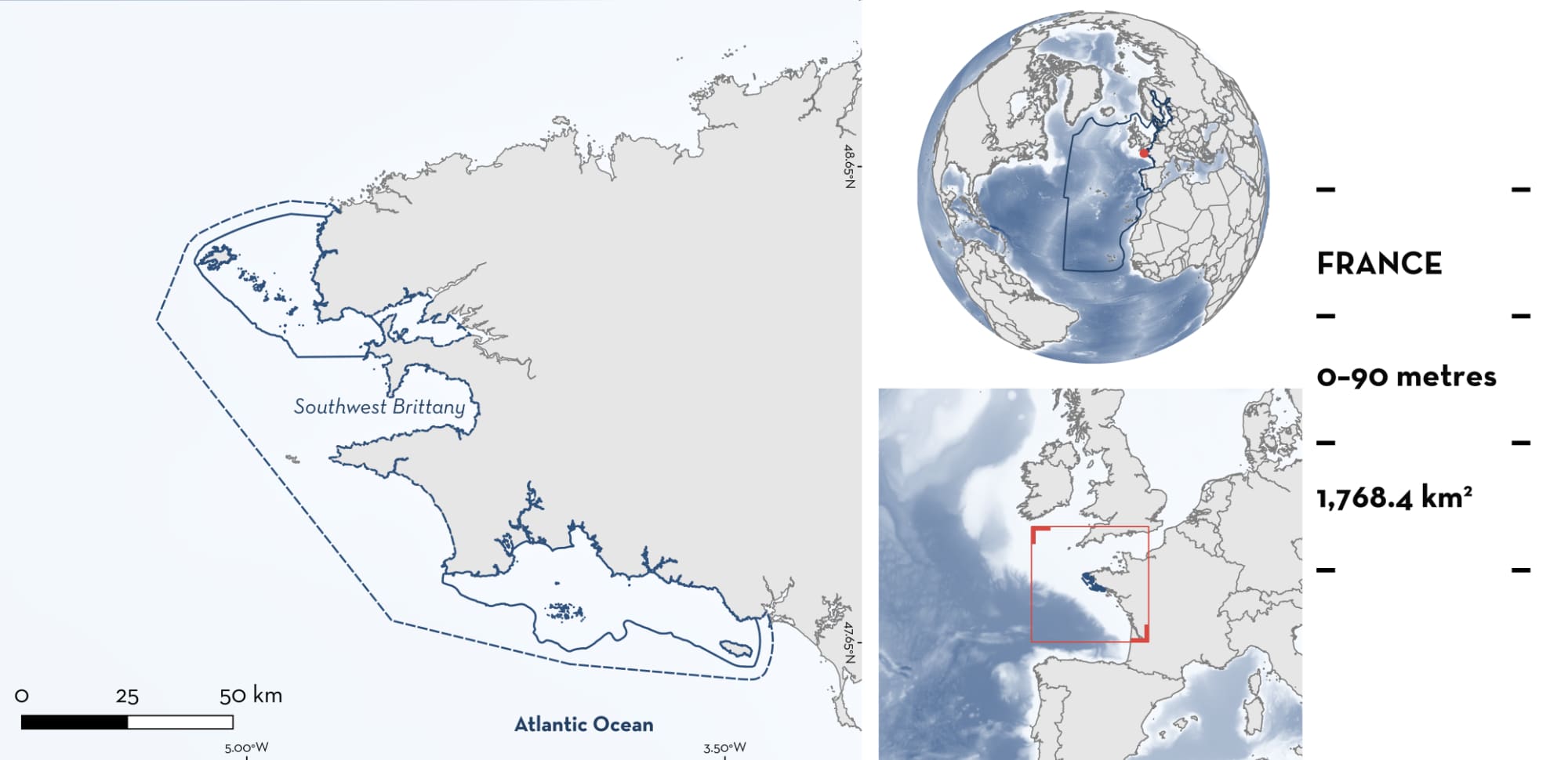
Southwest Brittany is located in the northwest of France. This split coastal area consists of a southern section around the Glénan Archipelago and Groix Island, and a northern section in the Iroise Sea around the Molène Archipelago and Ouessant (Ushant) Island. The habitat is characterised by rocky substrates, boulders, gravel, soft sediment substrates, and kelp forests. The area is influenced by strong tidal currents and tidal and thermal fronts. Within the area there are: threatened species and feeding areas (Basking Shark Cetorhinus maximus).
Download factsheet
Southwest Brittany
DESCRIPTION OF HABITAT
Southwest Brittany is located in northwestern France. This split coastal area consists of a southern section around the Glénan Archipelago and Groix Island, and a northern section in the Iroise Sea around the Molène Archipelago and Ouessant (Ushant) Island. The habitat is characterised by rocky substrates around the coast and islands, gravel, boulders, soft sediments such as coarse sand, sand, and mud, and one of Europe’s largest kelp forests (Ehrhold et al. 2006; Bajjouk et al. 2015).
The area is influenced by strong currents driven by semi-diurnal tides, with current speeds of up to ~4 m/s (Sentchev et al. 2013). Currents are also driven by wind and density gradients (Rubio et al. 2013) and there is a strong residual circulation near the western coast with a permanent anticyclonic eddy located north of Ouessant Island (Sentchev et al. 2013). The water in this area is well-mixed compared to the thermally-stratified offshore waters of the Celtic Sea west of the Ushant Front (Le Boyer et al. 2009). These tidal and thermal fronts are thought to concentrate plankton in this area.
This Important Shark and Ray Area is pelagic and is delineated from inshore and surface waters (0 m) to 90 m based on the bathymetry of the area.
CRITERION A
VULNERABILITY
One Qualifying Species considered threatened with extinction according to the IUCN Red List of Threatened Species regularly occurs in the area. This is the Endangered Basking Shark (Rigby et al. 2021).
CRITERION C
SUB-CRITERION C2 – FEEDING AREAS
Southwest Brittany is an important feeding area for one shark species.
Basking Sharks are regularly seen feeding in this area, which is split into a southern section (Glénan Archipelago & Groix Island) and a northern section (Iroise Sea). Sightings of the species have been reported from the Atlantic Ocean and English Channel of France through a public sightings recording scheme between 1998–2024 (APECS 2020; APECS unpubl. data 2025). Of a total of 2,701 reports, 1,223 sightings (45.3%) were recorded in this area, with 906 sightings (33.5%) in the southern section and 317 sightings (11.7%) in the northern section. Additional sightings are also reported from within the buffer zone across this area, however, the two sections are the two main hotspots for the species in France. The behaviour of 572 individuals was reported from this area, and 88.1% of these (n = 504) noted feeding. This behaviour is characterised by Basking Sharks swimming at the surface with their mouth open and is easily identified from boat-based observations (APECS 2020). Sightings were concentrated in the boreal spring and summer. In the southern section, most sightings (86%) were made from April–June, with a peak in May. In the northern section, most observations (95%) were made between April–August. Feeding was recorded in all 27 years in this area. Size was visually estimated for 766 Basking Sharks (63% of total) and most of them were 300–600 cm total length (TL; 64%), with 22% in the 601–900 cm TL range, and 10% were <300 cm TL (APECS unpubl. data 2025). The size-at-maturity for the species is 750–800 cm TL (Ebert et al. 2021), indicating that a mix of juveniles and adults use this as a feeding area. Historically, Basking Sharks used to be fished in the 1950s–1990, particularly in Glénan in the southern section of the area, highlighting that this has long been an important area for the species (APECS 2020).
Download factsheet
SUBMIT A REQUEST
ISRA SPATIAL LAYER REQUEST
To make a request to download the ISRA Layer in either a GIS compatible Shapefile (.shp) or Google Earth compatible Keyhole Markup Language Zipped file (.kmz) please complete the following form. We will review your request and send the download details to you. We will endeavor to send you the requested files as soon as we can. However, please note that this is not an automated process, and before requests are responded to, they undergo internal review and authorization. As such, requests normally take 5–10 working days to process.
Should you have questions about the data or process, please do not hesitate to contact us.