
ISRA FACTSHEETS
ISRA FACTSHEETS
AUSTRALIA AND SOUTHEAST INDIAN OCEAN
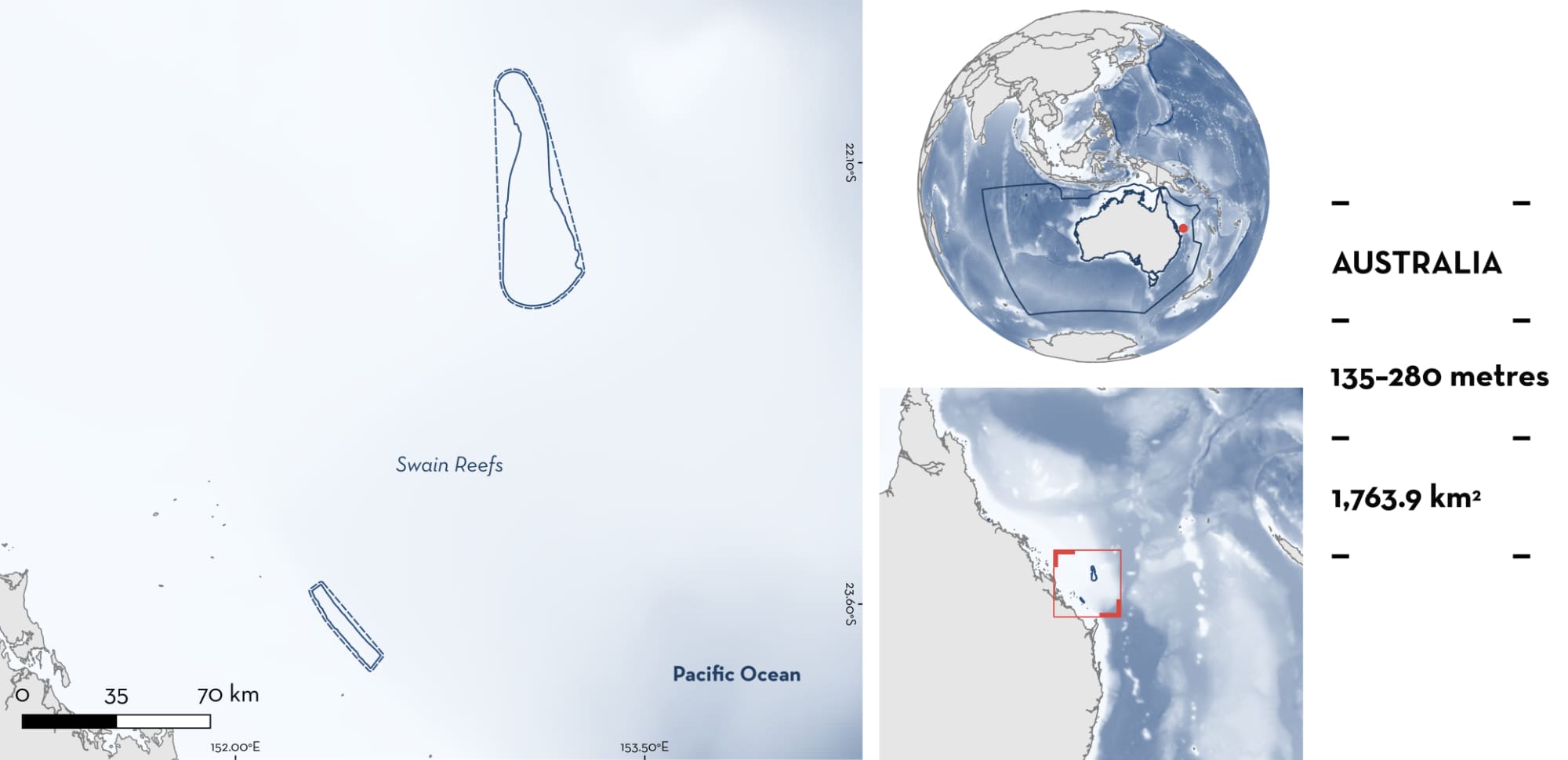
Swain Reefs
Summary
Swain Reefs is located off central Queensland, Australia. This split area is situated on the outer edge of the continental shelf on the southern Great Barrier Reef. It is characterised by hard coral and rocky formations beside a steep drop-off. The area is influenced by the southward-flowing East Australian Current with limited water exchange between adjacent locations. This area overlaps with the Swain Reefs National Park. Within this area there are: range-restricted species (e.g., Argus Skate Dentiraja polyommata).
Download factsheet
Swain Reefs
DESCRIPTION OF HABITAT
Swain Reefs is located off central Queensland, Australia. This split area is situated on the outer edge of the continental shelf on the southern Great Barrier Reef. The reef lies ~200 km off the coast of mainland Australia, and is characterised by a mosaic of small, flat-topped platforms beside a steep drop-off. The area is dominated by hard coral coverage, which creates various structures including caves, overhangs, terraces, and ledges (Marine Life Network 2025). The substrate is sandy (Marine Life Network 2025). It is separated from mainland Australia by the Capricorn Channel (Benthuysen et al. 2022).
The area is influenced by the southward-flowing East Australian Current. There is limited water exchange between this area and the adjacent Capricorn-Bunker Reefs (Benthuysen et al. 2022). Thus, the area may be more exposed to warming events due to a lack of respite from lower tidal mixing or subsurface upwelling (Benthuysen et al. 2022).
This area overlaps with the Swain Reefs National Park (QPWS 2024).
This Important Shark and Ray Area is benthic and subsurface and is delineated from 135 m to 280 m based on the global depth range of Qualifying Species.
CRITERION B
RANGE RESTRICTED
This area holds the regular presence of Pale Spotted Catshark and Argus Skate as resident range-restricted species.
Surveys of the incidental catch of two commercial prawn trawl fishing vessels were undertaken in June–July 2011 and March–April 2012 (Rigby et al. 2016b). In total, 211 otter trawl shots were observed from dusk until dawn between 117–280 m depth in this area and adjacent locations of the Great Barrier Reef. Each deepwater species captured was identified, sexed, and measured.
Pale Spotted Catsharks were regularly recorded in this area and were the third most abundant deepwater chondrichthyan species (n = 225, 14.7%) recorded from the trawl surveys in 2011–2012 (Rigby et al. 2016b). Pale Spotted Catsharks were caught between 174–280 m depth. Animals measured 14.1–43.6 cm total length (TL); some were neonate/young-of-the-year (YOY) but most were mature individuals. The published size-at-birth of this species is 19 cm TL (Ebert et al. 2021). The ratio of males (n = 110) to females (n = 115) was even (Rigby et al. 2016b). Females with egg cases in utero were collected in fairly even numbers in both years (n = 22 total), with most gravid females (n = 18, 81.8%) being caught between 203–280 m depth. Catches of this species were restricted to the eastern extremity of the sampled area, at the edge of the shelf, with clearly higher numbers than in adjacent areas within its restricted range to offshore Queensland (Rigby et al. 2016b). Additional temporal data are required to determine the seasonality of occurrence in this area.
Argus Skates were regularly recorded in this area and were the most abundant deepwater chondrichthyan species (n = 768, 50.1%) recorded from the trawl surveys in 2011–2012 (Rigby et al. 2016a, 2016b). Argus Skate were caught between 135–280 m depth. Argus Skate measured 9.5–37.1 cm TL; recorded individuals range from neonate/YOY to mature reproductively active females (based on the presence of gravid females). The size-at-birth of this species is 8.9–11.1 cm TL (Rigby et al. 2016b). Indications of reproductive condition in Argus Skate was highest in March–April (Rigby et al. 2016a). As the sampling period did not encompass the entire year, additional temporal data are required to determine the seasonality of the reproductive importance of this area for this species. The ratio of males (n = 369) to females (n = 371) was even (Rigby et al. 2016b). Catches of this species were clustered around this shelf area. Additional temporal data are required to determine the seasonality of occurrence in this area.
Pale Spotted Catshark and Argus Skate are restricted to the East-Central Australian Shelf Large Marine Ecosystem.
Download factsheet
SUBMIT A REQUEST
ISRA SPATIAL LAYER REQUEST
To make a request to download the ISRA Layer in either a GIS compatible Shapefile (.shp) or Google Earth compatible Keyhole Markup Language Zipped file (.kmz) please complete the following form. We will review your request and send the download details to you. We will endeavor to send you the requested files as soon as we can. However, please note that this is not an automated process, and before requests are responded to, they undergo internal review and authorization. As such, requests normally take 5–10 working days to process.
Should you have questions about the data or process, please do not hesitate to contact us.

