ISRA FACTSHEETS
ISRA FACTSHEETS
AUSTRALIA AND SOUTHEAST INDIAN OCEAN
Swan-Canning Estuary
Summary
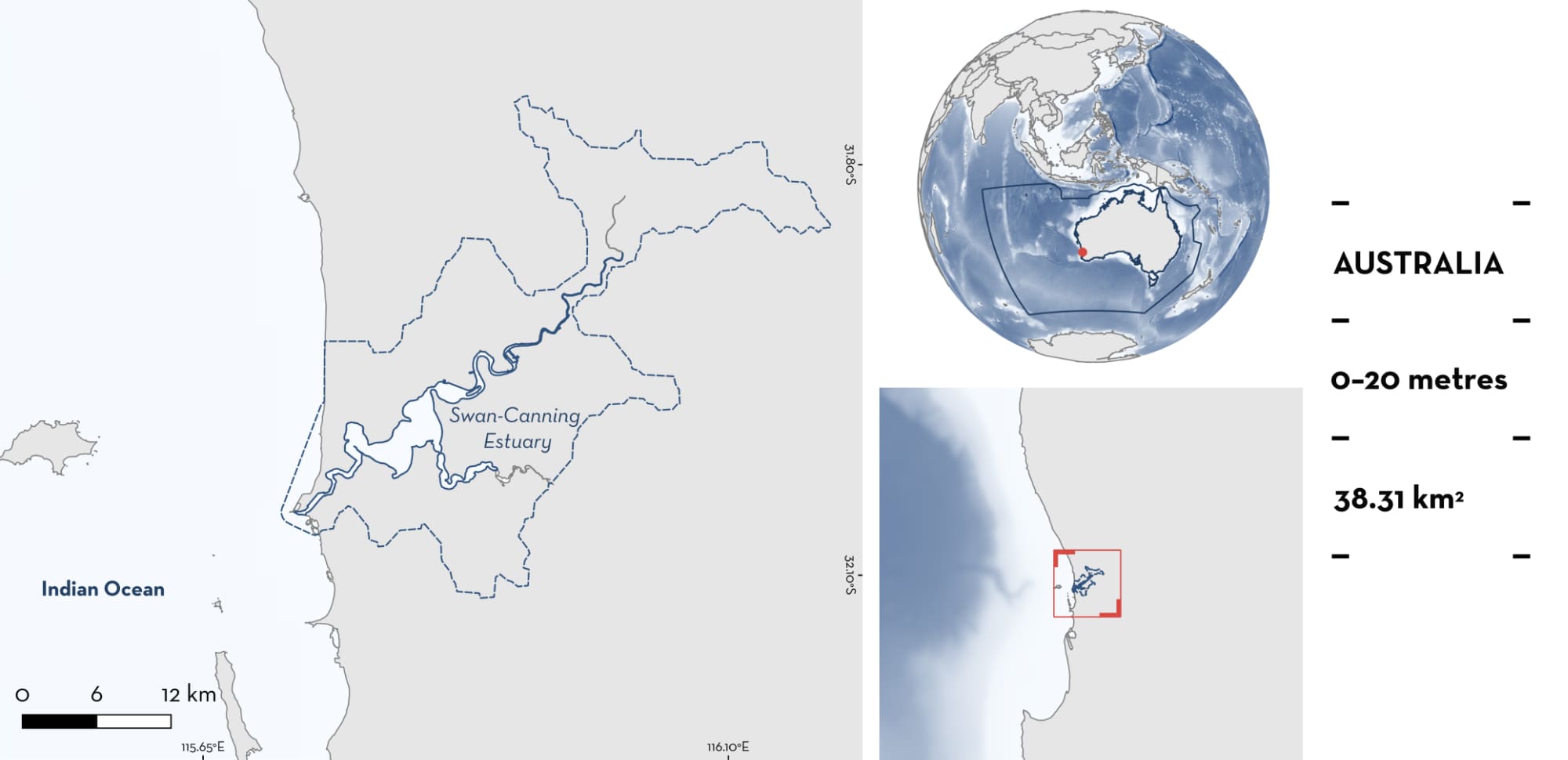
Swan-Canning Estuary is located in the city of Perth on the southwest coast of Western Australia, Australia. This estuary is permanently connected to the Indian Ocean via a narrow entrance channel and experiences highly seasonal freshwater flows and microtidal amplitudes. The area contains sandy–muddy substrates, sandflats, and seagrass beds. Within this area there are: threatened species (Bull Shark Carcharhinus leucas); reproductive areas (e.g., Southern Eagle Ray Myliobatis tenuicaudatus); and feeding areas (Southern Eagle Ray).
Download factsheet
Swan-Canning Estuary
DESCRIPTION OF HABITAT
Swan-Canning Estuary is located in the city of Perth on the southwest coast of Western Australia, Australia. This estuary is permanently connected to the Indian Ocean via a narrow entrance channel at the Port of Fremantle and extends ~50 km upstream (Taljaard 2024). This area encompasses Melville Water Basin, Perth Water Basin, and the saline reaches of the Canning River and Swan River. The Swan Estuary comprises four ecologically and morphologically distinct regions. The lower estuary includes a short (~7 km), narrow (~200 m), and deeper (>12 m) entrance channel, followed by a longer (~12 km), wider (1.5–2 km) central basin. The middle Swan Estuary is a narrow and shallow (<5 m) ~11 km stretch, while the upper estuary extends ~38 km upstream as a meandering, narrow, shallow (<5 m) section of the Swan River. The Canning Estuary consists of a similarly narrow, shallow, and meandering ~11 km stretch of the Canning River (Swan River Trust 2008). Swan-Canning Estuary contains sandy–muddy substrates, sandflats, woody debris, and ~6 km2 of seagrass meadows supporting a diverse benthic invertebrate community (Tweedley et al. 2023; Taljaard 2024; Stout 2025). It is recognised as a nursery for penaeid prawns, in particular for Western School Prawn Metapenaeus dalli and Western King Prawn Melicertus latisulcatus (Tweedley et al. 2017).
As southwest Australia experiences a Mediterranean climate, the Swan-Canning Estuary is influenced by warm, dry austral summers and wet winters with ~80% of the annual rainfall occurring between May–September (Hodgkin & Hesp 1998; Hallett et al. 2018). Due to the highly seasonal rainfall and microtidal amplitudes (tidal rage of ~0.6–0.8 m) present within the estuary, physico-chemical aspects of the water, in particular salinity and water temperature undergo seasonal changes (Tweedley et al. 2016). The average water temperature is higher in summer months (December–February) reaching a maximum of 25.2°C in February and declines during winter (June–August) to a minimum of 15.3°C in July (Taljaard 2024). Medium-high salinity levels are present in November (30.2 ppt) and increase sequentially to a maximum of 37.5 ppt in March, before declining to a minimum of 23.7 ppt in June (Taljaard 2024).
This Important Shark and Ray Area is benthic and pelagic and is delineated from inshore and surface waters (0 m) to 20 m based on the bathymetry of the area.
CRITERION A
VULNERABILITY
One Qualifying Species considered threatened with extinction according to the IUCN Red List of Threatened Species regularly occurs in the area. This is the Vulnerable Bull Shark (Rigby et al. 2021).
CRITERION C
SUB-CRITERION C1 – REPRODUCTIVE AREAS
Swan-Canning Estuary is an important reproductive area for one shark and one ray species.
Neonate and young-of-the-year (YOY) Bull Sharks occur regularly and predictably mostly in the middle and upper Swan Estuary, although they have been documented in the lower reaches and Canning Estuary. Fish communities within the deeper waters (>1.5 m) of Swan-Canning Estuary were sampled every summer (January/February) and autumn (April/May) between 2012 and 2025 (Department of Biodiversity, Conservation and Attractions [DBCA] unpubl. data 2012–2025). Sampling was conducted using 160 m long, sunken, multi-mesh gillnets, each consisting of eight 20 m-long panels with stretched mesh sizes between 35 and 127 mm. These were deployed parallel to the bank at a depth of 2–8 m (depending on the depth of water at each site) from a boat immediately before sunset and retrieved after three hours. From 2022, rod-and-line fishing was also employed as part of DBCA’s Bull Shark tagging program.
Between 2012–2025, 44 Bull Sharks were captured, mostly during summer (n = 38). Of these, 29 were captured between 2012–2022 and 15 between 2023–2025 (DBCA unpubl. data 2012–2025). Between 2012–2022, no size information was recorded from individuals captured, however, they were all visually estimated as <150 cm total length (TL) with ~80% (n = 23) <100 cm TL (J Tweedley pers. obs. 2012–2022). Of the 15 Bull Sharks captured in 2023–2025, all individuals were neonates or YOY (74–98 cm TL) (DBCA unpubl. data 2012–2025). Size-at-birth is 56–81 cm TL and size-at-maturity is 157–226 cm TL for males and 180–230 cm TL for females (Ebert et al. 2021), indicating they were all immature individuals, and that Swan-Canning Estuary is an important area for the early life stages of Bull Sharks. An additional two neonates (75–97 cm TL) were caught in other surveys (DBCA unpubl. data 2012–2025) and a carcass of a 72 cm TL neonate was also found in this area in 2023. Additionally, one aggregation of 11 juvenile Bull Sharks (~150 cm TL) was observed in September 2025 in the lower estuary (9 News 2025; J Watsham pers. obs. 2025).
Gillnetting was conducted at six sites to capture Southern Eagle Rays in the Swan-Canning Estuary monthly between November 2022 and October 2023 (Taljaard 2024). Each 160 m gillnet, negatively buoyant, was set from a boat parallel to shore at 2–6 m depth after sunset and retrieved after three hours. All Southern Eagle Rays were counted, sexed, and disc width (DW) was measured. Monthly, up to 15 individuals of various sizes and stages of maturity were randomly selected for reproductive, age-and-growth, and dietary analysis.
A total of 323 Southern Eagle Rays were caught in the area. Southern Eagle Rays were found in the estuary year-round (Taljaard 2024). On average, catches fluctuated from November–March, peaked in April, and declined by June. The increase in March–May reflected the abundance of newborn individuals. Male Southern Eagle Rays had an average size (± standard deviation) of 55.0 ± 1.3 cm DW (range = 23.5–81.6 cm DW) and females of 61.2 ± 2.1 cm DW (range = 24.3–118.1 cm DW). Two main size cohorts were identified in the male population, at 30 cm and 55–65 cm DW, and two main cohorts in the female population at 25 and 60 cm DW. A female cohort at 80–95 cm DW was also recorded. Neonates (individuals <30 cm DW; n = 30) were found within the estuary every month except January and September. This species has a size-at-birth of 20–30 cm DW (Last et al. 2016). The age of Southern Eagle Rays caught in this area ranged between 0.1–15.9 years (females, 0.1–15.9 years; males, 0.3–9.9 years). A total of 20 of the 27 mature females examined were pregnant (due to the presence of eggs and embryos, at different development levels) and these were recorded in all months, except March. Gonadosomatic indices peaked in the summer for females and in spring for males, indicating breeding occurs in spring and females give birth during summer (Taljaard 2024). Additionally, Southern Eagle Rays are one of the most commonly caught species by the regular fishery-independent scientific monitoring program in this area over multiple years, highlighting the importance of the area for this species (DBCA unpubl. data 2012–2025).
CRITERION C
SUB-CRITERION C2 – FEEDING AREAS
Swan-Canning Estuary is an important feeding area for one ray species.
Between November 2022 and October 2023, the stomachs of 133 Southern Eagle Rays caught in gillnetting surveys within Swan-Canning Estuary were examined, with 107 (80%) found to contain prey items (Taljaard 2024). Southern Eagle Rays are durophagous (i.e., behaviour that involves consuming or crushing hard-shelled or hard-bodied prey) generalist mesopredators feeding predominantly on polychaetes, crustaceans (mainly prawns and brachyurans), and molluscs (Trayler et al. 2024). Frequency of occurrence of each prey item also document similar trends, with crustaceans present in over 41% of samples. Molluscs were found in more stomachs than polychaetes (20% and 18%, respectively), despite polychaetes maintaining a higher percentage volume. Polychaetes dominated the diet in spring, while more prawns were consumed in summer and autumn when Western School Prawn move into shallow estuarine waters. When comparing the dietary composition of Southern Eagle Rays in this area with other marine locations of southwest Australia, this area had diets with the highest volume of penaeid prawns recorded for the species (Taljaard 2024). Western School Prawn is found along the Western Australian coastline from Cape Naturaliste in the south to Darwin (Northern Territory) in the north but at the southern limit of its distribution (i.e. south of ∼31°S), it is found only in estuaries (Poh et al. 2019). This suggests that Southern Eagle Rays use this area for specialised feeding on seasonally dense concentrations of prey easily accessible in shallow sandy–muddy habitat
Download factsheet
SUBMIT A REQUEST
ISRA SPATIAL LAYER REQUEST
To make a request to download the ISRA Layer in either a GIS compatible Shapefile (.shp) or Google Earth compatible Keyhole Markup Language Zipped file (.kmz) please complete the following form. We will review your request and send the download details to you. We will endeavor to send you the requested files as soon as we can. However, please note that this is not an automated process, and before requests are responded to, they undergo internal review and authorization. As such, requests normally take 5–10 working days to process.
Should you have questions about the data or process, please do not hesitate to contact us.