
ISRA FACTSHEETS
ISRA FACTSHEETS
EUROPEAN ATLANTIC
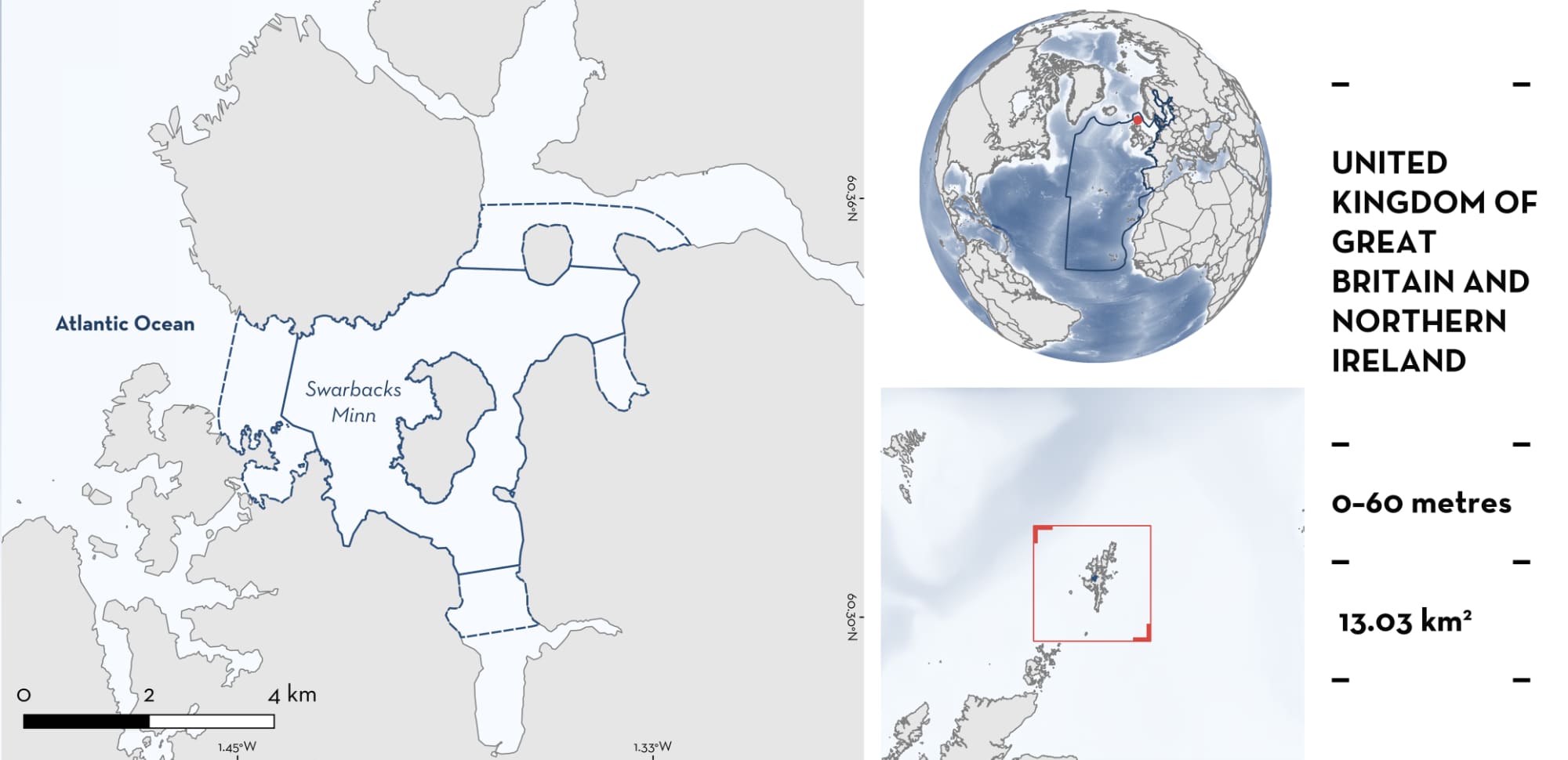
Swarbacks Minn
Summary
Swarbacks Minn is located in the Shetland Islands of Scotland, in the United Kingdom of Great Britain and Northern Ireland. The area is situated to the southeast of St Magnus Bay. It is characterised by the central Swarbacks Minn Channel which branches into a complex area of inlets (known locally as ‘voes’), islands, and sounds. The sublittoral seabed is mostly composed of fine mud, muddy sand, and mixed sediments which are fringed by bedrock and boulders along the shore. Within this area there are reproductive areas (Thornback Skate Raja clavata).
Download factsheet
Swarbacks Minn
DESCRIPTION OF HABITAT
Swarbacks Minn is located in the Shetland Islands of Scotland, in the United Kingdom of Great Britain and Northern Ireland. The area is situated to the southeast of St Magnus Bay. It is characterised by the central Swarbacks Minn Channel which branches into a complex area of inlets (known locally as ‘voes’), islands, and sounds which altogether form the Swarbacks Minn ‘complex’ or ‘system’ (Pugh et al. 2020).
The broader Swarbacks Minn system is relatively deep (>100 m) in the context of the nearshore environment of the Shetland Islands, with the Aith Voe reported to be the deepest in Shetland. Most of the area is sheltered from the influence of wave action and tidal currents (Thomason & Fraser 2025). The sublittoral seabed is mostly composed of fine mud, muddy sand, and mixed sediments which are fringed by bedrock and boulders along the shore.
This Important Shark and Ray Area is benthic and pelagic and is delineated from inshore and surface waters (0 m) to 60 m based on the bathymetry of the area.
CRITERION C
SUB-CRITERION C1 – REPRODUCTIVE AREAS
Swarbacks Minn is an important reproductive area for one ray species.
Between 2017–2024, data were collected annually (August–September) from Shetland Inshore Fish Survey (SIFS) (McAllister et al. 2024). Surveys were carried out at pre-defined scientific trawl stations and comprised two types: ‘shallow’ (20–50 m) and ‘inshore’ (50–150 m). Neonate Thornback Skates (age-0) were assigned a length threshold of <23 cm total length (TL) (Carbonara et al. 2020), young-of-the-year (YOY; age-1) a length threshold of <30 cm TL (Whittamore & McCarthy 2005; Carbonara et al. 2020), and juveniles a length threshold of <60 cm TL (McCully et al. 2012; Ebert & Stehmann 2013; McAllister et al. 2024). Two key areas emerged as persistent hotspots with the highest relative abundances: Swarbacks Minn and Lunna Sound. Swarbacks Minn consistently recorded higher numbers of young age classes of this species. The area encompasses two of the survey stations with the highest proportions of juveniles in the Shetland Islands: Cole Deep and Skeetlie (McAllister et al. 2024). A study from across the British Isles has confirmed young skates prefer inshore and shallow waters (Ellis et al. 2024), supporting the importance of this habitat for young age classes of this species.
Shallow tows were characterised by small length classes of Thornback Skates (<60 cm TL), with evidence of consistent immature age classes using this habitat over time (McAllister et al. 2024; M McAllister unpubl. data 2025). A total of 16 adults (>60 cm TL) and 118 immature individuals were observed in Swarbacks Minn during the survey period, with Thornback Skates present in every survey year. The surveys did not look for evidence of pregnancies when recording size measurements (M McAllister pers. obs. 2025). Of the immature individuals recorded, 13 were YOY (11%) and four were neonates (3.4%; 2018, n = 2; 2019, n = 2). In general, there are few field data available on the distribution of females with egg cases in the United Kingdom, and there are also few data on the distribution of in situ egg cases (Ellis et al. 2012). Although there has been insufficient data to delineate spawning grounds for this species based on the occurrence of egg cases or egg bearing females during the spawning season, it is assumed these areas should broadly overlap with nursery grounds for immature individuals (Ellis et al. 2012).
These surveys provide a seasonal snapshot (August–September) of the distribution of young age classes of this species. However, it is important to consider the mismatch between the survey period and the species’ reproductive cycle. In the United Kingdom, this species is known to aggregate and move into shallower waters for mating and egg-laying purposes, with the peak spawning for Thornback Skates suggested to occur in June, with hatching peaking around November (Holden 1975; Serra-Pereira et al. 2011). The annual SIFS surveys likely occur prior to hatching, missing much of the immediate post-hatch neonate phase. As a result, individuals hatched in November will have several months to grow and may exceed 23 cm TL in length before being sampled in the following year’s survey, likely contributing to the modest numbers of observed neonates. Additionally, due to sampling methods, egg cases are less likely to be encountered due to factors like mesh size and habitat type (M McAllister pers. obs 2025). It is entirely possible that egg cases are laid in shallower, rocky areas that are inaccessible due to gear limitations, but which are included in the boundaries of the area (M McAllister pers. obs. 2025).
Download factsheet
SUBMIT A REQUEST
ISRA SPATIAL LAYER REQUEST
To make a request to download the ISRA Layer in either a GIS compatible Shapefile (.shp) or Google Earth compatible Keyhole Markup Language Zipped file (.kmz) please complete the following form. We will review your request and send the download details to you. We will endeavor to send you the requested files as soon as we can. However, please note that this is not an automated process, and before requests are responded to, they undergo internal review and authorization. As such, requests normally take 5–10 working days to process.
Should you have questions about the data or process, please do not hesitate to contact us.

