ISRA FACTSHEETS
ISRA FACTSHEETS
ASIA REGION
Tubbataha Reefs
Summary
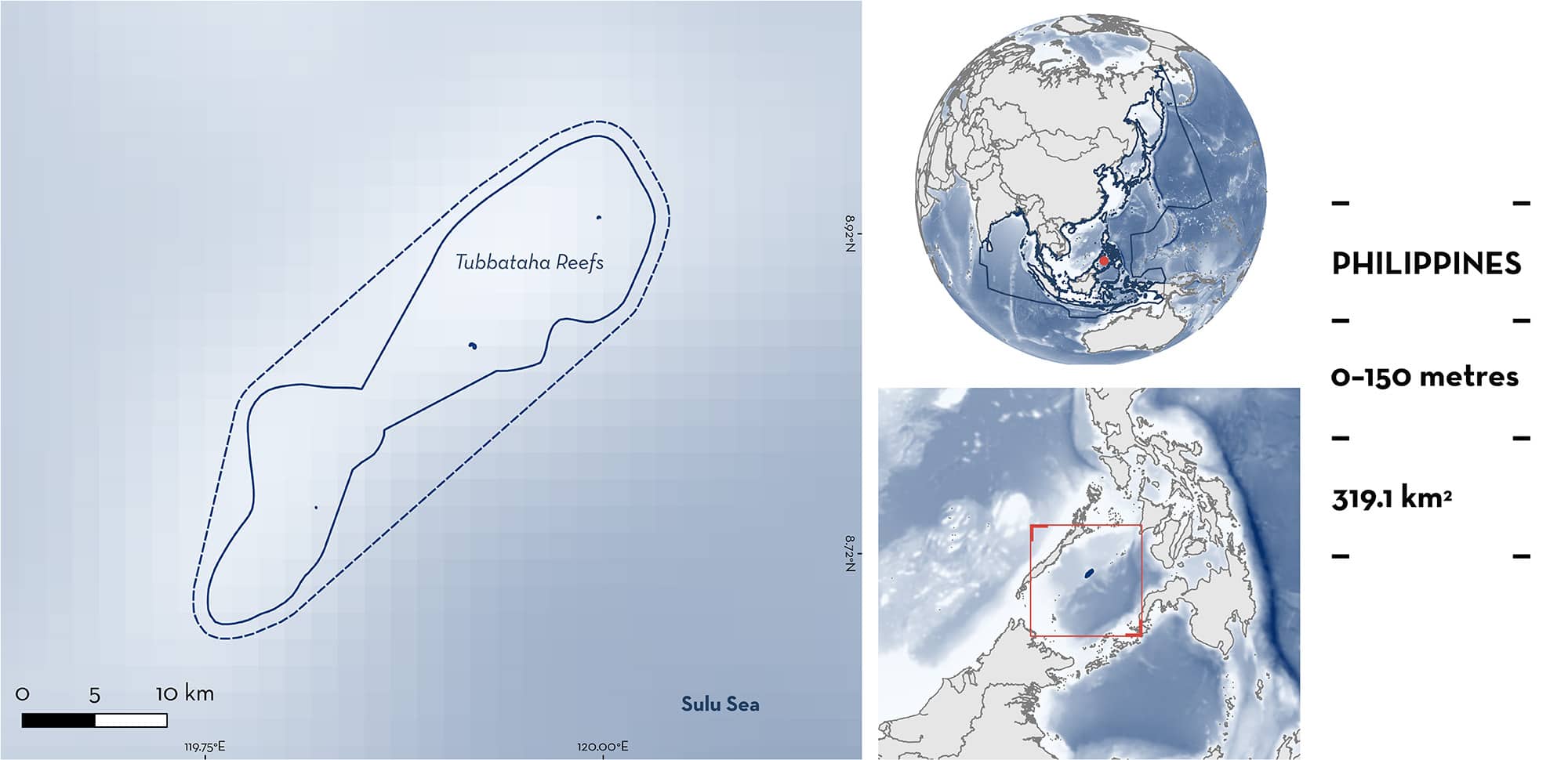
Tubbataha Reefs is located in the middle of the Sulu Sea, in the western Philippines. This area is one of the few coral atolls in the Philippines, and within the Sulu Sea it represents one of the few pristine locations. The area consists of two large atolls, separated by an 8 km channel. Both atolls are characterised by shallow fringing reefs (<15 m deep) and steep reef walls. It sits within the Sulu-Sulawesi Marine Ecoregion Ecologically or Biologically Significant Marine Area, and partly overlaps with Tubbataha Reef National Marine Park Key Biodiversity Area. Within this area there are: threatened species (e.g., Whitetip Reef Shark Triaenodon obesus); and undefined aggregations (e.g., Grey Reef Shark Carcharhinus amblyrhynchos).
Download factsheet
Tubbataha Reefs
DESCRIPTION OF HABITAT
Tubbataha Reefs is located in the middle of the Sulu Sea, ~170 km southeast of Puerto Princesa City, Palawan, and ~100 km south of Cavili Island, Cagayancillo, which is the closest human settlement. The area sits atop the middle of Cagayan Ridge which spans the centre of the Sulu Sea longitudinally. This area is one of the few coral atolls in the Philippines (Claudino-Sales 2019). Within the Sulu Sea, this area represents one of the few pristine locations with live coral cover exceeding 75% (CBD 2024).
This area consists of two large atolls, the north atoll and south atoll (Claudino-Sales 2019). The north atoll is ~ 16.8 km in length and 6.6 km in width at its widest point, whereas the south atoll is smaller at ~ 8.5 km in length and 3.9 km at its widest point (Murray et al. 2019). The north and south atolls are separated by an 8 km channel where depths exceed 1,600 m. Both atolls are characterised by shallow fringing reefs (<15 m deep) and steep reef walls extending to a slope that, from 60 to 120 m, rapidly descends to (###gt(###1,000 m (Gordon et al. 2011). The north and south atolls contain lagoons. The dominant habitats located in this area are coral reefs (~ 100 km2) with scattered seagrass beds.
The Sulu Sea has a tropical monsoon climate with only two seasons each year: the dry (boreal winter) season that prevails from November to April, and the rainy (summer) season, extending from May to October (Wang et al. 2006). The surface wind of the Sulu Sea is strongly influenced by the East Asian Monsoon System: northeasterly in winter, southwesterly in summer, and highly variable during the transitional periods (Wyrtki 1961). Vertical upwelling and cold nutrient-rich waters are caused by the northeast winds (winter season) increasing marine productivity and causing phytoplankton blooms (Wang et al. 2006).
This area sits within the Sulu-Sulawesi Marine Ecoregion Ecologically or Biologically Significant Marine Area (EBSA; CBD 2024), partially overlaps with the Tubbataha Reef National Marine Park Key Biodiversity Area (KBA 2024), and overlaps with the Tubbataha Reefs Natural Park.
This Important Shark and Ray Area is benthopelagic and is delineated from surface waters (0 m) to 150 m based on the depth range of the Qualifying Species in the area.
CRITERION A
VULNERABILITY
Two Qualifying Species considered threatened with extinction according to the IUCN Red List of Threatened Species regularly occur in the area. These are the Endangered Grey Reef Shark (Simpfendorfer et al. 2020a) and the Vulnerable Whitetip Reef Shark (Simpfendorfer et al. 2020b).
CRITERION C
SUB-CRITERION C5 – UNDEFINED AGGREGATIONS
Tubbataha Reefs is an important undefined aggregation area for two shark species.
Between March–June 2015 (n = 47) and April–June 2016 (n = 66), 113 Baited Remote Underwater Video Surveys (BRUVS) were undertaken in this area (Murray et al. 2019; R Murray unpubl. data 2023). BRUVS were deployed 500 m apart from each other and were left to record for 1–4.5 hours. Surveys were carried out in shallow (3–30 m) and deep reef habitats (40–100 m). For each species, cumulative Max N (i.e., maximum number of individuals appearing in a video frame at the same time). MaxN values were divided by survey length to generate catch-per-unit-effort (CPUE) metrics (sharks/hour).
Underwater Visual Census (UVC; n = 20) were also undertaken in May 2015 (n = 10) and June 2016 (n = 10) covering an area of 0.2067 km2 in 2015 and 0.2238 km2 in 2016 (Murray et al. 2019). The survey began when the SCUBA divers, experienced in shark and ray identification, reached a depth of 15 m, whereby the two observers, located on each side of the scribe, swam for 40 min, 5 m from the substrate, surveying a transect strip 30 m wide (15 m on either side of the scribe). Sharks that exited and re-entered the survey area were omitted from the count to avoid repeated encounters. Overall, Tubbataha Reefs had the highest CPUEs compared to seven other study sites in the Philippines (R Murray unpubl. data 2023).
For Whitetip Reef Sharks, BRUVS results showed that Whitetip Reef Sharks form large aggregations (R Murray unpubl. data 2023). Sharks were present in 71.7% of surveys with an overall CPUE of 0.87 (± 0.84) sharks/hour (Murray et al. 2019). The UVC results showed that this species was the most abundant in this area, among the eight species of sharks recorded, with an average density of 3.66 ± 2.14 individuals/hectare (Murray et al. 2019). No significant difference in abundance was detected between years (Murray et al. 2019).
For Grey Reef Sharks, BRUVS results showed that this shark was the most abundant species, among the fourteen species of sharks recorded. Grey Reef Sharks formed large aggregations (R Murray unpubl. data 2023) and were present in 54.8% of surveys, with an overall CPUE of 0.91 ± 1.64 sharks/hour (Murray et al. 2019). The UVC results showed that this species had an average density of 3.34 ± 2.9 individuals/hectare (Murray et al. 2019). No significant difference in abundance was detected between years (Murray et al. 2019).
Both survey methods reported one of the highest densities of Grey Reef Sharks and Whitetip Reef Sharks documented in the Philippines year-around (Murray et al. 2019). Due to the life-history of both species and the isolated and healthy condition of this area, sharks are most probably feeding and resting in this area. This is further supported by a preliminary analysis of acoustic data from 17 tagged Grey Reef Sharks in this area which showed high residency and no confirmed movements of tagged sharks outside of the park (e.g., these sharks were not detected on acoustic receivers at Cagayancillo, Cavili, and Arena Islands – the closest islands in the region) (LAMAVE unpubl. data 2024).
Liveaboards that frequently come to this location have been reporting these aggregations regularly and predictably, as these species are a main attraction for recreational divers. Other previous studies have also recorded high densities for Grey Reef Sharks and Whitetip Reef Sharks (Walker & Palomar-Abesamis 2005; Alava 2010). A mean density of 5.5 Whitetip Reef Sharks/hectare with densities reaching as 13 individuals/hectare in some areas (WD Robbins unpubl. data 2008).
Further information is needed to understand the nature and function of these aggregations.
Download factsheet
SUBMIT A REQUEST
ISRA SPATIAL LAYER REQUEST
To make a request to download the ISRA Layer in either a GIS compatible Shapefile (.shp) or Google Earth compatible Keyhole Markup Language Zipped file (.kmz) please complete the following form. We will review your request and send the download details to you. We will endeavor to send you the requested files as soon as we can. However, please note that this is not an automated process, and before requests are responded to, they undergo internal review and authorization. As such, requests normally take 5–10 working days to process.
Should you have questions about the data or process, please do not hesitate to contact us.