ISRA FACTSHEETS
ISRA FACTSHEETS
AUSTRALIA AND SOUTHEAST INDIAN OCEAN
Upper Gulf St Vincent
Summary
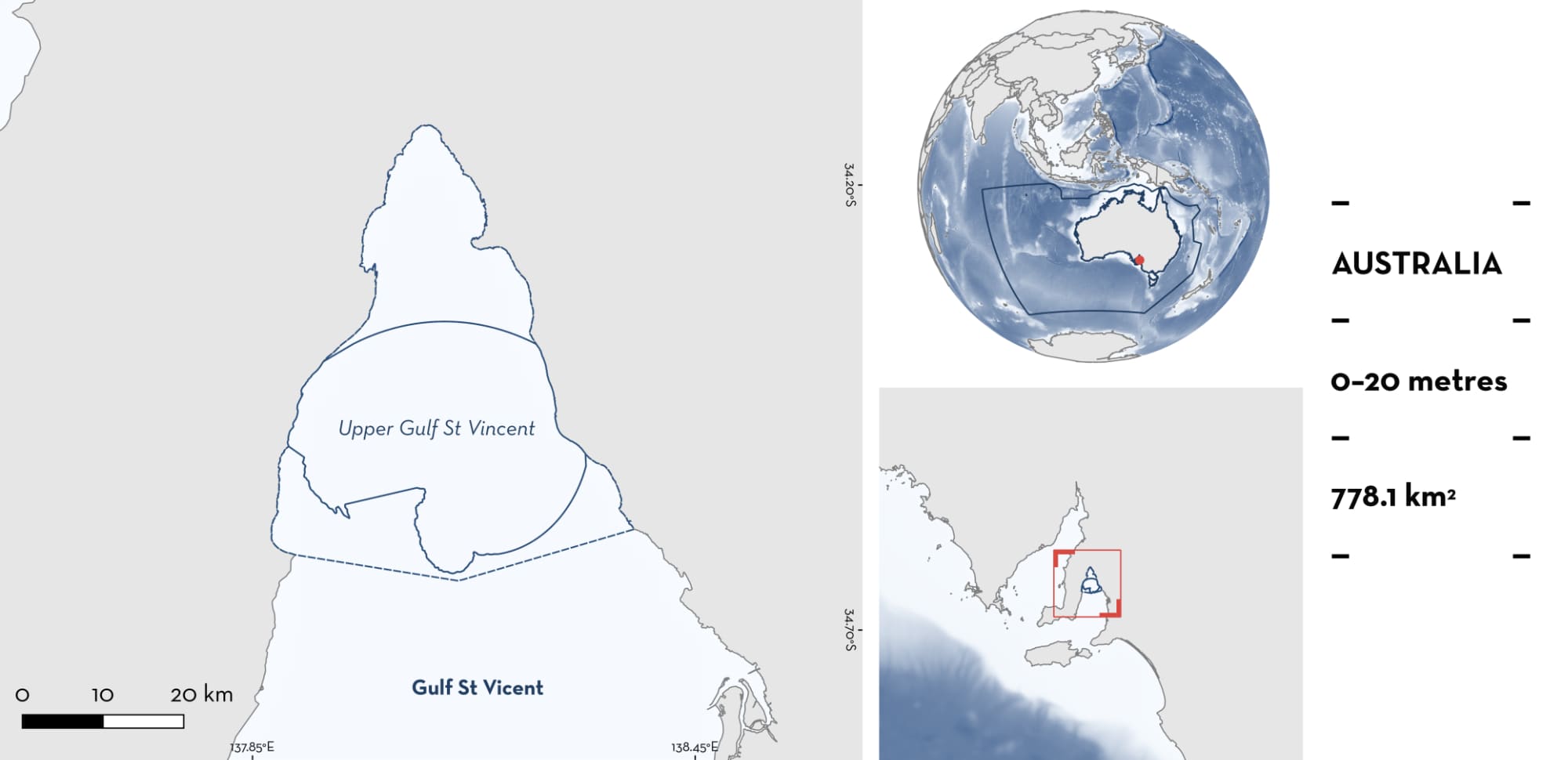
Upper Gulf St Vincent is located in the northern Gulf St Vincent, South Australia, Australia. The habitat is characterised by dense seagrass habitats (Posidonia, Zostera, and Amphibolis spp.) and silty substrates. It is influenced by an inverse estuarine system with sea surface temperature ranging 11–24°C from August to March. The area overlaps with the Upper Gulf St Vincent Marine Park. Within this area there are: threatened species and reproductive areas (Copper Shark Carcharhinus brachyurus).
Download factsheet
Upper Gulf St Vincent
DESCRIPTION OF HABITAT
Upper Gulf St Vincent is located in South Australia, Australia. It is found in the northernmost part of the Gulf St Vincent. The area is shallow and is characterised by the presence of dense seagrass (Posidonia, Zostera, and Amphibolis spp.) habitats and silty substrates (Edyvane 1999).
The area is influenced by the dynamics of the Gulf St Vincent, which is a shallow gulf environment (maximum depth ~40 m) that supports an abundance of tidal wetlands, seagrass meadows, mangroves, rocky reefs, and saltmarshes (Edyvane 1999). This is an inverse estuary system, with salinity increasing with distance from the open ocean because of the evaporative processes occurring at the top of the gulf (Bye 1976). Water is transported into the gulf via Investigator Strait and Backstairs Passage, but Kangaroo Island blocks most of the gulf mouth from the open ocean, limiting water exchange and sheltering the gulf from high wave energy (Tanner 2002). At Upper Gulf St Vincent, the sea surface temperature ranges 11–24°C from August to March (Drew et al. 2019).
The area overlaps with the Upper Gulf St Vincent Marine Park (NPWS SA 2025).
This Important Shark and Ray Area is benthic and pelagic and is delineated from inshore and surface waters (0 m) to 20 m based on the bathymetry of the area.
CRITERION A
VULNERABILITY
One Qualifying Species considered threatened with extinction according to the IUCN Red List of Threatened Species regularly occurs in the area. This is the Vulnerable Copper Shark (Huveneers et al. 2020).
CRITERION C
SUB-CRITERION C1 – REPRODUCTIVE AREAS
Upper Gulf St Vincent is an important reproductive area for one shark species.
Neonate and young-of-the-year (YOY) Copper Sharks have been regularly recorded from commercial fisheries and fishing surveys in the area (Drew et al. 2017, 2019; Izzo et al. 2016). Historically, one late term pregnant female was caught in the area in January 2009 during the reported pupping season between November–February (Rogers et al. 2013; Drew et al. 2017). Upper Gulf St Vincent is the only known area in South Australia (along with Spencer Gulf) where neonate/YOY Copper Sharks have been regularly recorded in contemporary years. Between September–May 2011–2013, 60 Copper Sharks measuring 73–179 cm total length (TL) were sampled to collect vertebrae for elemental analysis (Izzo et al. 2016). Of these, 27 (45%) were neonate/YOY measuring <100 cm TL (Izzo et al. 2016). The reported size-at-birth of this species is 59–70 cm TL (Ebert et al. 2021) and the YOY size reported for the region is ~100 cm TL (Drew et al. 2017). In addition, 16 (28.3%) were small juveniles measuring <110 cm TL.
Between 2009–2014, 56 Copper Sharks were tagged with acoustic tags and were monitored on an acoustic array (n = 77 receivers) deployed in the area and in the adjacent Adelaide metropolitan area and Aldinga Reef (Drew et al. 2019). Of these individuals, 28 (50%) were classified as neonate/YOY measuring <100 cm TL. Furthermore, 11 (32.9%) Copper Sharks were small juveniles measuring <150 cm TL. Only 47 individuals provided enough tracking data to explore residency patterns with monitoring time ranging between 516–1,434 days. Most of the individuals (n = 36, 76.6%) were detected in multiple years with 36% detected over 3–4 years. Residency was higher for smaller individuals showing that this area is used mostly by early life-stages with detections peaking between September–April when bottom temperatures are the highest in the area (~24°C). Tagged individuals were detected mostly in the area (83% of the detections) around dense seagrass patches with few detections outside the area around less dense seagrass and reef habitats (Drew et al. 2019).
Download factsheet
SUBMIT A REQUEST
ISRA SPATIAL LAYER REQUEST
To make a request to download the ISRA Layer in either a GIS compatible Shapefile (.shp) or Google Earth compatible Keyhole Markup Language Zipped file (.kmz) please complete the following form. We will review your request and send the download details to you. We will endeavor to send you the requested files as soon as we can. However, please note that this is not an automated process, and before requests are responded to, they undergo internal review and authorization. As such, requests normally take 5–10 working days to process.
Should you have questions about the data or process, please do not hesitate to contact us.