
ISRA FACTSHEETS
ISRA FACTSHEETS
NEW ZEALAND & PACIFIC ISLANDS REGION
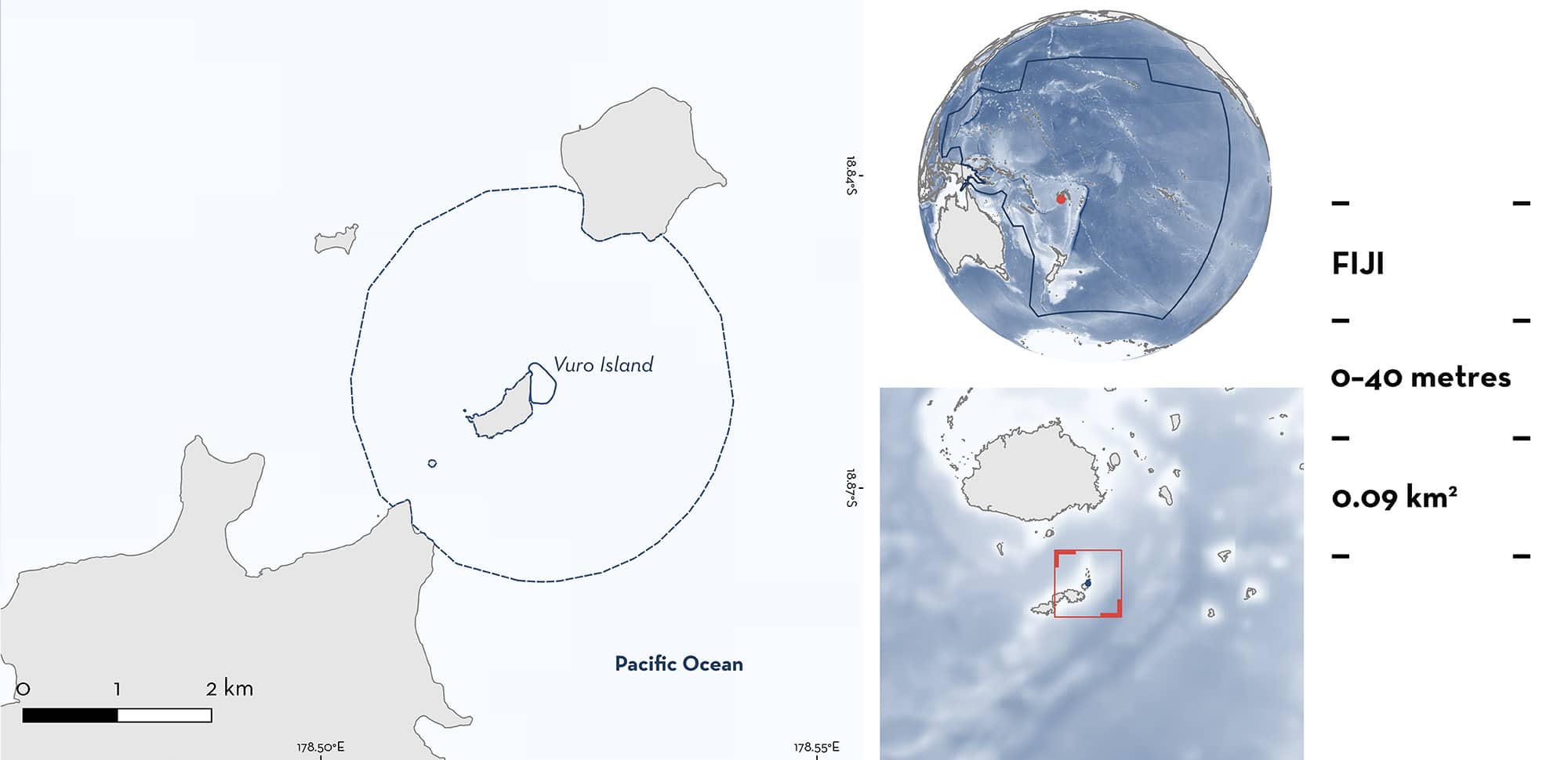
Vuro Island
Summary
Vuro Island is located in the northern region of Kadavu Province in Fiji. It is a small island surrounded by a shallow sloping fringing reef that lies within a large, sheltered lagoon created by the Great Astrolabe Reef system. The area overlaps with the Kadavu and the Southern Lau Region Ecologically or Biologically Significant Marine Area. Within this area there are: threatened species and undefined aggregations (Reef Manta Ray Mobula alfredi).
Download factsheet
Vuro Island
DESCRIPTION OF HABITAT
Vuro Island is located in the north Kadavu region of Fiji. It is situated off a small island on the northeastern tip of Ono Island. The island is surrounded by a shallow fringing coral reef that slopes to ~25 m (Gordon et al. 2023). A sandy slope extends from 25 m and flattens at ~40 m depth (L Gordon pers. obs. 2023). Three coral bommies are the main cleaning stations in the area, including one off the reef crest in shallow water and two at the bottom of the reef slope at ~20 m depth. The island is sheltered inside a large lagoon (~10 by 30 km) enclosed by the Great Astrolabe Reef, meaning the area experiences limited swell and currents.
The area overlaps with the Kadavu and the Southern Lau Region Ecologically or Biologically Significant Marine Area (EBSA; CBD 2024).
This Important Shark and Ray Area is benthopelagic and is delineated from surface waters (0 m) to 40 m based on the bathymetry of the area.
CRITERION A
VULNERABILITY
One Qualifying Species considered threatened with extinction according to the IUCN Red List of Threatened Species regularly occurs in the area. This is the Vulnerable Reef Manta Ray (Marshall et al. 2022).
CRITERION C
SUB-CRITERION C5 – UNDEFINED AGGREGATIONS
Vuro Island is an important area for undefined aggregations of one ray species.
Large groups of Reef Manta Rays regularly visit cleaning stations in this area (Gordon et al. 2023; Manta Project Fiji unpubl. data 2024). Between 2019–2024, 441 snorkel surveys were conducted in the area, with most surveys between April–November. Surveys recorded 2,161 Reef Manta Ray sightings of 131 individuals identified using photo-identification (Gordon et al. 2023; Manta Project Fiji unpubl. data 2024). Reef Manta Rays aggregate in the area to visit specific reef sections for cleaning services offered by small reef fishes. This is a mutualistic symbiosis in which the fishes remove parasites and dead tissue from the Reef Manta Rays (Armstrong et al. 2021). Vuro Island is home to four main cleaner fish species which are responsible for providing cleaning services to Reef Manta Rays: Bluestreak Cleaner Wrasse Labroides dimidiatus, Bicolor Cleaner Wrasse Labroides bicolor, Moon Wrasse Thalassoma lunare, and Blunthead Wrasse Thalassoma amblycephalum (L Gordon pers. obs. 2024). Aggregations of up to 47 Reef Manta Rays (mean = 6 individuals) use cleaning stations in this area (Manta Project Fiji unpubl. data 2024). Of the 404 surveys conducted between 2020–2023, at least one Reef Manta Ray was sighted being cleaned on 392 (97%) of surveys. Reef Manta Rays have been recorded being cleaned year-round, with sightings peaking between May–October. They display high site fidelity, with 87% of individuals resighted in more than one year and 68% seen in more than two years (Gordon et al. 2023; Manta Project Fiji unpubl. data 2024). Courtship and pregnant females are observed in this area (L Gordon pers. obs. 2024), suggesting that Vuro Island may also be important for reproduction, but additional information is required to examine this further.
In addition to snorkel surveys, 36 acoustic tags were deployed on Reef Manta Rays in the area with a receiver placed near the cleaning stations between August 2019 and November 2021. The receiver at Vuro Island recorded most detections among the 15 receivers in the region, with ~119,000 detections of 32 tagged individuals (Manta Project Fiji unpubl. data 2019–2021), indicating that this area is regularly used by Reef Manta Rays. It is well documented that Reef Manta Rays demonstrate site affinity to cleaning stations in other locations such as Maldives (Stevens 2016) and Indonesia (Germanov et al. 2019), and that cleaning interactions dominate habitat use at cleaning stations (Armstrong et al. 2021). It is likely that most acoustic detections at this site are indicative of cleaning habitat use.
Download factsheet
SUBMIT A REQUEST
ISRA SPATIAL LAYER REQUEST
To make a request to download the ISRA Layer in either a GIS compatible Shapefile (.shp) or Google Earth compatible Keyhole Markup Language Zipped file (.kmz) please complete the following form. We will review your request and send the download details to you. We will endeavor to send you the requested files as soon as we can. However, please note that this is not an automated process, and before requests are responded to, they undergo internal review and authorization. As such, requests normally take 5–10 working days to process.
Should you have questions about the data or process, please do not hesitate to contact us.

