ISRA FACTSHEETS
ISRA FACTSHEETS
EUROPEAN ATLANTIC
Wembury Bay
Summary
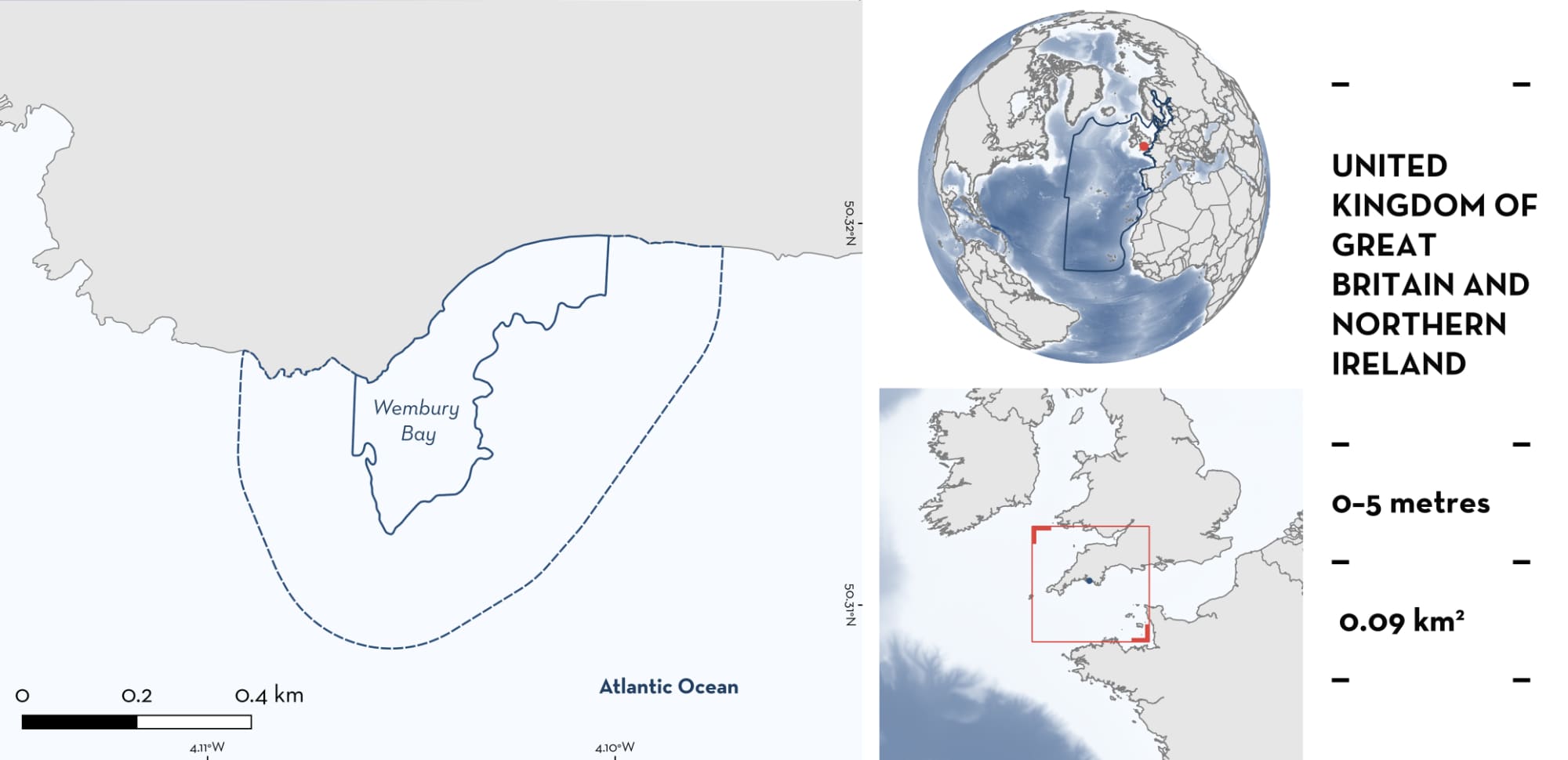
Wembury Bay is located in Devon on the southwestern coast of England, United Kingdom of Great Britain and Northern Ireland. The area is a shallow, sheltered, intertidal gully characterised by rocky, sandy, and shingle substrates. This area is influenced by freshwater input from the River Yealm. Within the area there are: threatened species and reproductive areas (Nursehound Scyliorhinus stellaris).
Download factsheet
Wembury Bay
DESCRIPTION OF HABITAT
Wembury Bay is located in Devon on the southwestern coast of England, United Kingdom of Great Britain and Northern Ireland. This is a shallow area with a maximum depth of ~1.5 m at low tide. It is a sheltered and intertidal gully (Wembury Marine Centre 2025) characterised by rocky, sandy, and shingle substrates (J Hepburn pers. obs. 2025), and smooth sloping bedrock (Noël et al. 2009). It is influenced by freshwater input from the nearby River Yealm.
This Important Shark and Ray Area is benthic and is delineated from inshore and surface waters (0 m) to 5 m based on observations of the Qualifying Species.
CRITERION A
VULNERABILITY
One Qualifying Species considered threatened with extinction according to the IUCN Red List of Threatened Species regularly occurs in the area. This is the Vulnerable Nursehound (Finucci et al. 2021).
CRITERION C
SUB-CRITERION C1 – REPRODUCTIVE AREAS
Wembury Bay is an important reproductive area for one shark species.
In situ egg cases of Nursehound are regularly and predictably reported from this area during citizen science snorkel surveys (two per month, year-round, when possible) between 2014–2024 (Shark Trust unpubl. data. 2025). Egg case identification is confirmed through species-specific guides (Shark Trust unpubl. data. 2025). Overall, from the 2,241 observations made from this area, 519 egg cases were reported – egg cases are tagged to track development across multiple years, therefore a single egg case can be observed multiple times across the period. Observations of egg cases were recorded in 2014 (n = 170 observations; n = 83 egg cases), 2015 (n = 312; n = 73 egg cases), 2016 (n = 221; n = 42 egg cases), 2017 (n = 120; n = 32 egg cases), 2018 (n = 163; n = 34 egg cases), 2019 (n = 297; n = 54 egg cases), 2020 (n = 285; n = 63 egg cases), 2021 (n = 265; n = 50 egg cases), 2022 (n = 143; n = 38 egg cases), 2023 (n = 131; n = 24 egg cases), and 2024 (n = 134; n = 26 egg cases). On average, 26 Nursehound egg cases are reported each year in this area. Egg cases are laid and hatch year-round, as reported by the resident citizen scientist who surveys this area (Shark Trust unpubl. data. 2025). Between 2014–2024, 346 egg cases were laid and observed in 2014 (n = 83 egg cases), 2015 (n = 36), 2016 (n = 24), 2017 (n = 16), 2018 (n = 26), 2019 (n = 37), 2020 (n = 43), 2021 (n = 29), 2022 (n = 21), 2023 (n = 15), and 2024 (n = 16). In total, 176 egg cases reported from this area have been confirmed as hatched. These observations are associated with the rocky reef that characterises this area. There are anecdotal reports of Nursehound egg cases from adjacent areas, however, this area has amongst the largest, most regular, and most predictable observations of in situ egg cases of this species in the United Kingdom of Great Britain and Northern Ireland.
Download factsheet
SUBMIT A REQUEST
ISRA SPATIAL LAYER REQUEST
To make a request to download the ISRA Layer in either a GIS compatible Shapefile (.shp) or Google Earth compatible Keyhole Markup Language Zipped file (.kmz) please complete the following form. We will review your request and send the download details to you. We will endeavor to send you the requested files as soon as we can. However, please note that this is not an automated process, and before requests are responded to, they undergo internal review and authorization. As such, requests normally take 5–10 working days to process.
Should you have questions about the data or process, please do not hesitate to contact us.