ISRA FACTSHEETS
ISRA FACTSHEETS
AUSTRALIA AND SOUTHEAST INDIAN OCEAN
Western Port Bay
Summary
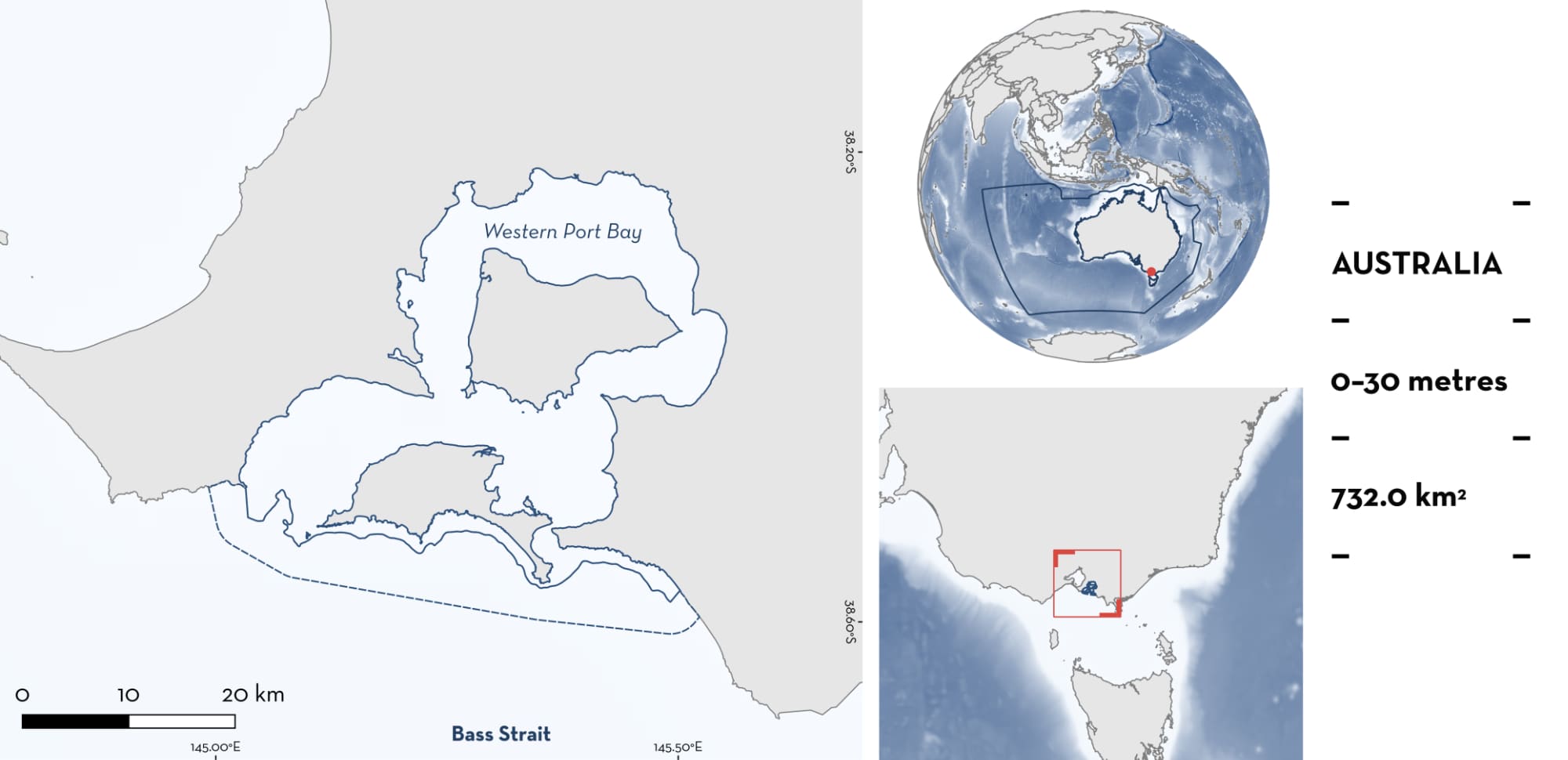
Western Port Bay is located in Victoria, southeast Australia. This is the second largest bay in Victoria and is connected to Bass Strait mainly by a southwest opening. It includes two large islands (French Island and Phillip Island) and multiple small ones. It is characterised by extensive intertidal mud flats exposed at low tide, mangroves, seagrass beds, and sand banks. It is influenced by freshwater input from multiple rivers. The area overlaps with two Key Biodiversity Areas, a Ramsar Site, and three Marine National Parks. Within this area there are: threatened species (Tope Galeorhinus galeus); and reproductive areas (e.g., Elephantfish Callorhinchus milii).
Download factsheet
Western Port Bay
DESCRIPTION OF HABITAT
Western Port Bay is located in Victoria, southeast Australia. This is the second largest bay in Victoria and is connected to Bass Strait by a ~8 km opening east of Phillip Island and a small opening west of the island. The area is divided into five segments: the northernmost Upper North Arm, Lower North Arm in the northwest, Corinella Segment in the northeast, Rhyll Segment in the southeast (south of French Island), and Western Entrance Segment in the southwest (Jenkins et al. 2022). It includes two large islands (French Island and Phillip Island) and multiple small ones. It is characterised by extensive intertidal mud flats exposed at low tide, mangroves, seagrass beds, and sand banks. During the 1970s there was a loss of seagrasses in the area, mostly of Zostera nigricaulis (Walker 2011). Currently, seagrass beds are dominated by Z. muelleri in intertidal flats, Z. nigricaulis and Halophila australis in subtidal areas, and Amphibolis antarctica near the entrance (Blake & Ball 2001; Walker 2011)
Water circulation is dominated by semi-diurnal tides with tidal ranges between 2–3 m (Lee 2011). Flow of water has a clockwise direction with sediment flowing to the area in the northeast and depositing mostly into the Corinella and Rhyll segments (Lee 2011). Sea surface temperatures range between 11–12°C in the austral winter and 23–24°C in summer (Lee 2011). Multiple rivers (e.g., Bunyip, Bass, and Lang Lang rivers) and creeks flow into the northern part of the bay.
The area overlaps with Phillip Island Key Biodiversity Area (KBA) and Western Port KBA (KBA 2025a, 2025b), Western Port Ramsar Site (Wetland of International Importance; Ramsar 2025), and three Marine National Parks: Yaringa, Churchill Island, and French Island (Parks Victoria 2025).
This Important Shark and Ray Area is benthic and pelagic and is delineated from inshore and surface waters (0 m) to 30 m based on the bathymetry of the area.
CRITERION A
VULNERABILITY
One Qualifying Species considered threatened with extinction according to the IUCN Red List of Threatened Species regularly occurs in the area. This is the Critically Endangered Tope (Walker et al. 2020).
CRITERION C
SUB-CRITERION C1 – REPRODUCTIVE AREAS
Western Port Bay is an important reproductive area for two shark and one chimaera species.
Fishing surveys and catch data have revealed the regular presence of neonate and young-of-the-year (YOY) Tope in the area since the 1940s (Olsen 1954, 1959; Stevens & West 1997; Walker et al. 2008). In southern Australia, this area has been recognised as one of the six major nursery areas across Victoria and Tasmania for the species (Olsen 1954; Stevens & West 1997; Walker et al. 2008).
Between 1947–1953, 11 areas across Victoria and Tasmania were surveyed with handlines and gillnets to look for potential nursery areas for Tope (Olsen 1954). In Western Port Bay, two Tope measuring 41–44 cm total length (TL) were caught by handline. These individuals were classified as neonate/YOY. Reported size-at-birth for the species is 30–40 cm TL (Ebert et al. 2021) and YOY size in this region was set at 50 cm TL (Olsen 1954; Moulton et al. 1992). Subsequently, between 1992–1996, three bays were also surveyed in Victoria to explore nursery areas for this species (Stevens & West 1997). In Western Port Bay, gillnet (n = 108, 75 m long gillnet) and longline (n = 82, 50 hook longline) sets were deployed in the area and 248 Tope were recorded mostly (95.9%) on longlines. Of these, 205 (83.7%) were classified as neonate/YOY based on their size and the rest were classified as one-year-old sharks (Stevens & West 1997). Western Port Bay had the largest number of individuals and catch-per-unit-effort (CPUE) of these life-stages in Victoria. Neonate/YOY Tope were recorded mostly in summer, between December–March (Stevens & West 1997). Additional sampling was conducted in South Australia, but no neonate/YOY were recorded (Stevens & West 1997).
Population declines of Tope have been recorded since the 1950s across Australia (Walker 1999; Braccini et al. 2009). As part of regulations focused on population recovery, the catch of Tope measuring <45 cm partial length (from the rear gill slit to the start of the tail) is prohibited in this area (VFA 2023). Existing regulations and the lack of surveys focused on monitoring neonate/YOY Tope are related with the reduction of contemporary records. However, records from recreational fishing forums and citizen science observations between 2018–2025 have revealed that these life-stages are still regularly incidentally caught in the area (Fishbrain 2025; iNaturalist 2025c). These records confirm the contemporary importance of this area for reproductive purposes of this species. Despite the records of neonates and YOY, no pregnant females were recorded across all studies conducted in the area.
In the same monitoring from 1992–1996, 415 Gummy Sharks were caught in the area, mostly (83.8%, n = 348) on longlines (Stevens & West 1997). Of these, 53 (12.7%) were classified as neonate/YOY. These individuals measured <45 cm TL which is close to the reported size-at-birth (30–35 cm TL; Ebert et al. 2021) and to the size set for YOY Gummy Sharks (50 cm TL) in the region (Moulton et al. 1992; Stevens & West 1997). Western Port Bay recorded the second largest number of neonate/YOY and CPUE across all bays monitored in Victoria. As with Tope, existing regulations for the use of nets and size limits, and the lack of surveys focused on monitoring neonate/YOY Gummy Sharks are related to the shortage of contemporary records. However, records from recreational fishing forums and citizen science records between 2018–2025 have revealed that these life-stages are still incidentally caught in the area (Fishbrain 2025; iNaturalist 2025b). These records confirm the contemporary importance of this area for reproductive purposes of this species. In addition, pregnant females have been observed in coastal waters around the entrances of the bay (Storrie 2004).
This area has been considered one of the largest egg-laying grounds for Elephantfish in southern Australia due to the number of pregnant females caught and number of egg cases found (Braccini et al. 2008). Elephantfish prefer to lay their egg cases in soft, sandy areas (Bell 2012). Catches of Elephantfish in the area started to increase in the 1980s, after seagrass coverage declines (Bell 2012). These catches increased to the point that the species started being targeted by recreational fisheries. Catches between 1998–2008 were similar to the entire catches from commercial fisheries across all southeast Australia (Braccini et al. 2008).
Catch data from recreational fisheries in the area were collected during creel/angler surveys between 1998–2007 and an additional on-board survey on charter boats was conducted in 2008; both surveys were conducted between February–May (Braccini et al. 2008). Catches from the boat surveys showed that of 3,908 Elephantfish collected, 71% were females. Individuals sampled in the boat surveys were between 40–90 cm fork length (FL) for males and 40–80 cm FL for females with mean length of 69.9 ± 0.1 cm FL and a mode of 68 cm FL for females. Individuals sampled in the creel survey were between 30–110 cm FL for males and 40–100 cm FL for females with a mean length of 63.3 ± 0.4 cm FL and a mode of 63 cm FL for females (Braccini et al. 2008). Reported size-at-maturity for the species is 50–54 cm FL for males and 59–70 cm FL for females (Francis 1997), indicating that most of the individuals caught were mature. This was confirmed from a sample of 134 females and 39 males dissected of which 99% and 98% were mature, respectively (Braccini et al. 2008). Elephantfish is known to occupy slope habitats most of the year and migrate to shallow bays during summer to breed and lay their eggs (Last & Stevens 2009; Bell 2012) indicating that recreational fishers in Western Port Bay targeted aggregations of breeding Elephantfish (Braccini et al. 2008). Aggregations of females were mostly found in shallow waters with muddy substrates and little tidal and current movement that seems to be used to lay the eggs. Aggregations of both sexes were caught around channels and deeper waters (Braccini et al. 2008). Opportunistic underwater visual census (UVC) surveys conducted in 2008 in the area showed a large number of egg cases in the outer margins of subtidal areas on sandy sediments with patches of the seagrass H. australis along the Rhyll Bank (Braccini et al. 2008). Also, neonates were observed sporadically in seagrass beds in the area (Braccini et al. 2008).
In addition, between March–May 2008–2010, Underwater Visual Census (UVC) surveys were conducted sporadically in the area (Bell 2012). In these surveys, 454 egg cases were recorded of which 201 (44.3%) where classified as alive (with living eggs) and the rest as dead (40.8%) or hatched (14.9%). Egg cases were found in waters <3.5 m around seagrass beds and fine-grained substrates (Bell 2012).
Between February–May of 2010–2013, 120 pregnant Elephantfish were collected with rod-and-reel for embryological studies in captivity (Boisvert et al. 2015). Pregnancy was determined by presence of mating wounds during catch procedures. Individuals were taken to the local aquarium for up to four weeks so they could lay their eggs there before being released. On average, pregnant females laid a pair of egg cases every four days. A total of 620 egg cases were collected with an average of 187 egg cases per year of which 81.5% were viable. Pups hatched after 143 days on average with preferred temperatures of ~16°C (Boisvert et al. 2015).
Recent records from citizen scientists showed that egg cases are still found in the area (iNaturalist 2025a). Of 159 observations of Elephantfish reported in iNaturalist for Australia, this area has the largest number of observations (n = 34; 21.4%) along with southeast Tasmania (n = 32; 20.1%). Most of the observations in the area are from egg cases washed up on the beach recorded between 2020–2025 confirming that this area is still used as an egg laying site.
Download factsheet
SUBMIT A REQUEST
ISRA SPATIAL LAYER REQUEST
To make a request to download the ISRA Layer in either a GIS compatible Shapefile (.shp) or Google Earth compatible Keyhole Markup Language Zipped file (.kmz) please complete the following form. We will review your request and send the download details to you. We will endeavor to send you the requested files as soon as we can. However, please note that this is not an automated process, and before requests are responded to, they undergo internal review and authorization. As such, requests normally take 5–10 working days to process.
Should you have questions about the data or process, please do not hesitate to contact us.