ISRA FACTSHEETS
ISRA FACTSHEETS
NORTH AMERICAN PACIFIC
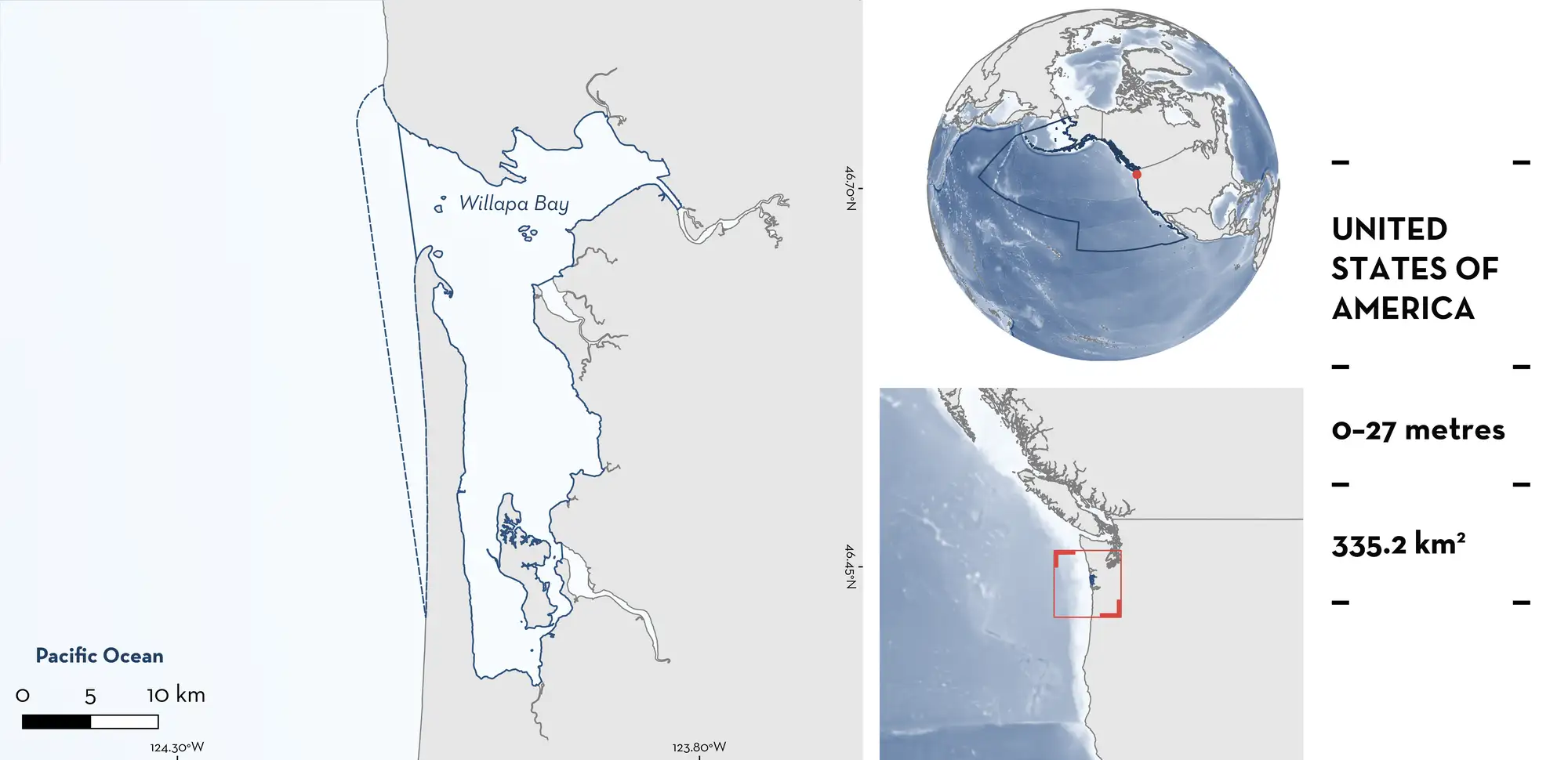
Willapa Bay
Summary
Willapa Bay is located on the southern coast of Washington State, United States of America. The area consists of shallow intertidal and subtidal habitats, extensive sand and mud flats, deeper central channels, a homogeneous sandy coastal flat, and significant eelgrass meadows. It is influenced by wind-driven upwelling during the boreal spring to autumn and the presence of the Columbia River plume. Within this area there are: threatened species (e.g., Tope Galeorhinus galeus); feeding areas (Tope); and undefined aggregations (e.g., Broadnose Sevengill Shark Notorynchus cepedianus).
Download factsheet
Willapa Bay
DESCRIPTION OF HABITAT
Willapa Bay is located on the southern coast of Washington State, United States of America. The area is a large coastal plain estuary consisting of extensive sand and mud tidal flats divided by deeper central channels and distributaries (Andrews 1965). It is home to substantial oyster and clam production and contains significant Common Eelgrass Zostera marina habitat, representing one of two known occurrences of eelgrass habitat on the outer Washington State coast (Hickey et al. 2002; Sherman & DeBruyckere 2018).
Water conditions within Willapa Bay are strongly influenced by seasonal upwelling–downwelling dynamics and tidal exchange (Banas et al. 2007). During late boreal autumn and winter, salinity declines substantially, with mean daily values ranging from ~11 to 22 ppt. This seasonal freshening is likely driven by increased precipitation and freshwater input, as well as coastal downwelling conditions that can promote northward transport and intrusion of the Columbia River plume into the bay. In contrast, during the summer and early autumn, strong tidal forcing maintains a well-mixed water column, while coastal upwelling promotes marine-dominated conditions. During this period, mean daily salinity remains relatively high, ranging from ~25 to 30 ppt between July and October. This marine signal propagates up the rivers during the summer (Banas et al. 2007).
This Important Shark and Ray Area is benthic and pelagic and is delineated from inshore and surface waters (0 m) to 27 m based on the bathymetry of the area.
CRITERION A
VULNERABILITY
Two Qualifying Species considered threatened with extinction according to the IUCN Red List of Threatened Species regularly occur in the area. These are the Critically Endangered Tope (Walker et al. 2020) and the Vulnerable Broadnose Sevengill Shark (Finucci et al. 2020).
CRITERION C
SUB-CRITERION C2 – FEEDING AREAS
Willapa Bay is an important feeding area for one shark species.
Tope relative abundance within this area coincides with the timing of Northern Anchovy Engraulis mordax availability. Between 2023 and 2025, 40 Tope were fitted with acoustic tags in Willapa Bay. To examine the relationship between Tope occupancy and Northern Anchovy availability, the mean number of unique tagged Tope detected within the area each month in 2024 and 2025 was compared with a running average of Southwest Washington State commercial Northern Anchovy landing data spanning 2023–2025, used as a proxy for Northern Anchovy abundance. This comparison indicates that both Tope occupancy and Northern Anchovy landings are highest from July through September, with both metrics peaking in August (EM Personius et al. unpubl. data 2026). Although commercial landings data are aggregated at the regional scale due to confidentiality constraints, these data are derived primarily from fishers operating within Willapa Bay, Grays Harbor (north of Willapa Bay; outside the area), and nearby coastal waters. This consistent temporal overlap is further supported by preliminary diet data from Tope sampled within the area. Stomach contents examined from two individuals contained only Northern Anchovy and no other prey items (EM Personius et al. unpubl. data 2026). Although sample size is limited, these observations taken with the highly male skewed sex ratio in northern latitudes (>97%) (Ripley 1946) suggest that Tope use the area primarily for foraging during periods of elevated prey availability.
The seasonal abundance of Northern Anchovy within Willapa Bay is likely supported by the physical and biological characteristics of this estuary. Northern Anchovy are known to use estuarine habitats in the Northern California Current System for spawning and early life-stage development (McGowan 1986). In larval fishes, survival is strongly influenced by prey availability and foraging success during the transition from yolk-sac dependence to exogenous feeding. Faster growing individuals may also experience lower cumulative mortality by progressing more rapidly through the high-mortality larval stage (Robert et al. 2023). Willapa Bay provides favourable conditions for Northern Anchovy production because it is shallow, seasonally warm, and strongly coupled to coastal upwelling nutrient transport processes during the growing season (May–September). In Willapa Bay, estuarine productivity is subsidised by ocean-derived phytoplankton. Willapa Bay functions as a sink for oceanic phytoplankton during the growing season, indicating that phytoplankton produced in adjacent coastal environments is transported into the estuary where it is rapidly consumed and retained within the estuarine food web (Banas et al. 2007). This combination of seasonal warming, upwelling-driven nutrient transport, and marine phytoplankton subsidies supports the high zooplankton production important to the early-life development of Northern Anchovies. These unique conditions may help explain why Northern Anchovy are seasonally abundant within the area and, in turn, why Tope relative abundance peaks during the same period.
This interpretation is consistent with observed patterns in regional Tope feeding ecology. In the North Pacific, available diet data demonstrate a high reliance on coastal pelagic forage species such as Pacific Sardine Sardinops sagax, which occurred in 33.3% of 71 stomachs and accounted for more than 59% of prey items (Ripley 1946). In the California Current System, Northern Anchovy and Pacific Sardine exhibit well-documented asynchronous population fluctuations (Lindegren et al. 2013). Because both species are energy-rich forage fishes, predator diets may shift with their relative availability (Green et al. 2015). Since the 2014 marine heatwave event known as ‘The Blob’, Northern Anchovy have become the dominant coastal pelagic forage fish relative to Pacific Sardine in this region (Swieca et al. 2025). This Northern Anchovy-dominant regime encompasses the period of recent Tope foraging observations and may explain the absence of Pacific Sardine in recovered stomach contents from the area.
Together, acoustic detections, commercial anchovy landings, preliminary stomach content data, and the known productivity dynamics of this estuary support the interpretation that Willapa Bay functions as a seasonal foraging area for Tope, likely mediated by the availability of Northern Anchovy.
CRITERION C
SUB-CRITERION C5 – UNDEFINED AGGREGATIONS
Willapa Bay is an important area for undefined aggregations of two shark species.
Passive acoustic telemetry data show that both Tope and Broadnose Sevengill Sharks regularly aggregate within this area (EM Personius unpubl. data 2026; J Schulte unpubl. data 2026). For both species, aggregations were defined as three or more tagged individuals detected on an acoustic receiver within a five-minute window. The underlying assumption of this analysis is that tagged sharks are representative of the local population, such that an aggregation of three tagged individuals is significant and likely includes additional untagged sharks responding to a common environmental or biological driver. Consecutive five-minute bins containing aggregations were grouped into a single event, and event duration was calculated from the first to the last detection associated with that event. The Willapa Bay receiver array has a detection range from ~400–750 m and can vary significantly depending on distance from the ocean and local water conditions in this highly dynamic system.
A total of 44 Tope were tagged with internal acoustic transmitters in Willapa Bay (n = 40), Newport, Oregon (n = 3), and San Franscisco, California (n = 1), between July 2023 and November 2025. Cumulative tagged sample size increased from 6 in 2023, to 15 by the end of 2024, and to 44 by the end of 2025. Tagged individuals ranged in size from 42 to 180 cm total length (TL) and comprised 41 males and three females. A total of 27 of these tagged individuals were detected on receivers within Willapa Bay and Grays Harbor (outside the area) between 22 July 2023 and 19 November 2025. There were 25,260 detections of Tope recorded within in this area. Based on these detections, 94 five-minute bins contained aggregations, which were grouped into 55 aggregation events lasting 0.45–29.22 min (median = 4.35 min). Aggregations comprised 3–5 individuals (mean = 3.1), representing 11–19% of the tagged Tope detected within the area. Aggregation frequency showed a seasonal pattern, with events occurring between July and September, most often during July.
Tagged sample sizes were small in 2023 and 2024 (<20 individuals), so aggregations observed in 2024 likely underestimate aggregation dynamics during that year. Outside of the area, Tope tagged within Willapa Bay were detected as far south as the California Channel Islands and as far north as Cape Flattery, Washington, indicating broad regional movements. However, despite the wide-ranging movements of these tagged sharks, outside of the area only nine aggregation events were recorded. All of these occurred in Grays Harbor, the estuary directly to the north of Willapa Bay. Additionally, there are no other documented inshore waters north of San Francisco Bay, California, where Tope can be encountered with comparable frequency, except the afore-mentioned Grays Harbor where a recreational fishery targets this species (Peeling Line 2023). Recreational catch reports suggest that Tope may also occur in notable numbers within San Francisco Bay (Ebert 2001). Together, these observations may indicate site fidelity to specific estuarine habitats. This interpretation is further supported by the single individual tagged in San Francisco Bay during this study, which remained in California and has not been detected in Oregon and Washington in the two years following its release (EM Personius unpubl. data 2026).
A total of 82 Broadnose Sevengill Sharks were tagged with internal acoustic transmitters in Washington State between 2021 and 2025. Tagged individuals ranged in size from 100–286 cm TL and included 44 males and 38 females. A total of 60 tagged Broadnose Sevengill Sharks were detected on receivers within Willapa Bay between 17 September 2021 and 25 October 2025. There were 441,206 detections of Broadnose Sevengill Sharks recorded in this area. Within this area, 6,779 five-minute bins contained aggregations, which were grouped into 3,221 aggregation events lasting 0.26–125.47 min (median = 4.33 min). Aggregations comprised 3–9 individuals (mean = 3.3), representing 5–15% of the tagged Broadnose Sevengill Sharks detected within the area. Aggregation frequency and duration showed a seasonal pattern, with events occurring most often during July and persisting longest during May. Acoustic arrays in Willapa River were not in service prior to the summer of 2025.
Outside of the area, tagged Broadnose Sevengill Sharks demonstrated broad regional movements with detections and re-captures ranging from San Diego, California, to British Columbia, Canada. Despite this wide-ranging dispersal, only two aggregations were detected outside of the area, both occurring in Grays Harbor. Broadnose Sevengill Sharks have been reported in South Puget Sound, Washington (Schulte et al. 2024); however, observed numbers fall below what could be considered aggregations, and targeted fishing in comparable habitats in Oregon yielded no additional captures. Broadnose Sevengill Sharks are known to occur in estuarine ecosystems along the California Current System, though the movements of this species have mainly been studied in San Francisco Bay and Willapa Bay. It is possible that aggregations do occur in Humbold Bay, California, but tagging sample size is insufficient for these analyses. San Francisco Bay supports aggregations of young-of-the-year (YOY)/juvenile Broadnose Sevengill Sharks and smaller numbers of adults (Ebert 1989; MM Holst pers. comm. 2026). In contrast, catch data indicate that Willapa Bay lacks YOY Broadnose Sevengill Sharks, with the demographic assemblage composed primarily of adult and subadult individuals and a relatively even sex ratio of 52:48 male to female (EM Personius unpubl. data 2026). Seasonal inshore aggregations followed by winter departure have been documented in Broadnose Sevengill Shark populations across multiple ocean basins (Ebert 1996; Barnett et al. 2010; Stehfest et al. 2014; Lewis et al. 2020), suggesting this pattern of estuarine site fidelity may be a broadly conserved behavioural strategy for the species.
These findings indicate that the Willapa Bay estuarine system contains specific locations that are repeatedly used by aggregating sharks of these species. Given the highly mobile nature of both species (Ketchum et al. 2017; Nosal et al. 2021), the repeated residency and detection of aggregations of tagged individuals indicate that this area is likely of particular importance to both Tope and Broadnose Sevengill Sharks.
Additional information is required to understand the nature and function of these aggregations.
Download factsheet
SUBMIT A REQUEST
ISRA SPATIAL LAYER REQUEST
To make a request to download the ISRA Layer in either a GIS compatible Shapefile (.shp) or Google Earth compatible Keyhole Markup Language Zipped file (.kmz) please complete the following form. We will review your request and send the download details to you. We will endeavor to send you the requested files as soon as we can. However, please note that this is not an automated process, and before requests are responded to, they undergo internal review and authorization. As such, requests normally take 5–10 working days to process.
Should you have questions about the data or process, please do not hesitate to contact us.