ISRA FACTSHEETS
ISRA FACTSHEETS
AUSTRALIA AND SOUTHEAST INDIAN OCEAN
Wolf Rock
Summary
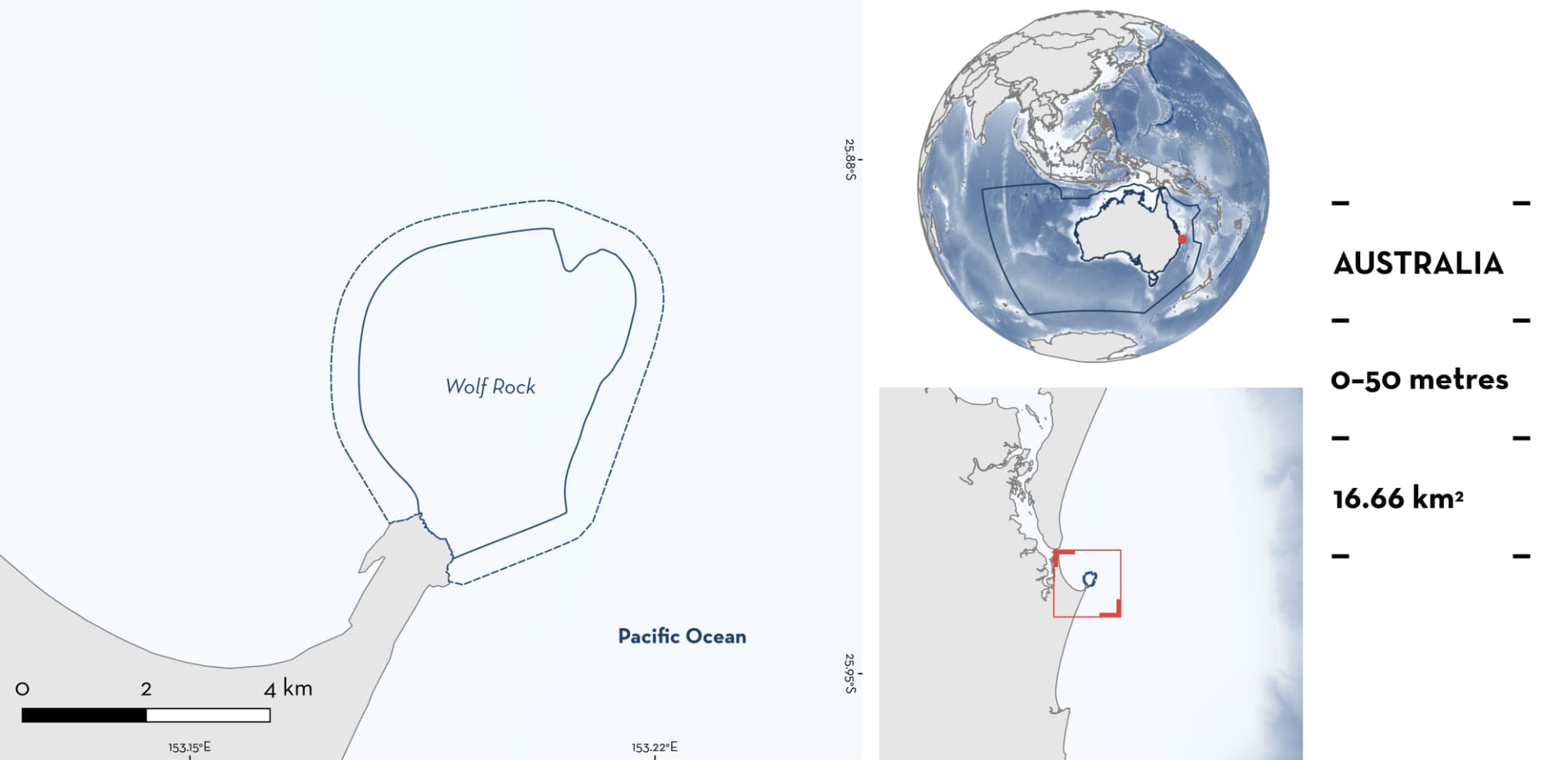
Wolf Rock is located off Double Island Point, Queensland, Australia. The area includes three main structures: Wolf Rock, Round Rock, and The Pinnacles. It is characterised by volcanic rock pinnacles and includes a range of steep walls, gullies, and rocky plateaus with varying benthic environments including sandy substrates, rugged boulder country, and rock covered by heads of hard and soft coral. This area overlaps with the Great Sandy Marine Park. Within this area there are: threatened species (e.g., Sand Tiger Shark Carcharias taurus); reproductive areas (e.g., Blotched Fantail Ray Taeniurops meyeni); and undefined aggregations (e.g., Reef Manta Ray Mobula alfredi).
Download factsheet
Wolf Rock
DESCRIPTION OF HABITAT
Wolf Rock is located off Double Island Point, Queensland, Australia. The area includes three main structures: Wolf Rock, Round Rock, and The Pinnacles. The main Wolf Rock structure consists of a series of four volcanic rock pinnacles aligned in a northeasterly direction, with the two most northerly pinnacles breaking the water surface under all tidal conditions (Bansemer & Bennett 2009). The immediate area around the volcanic pinnacles has a maximum depth of 35 m and is characterised by a range of steep walls, gullies, and rocky plateaus with varying benthic environments including sandy substrates, rugged boulder country, and rock covered by heads of hard and soft coral. Round Rock is located south-southeast of the central structure of Wolf Rock and consists of a single volcanic rock mound surrounded by sand flats and, on its southern side, rocky rubble. The top of the rocky mound sits at a depth of ~6 m with sandy substrates immediately around the mound reaching a maximum depth of ~16 m. The Pinnacles is located to the east of the central structure of Wolf Rock. The site consists of multiple volcanic rocky reef structures with a depth range of ~24–43 m and the benthos consisting of sandy substrates, rugged boulder country, and rocky reef covered by heads of hard and soft coral (Queensland Government 2024).
The area is influenced by its proximity to the East Australian Current, the poleward flowing western boundary current of the South Pacific Gyre (Suthers et al. 2011). The East Australian Current flow is strongest in the austral summer, and the formation of eddies along this coastline also fluctuates seasonally (Ridgway & Hill 2009).
This area overlaps with Great Sandy Marine Park (Queensland Government 2024).
This Important Shark and Ray Area is benthic and pelagic and is delineated from inshore and surface waters (0 m) to 50 m based on the bathymetry of the area.
CRITERION A
VULNERABILITY
Five Qualifying Species considered threatened with extinction according to the IUCN Red List of Threatened Species regularly occur in the area. Threatened sharks comprise one Critically Endangered species and one Endangered species; threatened rays comprise one Endangered species and two Vulnerable species (IUCN 2025).
CRITERION C
SUB-CRITERION C1 – REPRODUCTIVE AREAS
Wolf Rock is an important reproductive area for one shark and one ray species.
Wolf Rock is the only known gestation aggregation for the East Australian sub-population of Sand Tiger Sharks (Bansemer & Bennett 2009; Dwyer et al. 2023). Between 2002–2008, a combination of underwater visual census surveys, photo-identification, and acoustic tracking was used to investigate Sand Tiger Sharks in the area. Reproduction is seasonal, with fresh mating scars on female sharks observed in late November and December and pregnancies visible from late-February (Bansemer & Bennett 2009). Many pregnant sharks remain at Wolf Rock until August or September (9–10 months post-mating) and demonstrate strong site fidelity to the area (Bansemer & Bennett 2009). Underwater visual census (UVC) surveys revealed Sand Tiger Sharks aggregate in the area year-round. In total, 210 UVC surveys were conducted at Wolf Rock between 2022–2025, with an average of 18 surveys per month (range 10–36; JL Cameron et al. unpubl. data 2025). Sand Tiger Shark numbers peak in May (up to 56 sharks; mean = 24 sharks). In addition to the UVC surveys, between 2015–2025, recreational divers collected Go Pro footage in the area. From this footage, Sand Tiger Sharks were filmed attempting to mate six times (January = 1, October = 2, November = 3 times; JL Cameron et al. unpubl. data 2025). One observation from November resulted in copulation. In addition, in July 2021, the internal movement of a pup was filmed in a pregnant female. Between 2012–2018, 34 Sand Tiger Sharks were tagged with acoustic transmitters at Wolf Rock, and two locations outside the area (Flat Rock and Fish Rock; Dwyer et al. 2023). Eighteen out of 34 Sand Tiger Sharks (15 females, 3 males) were detected on receivers deployed within the area, with females showing higher levels of residency to this area (Dwyer et al. 2023). Tagged females spent on average 44.8 days (± 50.4 standard deviation [SD]; max = 254) resident at Wolf Rock, while tagged males spent on average 14.9 ± 18.9 days. Six of the tagged sharks made return migrations to Wolf Rock in subsequent years.
In total, 210 UVC surveys were conducted at Wolf Rock year-round between 2022–2025, with an average of 18 surveys per month (range 10–36; JL Cameron et al. unpubl. data 2025). Aggregations of Blotched Fantail Rays were recorded in the area on 48 days (22.9%) across most months (except May and July). On average, three Blotched Fantail Rays were observed each day (± 2.9 SD). Peak aggregations (maximum n = 14) occur in November and December, at which time 12 females with large and bulbous abdomens consistent with pregnancy have been observed (JL Cameron et al. unpubl. data 2025). In February 2023, two males were recorded courting and biting onto females (JL Cameron et al. unpubl. data 2025). Observations of pregnancy in this species are uncommon outside this area, supporting its importance for reproduction.
CRITERION C
SUB-CRITERION C5 – UNDEFINED AGGREGATIONS
Wolf Rock is an important area for undefined aggregations of one shark and two ray species.
In total, 210 UVC surveys were conducted at Wolf Rock between 2022–2025, with an average of 18 surveys per month year-round (range 10–36; JL Cameron unpubl. data 2025).
Indo-Pacific Leopard Sharks were recorded on 33 days from September–April with occasional observations outside these months (JL Cameron et al. unpubl. data 2025). Up to four individuals were observed at one time, generally resting together on the rocky or sandy substrates. Between 2014–2024, images of Indo-Pacific Leopard Sharks were submitted by citizen scientists from the area for photo-identification (Spot the Leopard Shark Project unpubl. data 2025). A total of 25 individuals were identified from 29 reported encounters (n = 1 female; n = 1 male; n = 27 unknown sex). This area holds the third highest number of sightings submitted along the east coast (after Nguthungulli Julian Rocks and The Group off North Stradbroke Island; Spot the Leopard Shark Project unpubl. data 2025). More information is needed to understand the nature and function of these aggregations.
Aggregations of Spotted Eagle Rays were recorded year-round on 26 days at Wolf Rock, with an average of 3.5 rays observed each day (± 3.41 SD). This species has been observed forming aggregations exceeding 30 individuals twice in January (2015 and 2019), suggesting there may be a seasonal component to their habitat use in this area. Two instances of attempted copulation and one instance of precopulatory behaviour (courtship train) were also filmed in January (2015, 2016, and 2025; JL Cameron et al. unpubl. data 2025). These observations suggest that aggregations in this area may be related to reproduction, however, more information is needed to understand the nature and function of these aggregations.
Between 2023–2025, Reef Manta Rays were observed at Wolf Rock on 43 days between March–December. An average of two rays were observed together, with the largest aggregation from June 2023 involving up to five individuals. These individuals were mostly observed utilising cleaning stations in the area, with occasional records of feeding (JL Cameron et al. unpubl. data 2025). Between 2007–2024, there were 144 sightings of 82 individual Reef Manta Rays identified using photo-identification of images submitted by citizen scientists from the area (Project Manta unpubl. data 2025). Only 22 sightings had the associated behaviour of the Reef Manta Rays recorded, with 86.4% of these sightings (n = 19) reporting cleaning behaviour and the remainder feeding behaviour (Project Manta unpubl. data 2025).
Download factsheet
SUBMIT A REQUEST
ISRA SPATIAL LAYER REQUEST
To make a request to download the ISRA Layer in either a GIS compatible Shapefile (.shp) or Google Earth compatible Keyhole Markup Language Zipped file (.kmz) please complete the following form. We will review your request and send the download details to you. We will endeavor to send you the requested files as soon as we can. However, please note that this is not an automated process, and before requests are responded to, they undergo internal review and authorization. As such, requests normally take 5–10 working days to process.
Should you have questions about the data or process, please do not hesitate to contact us.