ISRA FACTSHEETS
ISRA FACTSHEETS
ASIA REGION
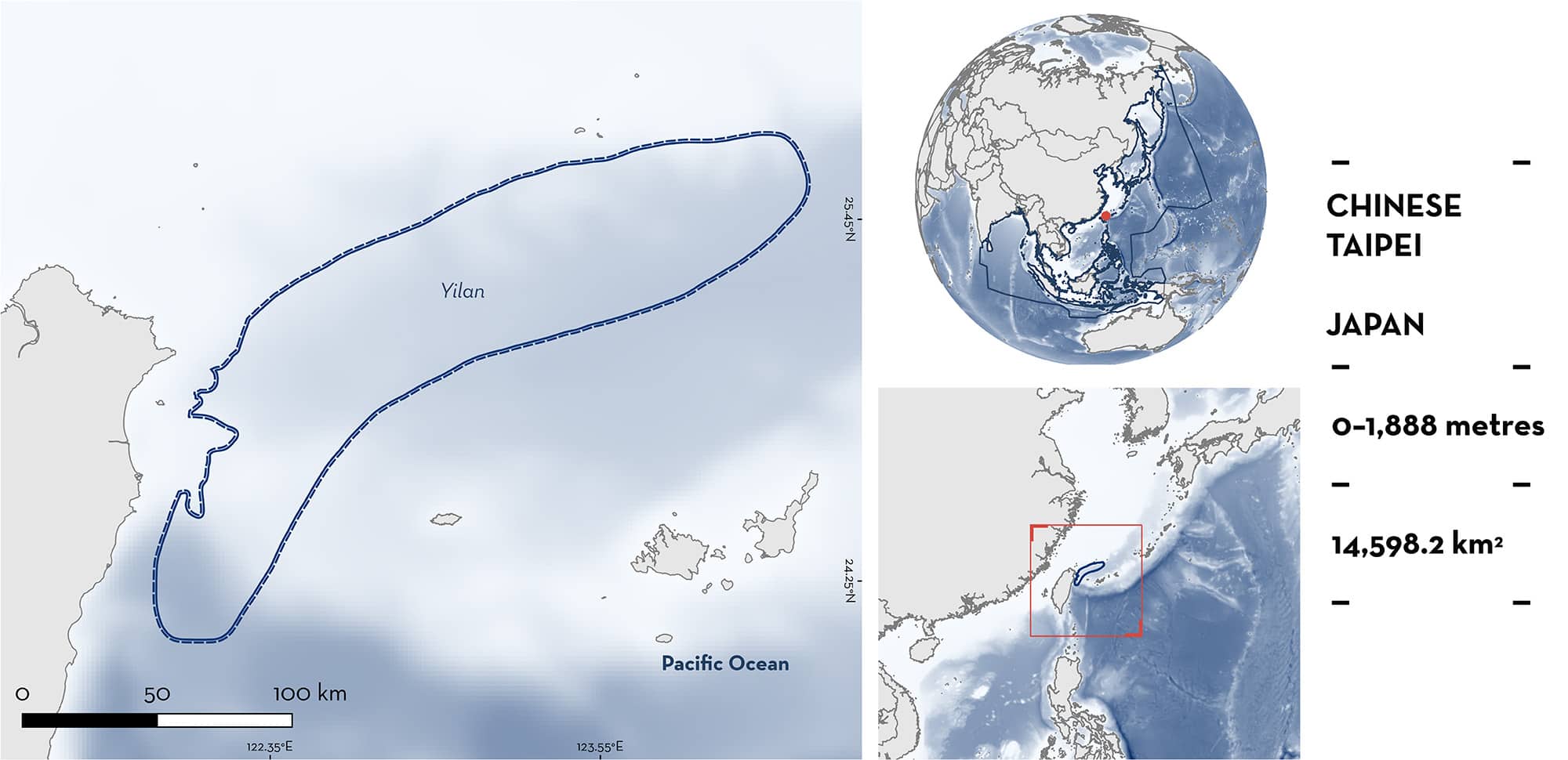
Yilan
Summary
Yilan is located off the northeast coast of Taiwan and encompasses a small part of the Japanese Exclusive Economic Zone. This area is characterised by pelagic waters and extends over continental shelf, slope, and abyssal mountain terrain. The warm Kuroshio Current flows north- and eastwards through this area and intensifies from May to August. The area partially overlaps with the Senkaku Islands Key Biodiversity Area. Within this area there are: threatened species (e.g., Bigeye Thresher Alopias superciliosus) and reproductive areas (e.g., Shortfin Mako Isurus oxyrinchus).
Download factsheet
Yilan
DESCRIPTION OF HABITAT
Yilan is located off northeast Taiwan in the Northwest Pacific Ocean. This pelagic area stretches from ~15 km off the coastline towards the northeast into the Pacific and encompasses a small part of the Japanese Exclusive Economic Zone. Yilan lies off the continental shelf and comprises mostly slope and abyssal mountain areas. The area is influenced by the warm Kuroshio Current that runs along eastern Taiwan. In the boreal summer, the Kuroshio moves away from the shelf and splits into two flows, with the northwestern flow creating an upwelling cell onto the shelf (Tang et al. 2000). In winter, the Kuroshio moves closer to, and sometimes onto, the shelf (Tang et al. 2000). Offshore waters largely experience a north- and eastward flow which intensifies from May to August (Tang et al. 2000).
Yilan partially overlaps with the Senkaku Islands Key Biodiversity Area (KBA 2024).
This Important Shark and Ray Area is pelagic and is delineated from surface waters (0 m) to 1,888 m based on the global depth range of the Qualifying Species.
CRITERION A
VULNERABILITY
Four Qualifying Species considered threatened with extinction according to the IUCN Red List of Threatened Species regularly occur in the area. These are the Critically Endangered Scalloped Hammerhead (Rigby et al. 2019a), the Endangered Shortfin Mako (Rigby et al. 2019b) and Pelagic Thresher (Rigby et al. 2019c), and the Vulnerable Bigeye Thresher (Rigby et al. 2019d).
CRITERION C
SUB-CRITERION C1 – REPRODUCTIVE AREAS
From September 1993 to August 1995, 831 Pelagic Threshers were surveyed, and the mature females (n = 145) captured in Yilan were in various stages of pregnancy, highlighting the importance of this area for their gestation (Liu et al. 1999). Females were pregnant throughout the year, indicating no seasonality and no resting phase in their reproduction (Liu et al. 1999). The 233 embryos analysed were in different stages of development and included late-stage embryos (up to 158 cm total length [TL]) close to parturition (the known size-at-birth of this species is 158–190 cm TL; Ebert et al. 2021), showing that this is also a pupping ground for the species (Liu et al. 1999). Observations of catch landings from Yilan in recent years confirm that pregnant females are still regularly caught (H Hsu, S Joung, C Yu pers. obs. 2024), and Pelagic Threshers are still caught in large numbers, with a yearly average of 155 t from 2001–2015 (Liu et al. 2016) compared to 222 t in the mid-1990s (Liu et al. 1999). Other studied areas in the Pacific have a smaller proportion of pregnant females (e.g., Ecuador 62% vs Yilan 100%) (Romero-Caicedo et al. 2014). A study on Japanese commercial longline catches (1993–2008) in offshore waters of the North Pacific showed that the species was only captured in the central Pacific south of Hawaii, and these were mostly juveniles (Clarke et al. 2011), emphasising the importance of Yilan for the reproduction of Pelagic Threshers.
Almost all adult female Bigeye Threshers (n = 77) surveyed in January–October 1984 and October 1992–March 1994 from Yilan were pregnant (Chen et al. 1997). Their litter size was two and a gestation period of ~10 months without a resting phase between pregnancies was suggested (Chen et al. 1997). Late-stage embryos were observed, and there was no seasonal trend in embryo size, suggesting that pupping occurs throughout the year. This early study showed that Yilan is an important area for gestation and pupping (Chen et al. 1997), and more recent landing surveys confirm the regular catches of pregnant Bigeye Threshers (H Hsu pers. obs. 2024). Additionally, Bigeye Threshers are still caught in large numbers, with an annual catch of ~275 t from 2001–2015 (Liu et al. 2016). The species is also caught in southeastern Taiwan, but fewer pregnant females are observed there (H Hsu pers. obs. 2024). A study on Japanese commercial longline catches (1993–2008) in the North Pacific showed that the species is also caught in large numbers in offshore waters of the Pacific (Clarke et al. 2011). Mature individuals were mostly landed east of the area (no survey inside the area) and catch was dominated almost exclusively by juveniles in the central Pacific south of Hawaii (Clarke et al. 2011), highlighting the regional importance of Yilan for the reproduction of Bigeye Threshers.
Shortfin Makos use the area seasonally to mate, gestate, and pup (Joung & Hsu 2005). In a reproductive study from October 2001 to March 2004, pregnant Shortfin Makos (24 of 750 total females) were recorded, but the number is likely to be much higher because fishers gut all large individuals >200 kg at sea (Joung & Hsu 2005). Adult males with large claspers and heavy testes were also recorded (n = 95). Mating scars were apparent in January, March, April, and June, and females with newly fertilised eggs were also found in that season, suggesting an extended mating period in the first half of the year. This season also corresponded to an increase in the gonadosomatic index of mature males. Similarly, the pupping season lasts from December to July after a long gestation of ~2 years, based on observed near-term embryos and free-swimming neonates captured (Joung & Hsu 2005). A year-long resting phase is also common, observed in ~30% of adult females, meaning that the area is also important for large females regaining energy between pregnancies (Joung & Hsu 2005). Shortfin Makos continue to be caught in large numbers in this area, with a yearly average of 505 t landed from 2001–2015 (Liu et al. 2016).
Pregnant Scalloped Hammerheads are frequently captured in large numbers in this area. The species is also landed in other areas of Taiwan, but at much lower abundances (Chen et al. 1988). During landing surveys of fisheries operating in this area from September 1982 to June 1983 and from December 1983 to September 1985, 25% of adult females (n = 446) were pregnant (Chen et al. 1988). Reproduction was seasonal, with ovulation in July–October, a gestation period of ~10 months, and parturition from May–July (Chen et al. 1988). The sex ratio of the landings was skewed towards females, particularly among the adults (4.9:1 Females:Males), indicating that males may seasonally move to the area to mate (Chen et al. 1988). Since this early study, Scalloped Hammerhead catch has remained high in this area, with ~150 t landed each year from 2010–2015 (Liu et al. 2016). Similar ratios of pregnant females were still recorded in the last decade (H Hsu pers. obs. 2023). Embryos are separated from the pregnant individuals to be sold separately, and in recent years these are also still frequently observed in large quantities (H Hsu pers. obs. 2023).
Download factsheet
SUBMIT A REQUEST
ISRA SPATIAL LAYER REQUEST
To make a request to download the ISRA Layer in either a GIS compatible Shapefile (.shp) or Google Earth compatible Keyhole Markup Language Zipped file (.kmz) please complete the following form. We will review your request and send the download details to you. We will endeavor to send you the requested files as soon as we can. However, please note that this is not an automated process, and before requests are responded to, they undergo internal review and authorization. As such, requests normally take 5–10 working days to process.
Should you have questions about the data or process, please do not hesitate to contact us.