
ISRA FACTSHEETS
ISRA FACTSHEETS
AUSTRALIA AND SOUTHEAST INDIAN OCEAN
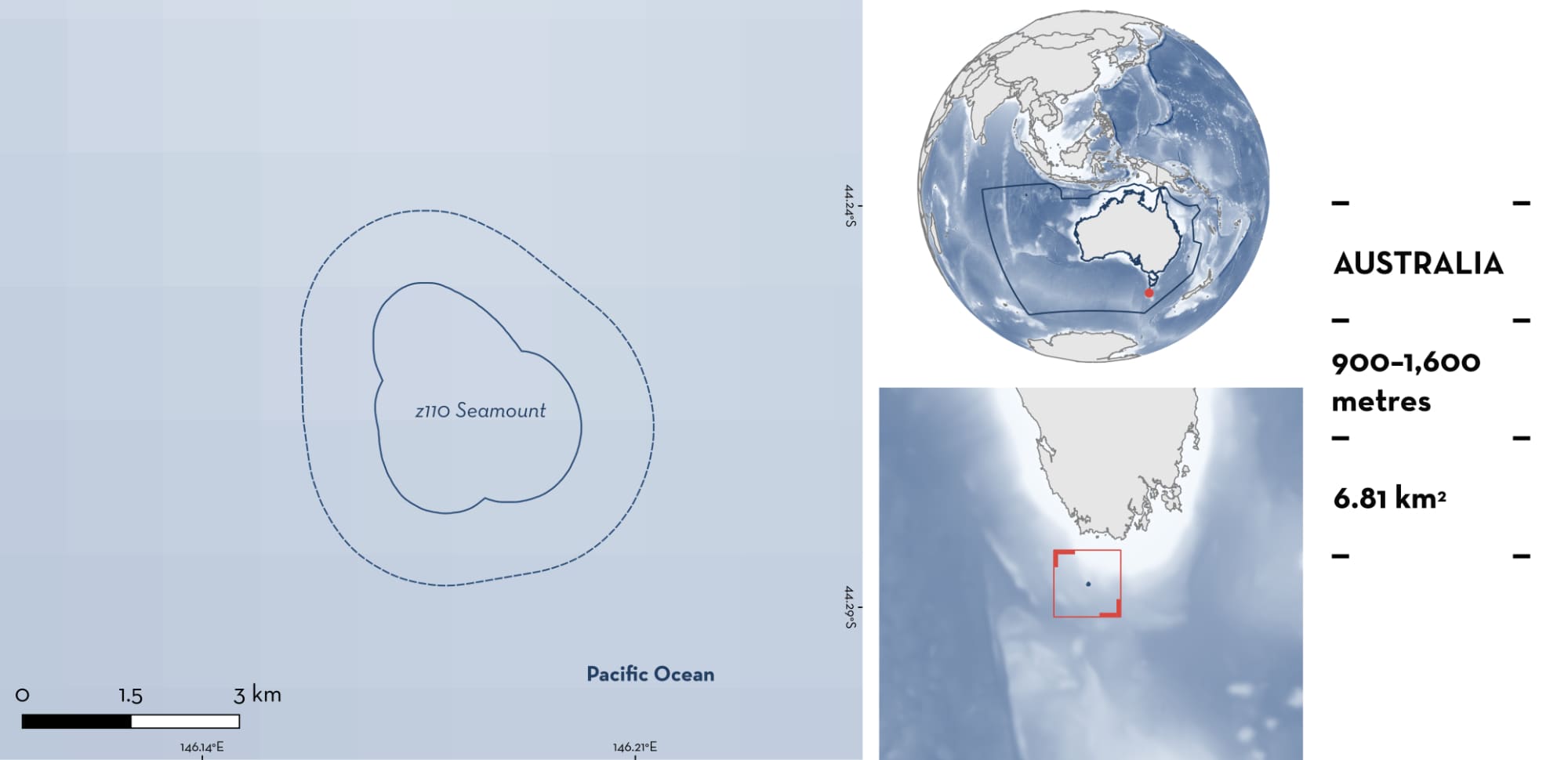
z110 Seamount
Summary
z110 Seamount is located on the continental slope south of Tasmania, Australia. This deep seamount is characterised by live hard corals, coral rubble, and rocky and sandy substrates. This area overlaps with the Tasman Fracture Marine Park. Within this area there are: reproductive areas (Arctic Skate Amblyraja hyperborea).
Download factsheet
z110 Seamount
DESCRIPTION OF HABITAT
z110 Seamount is located south of Tasmania, Australia. It is part of a deepsea seamount chain extending along the continental slope off Tasmania and it is characterised by live hard corals (stony coral Solenosmilia variabilis) around the top of the seamount and coral rubble, and rocky and sandy substrates around the edge of the seamount (Maguire et al. 2023). Mean annual bottom temperature is ~3.33°C (Maguire et al. 2023).
This area partially overlaps with the Tasman Fracture Marine Park (Parks Australia 2025).
This Important Shark and Ray Area is benthic and subsurface and is delineated from 900–1,650 m based on the bathymetry of the area.
CRITERION C
SUB-CRITERION C1 – REPRODUCTIVE AREAS
z110 Seamount is an important reproductive area for one ray species.
Between November–December 2018, 99 survey transects (2 km in length) using a towed platform with cameras were conducted across seamounts (n = 35) and the continental slope off Tasmania at depths of ~500–1,900 m (Maguire et al. 2023). Stereo-still images were taken every five seconds resulting in 50,928 paired images of which 240 (0.5%) showed skate egg cases. Within the area, 151 images were recorded, of which 39 (25.8%) had egg cases with a maximum of 100 egg cases counted in a single image. z110 Seamount held the largest number of skate egg cases (n = 468) and the highest density (5.47 egg cases/m2) recorded across all seamounts surveyed, with the majority being associated with the stony coral Solenosmilia variabilis (Maguire et al. 2023). Of the 113 egg cases identified at the species level, 37 (32.7%) were recorded in this area and all were identified as from Arctic Skates (Maguire et al. 2023). Records of egg cases in this area included ‘recently laid’ eggs (n = 63, 45.3%), which are those which have not darkened and had a partially/complete golden colour, and ‘aged’ egg cases, which are darkened eggs that had been in the substrate long enough to be degraded. Despite only one year of survey data, the presence of both types of egg cases confirms that this area is regularly used by this species to lay eggs (Maguire et al. 2023).
Download factsheet
SUBMIT A REQUEST
ISRA SPATIAL LAYER REQUEST
To make a request to download the ISRA Layer in either a GIS compatible Shapefile (.shp) or Google Earth compatible Keyhole Markup Language Zipped file (.kmz) please complete the following form. We will review your request and send the download details to you. We will endeavor to send you the requested files as soon as we can. However, please note that this is not an automated process, and before requests are responded to, they undergo internal review and authorization. As such, requests normally take 5–10 working days to process.
Should you have questions about the data or process, please do not hesitate to contact us.

