ISRA FACTSHEETS
ISRA FACTSHEETS
EUROPEAN ATLANTIC
Fanal Bay
Summary
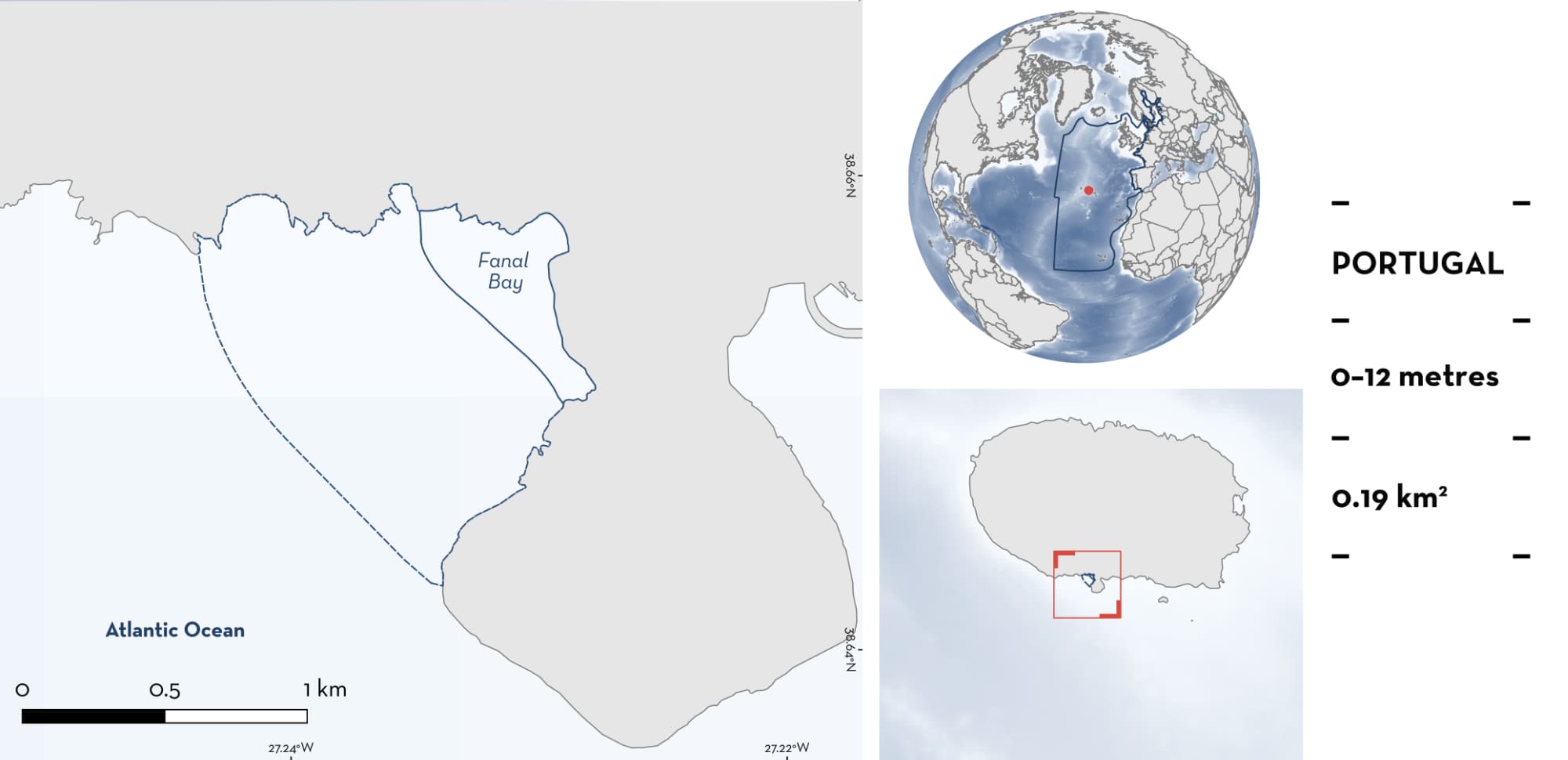
Fanal Bay is located on the coast of southern Terceira Island in the Azores Archipelago, Portugal. The habitat is characterised by a predominantly rocky substrate. This area falls within one of the few zones of weak currents around the island. Within this area there are: threatened species and undefined aggregations (Common Stingray Dasyatis pastinaca).
Download factsheet
Fanal Bay
DESCRIPTION OF HABITAT
Fanal Bay is located on the coast of southern Terceira Island in the Azores Archipelago, Portugal. The habitat is characterised by a predominantly rocky substrate, composed of lava flows with rounded shapes and rough surfaces, formed by terrestrial volcanic eruptions (Simbiente Açores – Engenharia e Gestão Ambiental 2023).
This area falls within one of the few zones of weak currents around the island, due to its sheltered hydrodynamic conditions provided by Monte Brasil Peninsula (Santos & Pinho 2005). Sea surface temperatures in the Azores vary seasonally, averaging 15°C in the boreal winter and reaching 27°C in summer (Amorim et al. 2017).
This Important Shark and Ray Area is benthic and is delineated from inshore and surface waters (0 m) to 12 m based on the depth range of habitat in the area.
CRITERION A
VULNERABILITY
One Qualifying Species considered threatened with extinction according to the IUCN Red List of Threatened Species regularly occurs in the area. This is the Vulnerable Common Stingray (Jabado et al. 2021).
CRITERION C
SUB-CRITERION C5 – UNDEFINED AGGREGATIONS
Fanal Bay is an important area for undefined aggregations of one ray species.
Between 2019–2023, opportunistic records of Common Stingray were recorded during diving trips. Observations included 12–30 Common Stingrays per dive in aggregations of 3–4 animals between July–September (JP Barreiros pers. obs. 2019–2025). Records during the rest of the year comprised a maximum of six individual rays that were not aggregating (JP Barreiros pers. obs. 2019–2025). During September–October 2024, as part of an ongoing project, 17 Underwater Visual Census (UVC) surveys ranging 20–30 minutes were conducted in the area (~3 dives per week) to survey the number of individuals and gather information on the sex of Common Stingrays (JP Barreiros unpubl. data 2019–2025). A total of 142 individuals (~65% in aggregations of >3 individuals) were observed. Sex was identified for 120 individuals: 87 were females (61.3% of total) and 33 were males (23.2%). The majority of individuals were recorded in September (n = 118, average ~13 per dive) (JP Barreiros unpubl. data 2019–2025).
This is the only scientific survey that has been conducted in the area, however, this site is recognised by the local community of Terceira Island and by divers for its high abundance of rays (JP Barreiros unpubl. data 2019–2025). The total number of sightings was three times higher during high tide than during low tide, with a decreasing trend in the number of sightings with decreasing temperature (that started to drop after mid-September) (JP Barreiros unpubl. data 2019–2025). It has been suggested that aggregations of Common Stingrays are most likely to be associated with breeding and increase only during warmer periods (Chaikin et al. 2020). In fact, aggregations in this area are present between July–September when waters are warmer, the sex ratio was 2.6 females: 1 male, and immature individuals (<30 cm disc width [DW]) are also observed in this area (>15 during September–October 2024). Young-of-the-year (YOY) Common Stingrays measure ~30 cm DW in the northeastern Mediterranean Sea (Yeldan et al. 2009). However, further information is required to understand the nature and function of these aggregations.
Download factsheet
SUBMIT A REQUEST
ISRA SPATIAL LAYER REQUEST
To make a request to download the ISRA Layer in either a GIS compatible Shapefile (.shp) or Google Earth compatible Keyhole Markup Language Zipped file (.kmz) please complete the following form. We will review your request and send the download details to you. We will endeavor to send you the requested files as soon as we can. However, please note that this is not an automated process, and before requests are responded to, they undergo internal review and authorization. As such, requests normally take 5–10 working days to process.
Should you have questions about the data or process, please do not hesitate to contact us.