ISRA FACTSHEETS
ISRA FACTSHEETS
EUROPEAN ATLANTIC
Sal Rei Reef
Summary
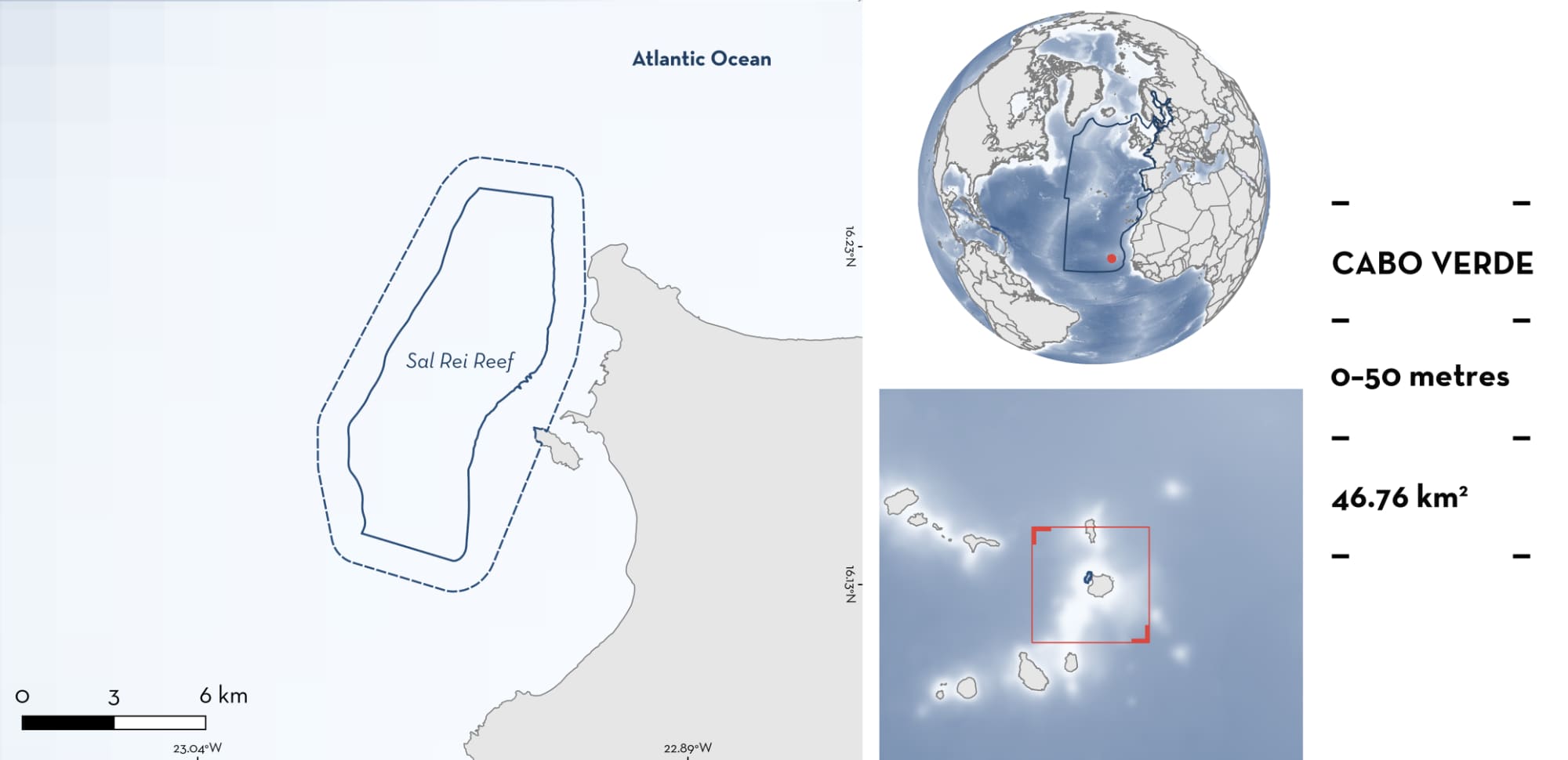
Sal Rei Reef is located off the coast of Boa Vista Island, Cabo Verde. The area is an offshore rocky reef west of the island. The habitat includes a mix of corals, sandy substrates, and sponges. It is under the influence of the Canary Current and the associated coastal upwelling. Within this area there are: threatened species and resting areas (Sand Tiger Shark Carcharias taurus).
Download factsheet
Sal Rei Reef
DESCRIPTION OF HABITAT
Sal Rei Reef is located off the coast of Boa Vista Island, Cabo Verde. It is an offshore rocky reef wall with caves west of the island (Divescover 2022; Soul Tours Cabo Verde 2022). The habitat includes a mix of corals, sandy substrates, and sponges (Malaquias et al. 2025).
The predominant direction of waves around Boa Vista Island is from the northeast under the influence of the Canary Current and the associated coastal upwelling (Peña-Izquierdo et al. 2012). Sea surface temperature in Cabo Verde ranges from approximately 22–25°C between December and June and from 25–28°C between July and November (Assokpa 2023).
This Important Shark and Ray Area is benthic and pelagic and is delineated from surface waters (0 m) to 50 m based on the bathymetry of the area.
CRITERION A
VULNERABILITY
One Qualifying Species considered threatened with extinction according to the IUCN Red List of Threatened Species regularly occurs in the area. This is the Critically Endangered Sand Tiger Shark (Rigby et al. 2021).
CRITERION C
SUB-CRITERION C3 – RESTING AREAS
Sal Rei Reef is an important resting area for one shark species.
Based on social media records and dive site descriptions from Cabo Verde, Sand Tiger Sharks regularly and predictably rest within this area. Animals are usually seen during recreational dives resting in pairs, slowly swimming around in caves (Divescover 2022; Soul Tours Cabo Verde 2022). Individual Sand Tiger Sharks are also sometimes observed in aggregations of 3–6 individuals comprised mainly of adults. These observations are based on the presence of long thick claspers for males, and females of similar size. Social media records (n = 9) were from December–June and span from 2014–2024. Sand Tiger Sharks achieve neutral buoyancy by gulping air into their stomach, which enables them to hover virtually motionless in mid-water to save energy (Ebert et al. 2021). This is the only area in Cabo Verde where Sand Tiger Sharks are regularly observed and are predictably resting.
Download factsheet
SUBMIT A REQUEST
ISRA SPATIAL LAYER REQUEST
To make a request to download the ISRA Layer in either a GIS compatible Shapefile (.shp) or Google Earth compatible Keyhole Markup Language Zipped file (.kmz) please complete the following form. We will review your request and send the download details to you. We will endeavor to send you the requested files as soon as we can. However, please note that this is not an automated process, and before requests are responded to, they undergo internal review and authorization. As such, requests normally take 5–10 working days to process.
Should you have questions about the data or process, please do not hesitate to contact us.