ISRA FACTSHEETS
ISRA FACTSHEETS
EUROPEAN ATLANTIC
West Coast of Clare
Summary
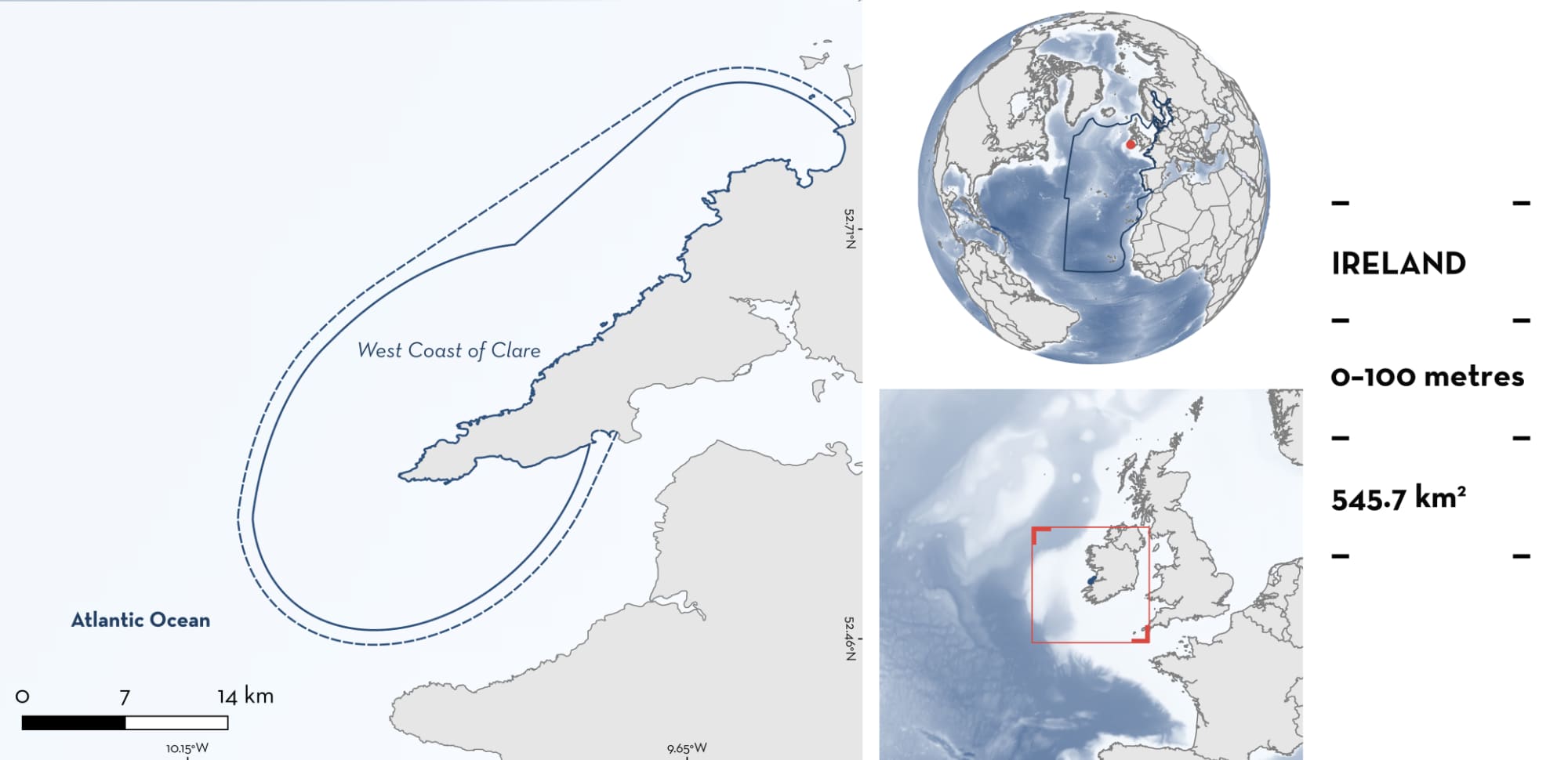
West Coast of Clare is located in County Clare on the west coast of Ireland. The area encompasses highly productive prominent headlands which are fed by the Lower Shannon Estuary, a funnel-shaped inlet leading to Loop Head with extensive estuarine–marine mixing, and the Shannon plume, where water from the Shannon Estuary mixes with water from the Atlantic Ocean. This area includes pelagic habitats, influenced by strong riverine inputs and productive coastal waters. Within this area there are: threatened species, reproductive areas, feeding areas, and areas with distinctive attributes (Basking Shark Cetorhinus maximus).
Download factsheet
West Coast of Clare
DESCRIPTION OF HABITAT
West Coast of Clare is situated on the west coast of Ireland. Geographically, the area lies on a gently sloping continental shelf that deepens to ~200 m before transitioning into the deeper Atlantic Ocean. The coastline around this area features sheltered estuarine waters, sandy and rocky bays, and prominent headlands.
The Lower Shannon Estuary is a funnel-shaped inlet which leads out to Loop Head with extensive estuarine–marine mixing, influenced by substantial freshwater discharge. The area is adjacent to the Shannon plume, which is where water from the Shannon Estuary mixes with water from the Atlantic Ocean, and small fronts and eddies aggregate prey, creating a highly productive ecosystem (Sims et al. 2022).
This Important Shark and Ray Area is pelagic and delineated from surface waters (0 m) to a depth of 100 m based on the bathymetry of the area and the maximum depth range of the habitat used by the Qualifying Species.
CRITERION A
VULNERABILITY
One Qualifying Species considered threatened with extinction according to the IUCN Red list of Threatened Species regularly occurs in this area. This is the Endangered Basking Shark (Rigby et al. 2021).
CRITERION C
SUB-CRITERION C1 – REPRODUCTIVE AREAS
West Coast of Clare is an important reproductive area for one shark species.
Each year, after an initial peak in sightings from April–June during which Basking Sharks are observed primarily feeding, a second peak in Basking Shark sightings occurs in the area from August–September (S Berrow & A McInturf pers. obs. 2025). During this second peak, the observed behaviours support the occurence of courtship. This behaviour includes the formation of groups of large mature individuals in a circling ‘torus’ with mixed sexes of individuals within each; scarring on female pectoral fins (potentially indicative of male bites, as has been shown in other shark species); close physical associations, parallel swimming, and following; and body rolling, exposing the ventral side of the individual to the nearest shark (Sims et al. 2022). These circling ‘torus’ courtship behaviours were first documented in August 2016, and again in 2021, 2022, and 2024 (Sims et al. 2022; Berrow et al. 2025). There is no other known site in the Northeast Atlantic Ocean where this behaviour has been consistently recorded.
CRITERION C
SUB-CRITERION C2 – FEEDING AREAS
West Coast of Clare is an important feeding area for one shark species.
Basking Sharks were regularly sighted in the area from 1992–2024 and reported to the Irish Basking Shark Group (IBSG unpubl. data 2025). Peak sightings are between April and May and during this season there have been a total of 75 sighting reports documenting 623 individual sharks. Only six sharks were reported in the spring prior to 2010 (IBSG unpubl. data 2025). No aggregations were recorded prior to 2010 but since then 42 aggregations have been recorded in the area during the boreal spring months (mean = 13.7 individuals; max = 85 individuals). Though these reports do not include behaviours, it is suspected that they are using the area for feeding as this is the primary behaviour observed in this area. Feeding (swimming with mouth open) is the main behaviour consistently observed during this season based on observations during visual identification tagging from 2008–2025 (S Berrow unpubl. data 2025) and acoustic tagging (n = 11 on one day in May 2025; A McInturf & T Chapple unpubl. data 2025). Specifically, Basking Sharks have been sighted solitary feeding and feeding in groups during calm weather windows, often with synchronized swimming (nose to tail, parallel swimming) (S Berrow & A McInturf pers. obs. 2025).
CRITERION C
SUB-CRITERION D1 – DISTINCTIVENESS
West Coast of Clare is an important area for distinctive behaviour of one shark species.
This is the only site in Ireland where the Basking Shark torus has been consistently recorded, with all observations recorded since 2016 (Sims et al. 2022). Globally, only the Northwest Atlantic (Nova Scotia) has recorded these circular torus behaviours during aerial surveys for whales (Harvey-Clark et al. 1999) and none have been recorded since 2014 (Sims et al. 2022). This identifies West Coast of Clare as of global significance for a critical part of the Basking Shark life history (courtship leading to mating), although mating has never been directly observed for this species. Breaching, another behaviour associated with courtship, has also been observed in the area (Motyer 2024).
Download factsheet
SUBMIT A REQUEST
ISRA SPATIAL LAYER REQUEST
To make a request to download the ISRA Layer in either a GIS compatible Shapefile (.shp) or Google Earth compatible Keyhole Markup Language Zipped file (.kmz) please complete the following form. We will review your request and send the download details to you. We will endeavor to send you the requested files as soon as we can. However, please note that this is not an automated process, and before requests are responded to, they undergo internal review and authorization. As such, requests normally take 5–10 working days to process.
Should you have questions about the data or process, please do not hesitate to contact us.