ISRA FACTSHEETS
ISRA FACTSHEETS
EUROPEAN ATLANTIC
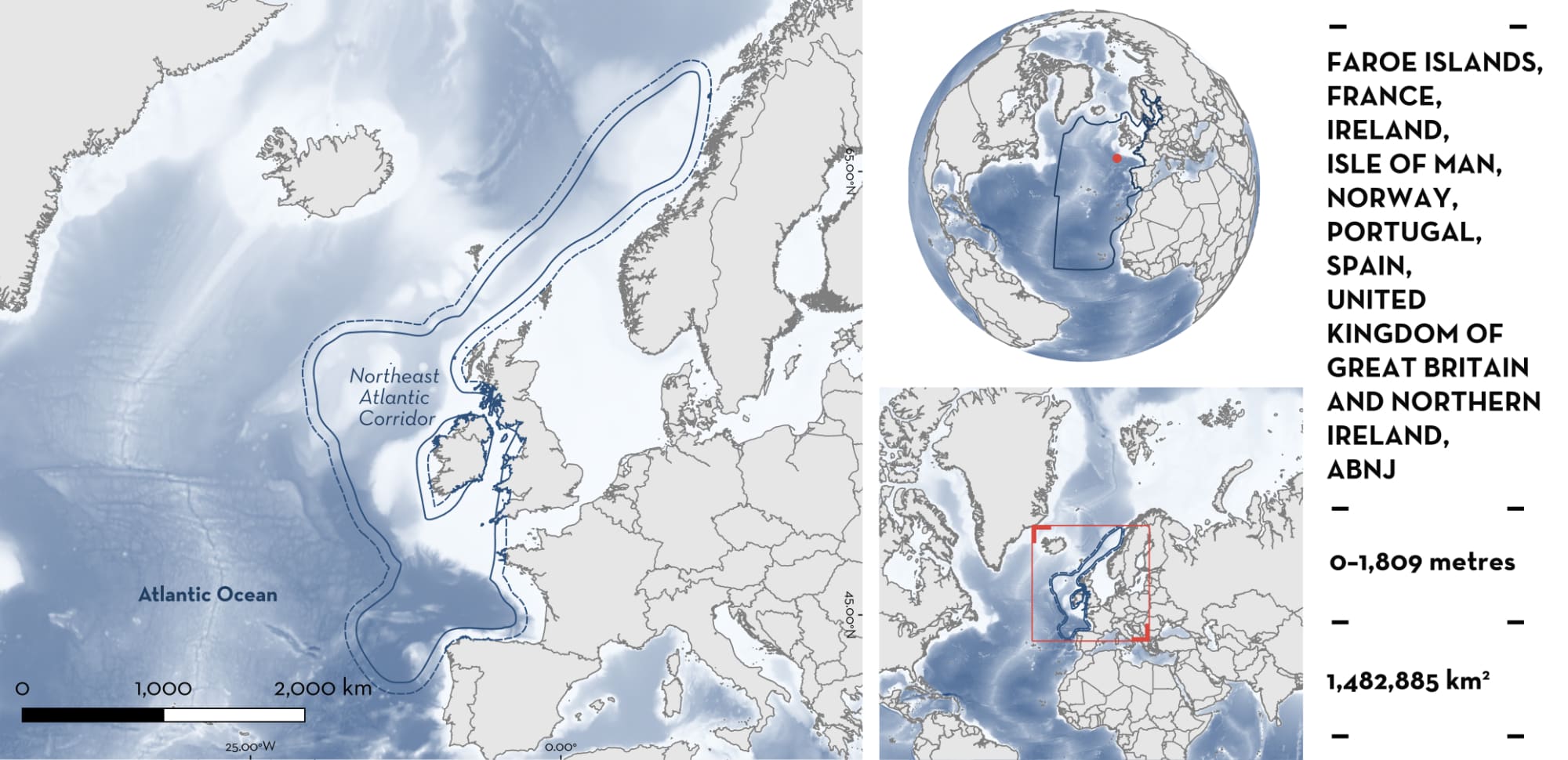
Northeast Atlantic Corridor
Summary
Northeast Atlantic Corridor spans from Norway in the north, via Faroe Islands, the United Kingdom of Great Britain and Northern Ireland, Ireland, Isle of Man, France, and Spain to northern Portugal. The area is characterised by pelagic waters mostly over the continental shelf break and also in offshore and shelf areas. It is mainly influenced by the Slope Current flowing northward along the continental slope. Within this area there are: threatened species (e.g., Porbeagle Lamna nasus); and areas important for movement (e.g., Basking Shark Cetorhinus maximus).
Download factsheet
Northeast Atlantic Corridor
DESCRIPTION OF HABITAT
Northeast Atlantic Corridor spans from Norway in the north, via Faroe Islands, the United Kingdom of Great Britain and Northern Ireland, Ireland, Isle of Man, France, and Spain to northern Portugal. It includes (from north to south) parts of the Norwegian Sea, the Faroe-Shetland Channel, Rockall Trough, Porcupine Bank and Porcupine Abyssal Plain, the Irish and Celtic seas, Bay of Biscay and Biscay Abyssal Plain, and the Iberian Abyssal Plain. This large area is characterised by pelagic waters mostly over the continental shelf break and also in offshore and shelf areas.
The area is mainly influenced by the Slope Current flowing northward along the continental slope, which is stronger in the boreal winter. The Slope Current is also stronger with increasing latitude (Huthnance & Gould 1989).
This Important Shark and Ray Area is pelagic and is delineated from surface waters (0 m) to 1,809 m based on the depth range of Qualifying Species globally.
CRITERION A
VULNERABILITY
Two Qualifying Species considered threatened with extinction according to the IUCN Red List of Threatened Species regularly occur in the area. These are the Endangered Basking Shark (Rigby et al. 2021) and the Vulnerable Porbeagle (Rigby et al. 2019).
CRITERION C
SUB-CRITERION C4 – MOVEMENT
Northeast Atlantic Corridor is an important movement area for two shark species.
Basking Sharks regularly use this corridor connecting feeding areas off Scotland with the Isle of Man, the Irish and Celtic seas, and the Bay of Biscay. A total of 28 Basking Sharks were tracked for an extended time from summer into the following winter, with individuals tracked with archival satellite tags (n = 12) and geolocation satellite tags (n = 16) deployed on the west coast of Scotland and off the Isle of Man in June, July, and August of 2012–2015 (Doherty et al. 2017).
While tracked Basking Sharks dispersed widely, their main post-summer migration areas were from the west coast of Scotland to the Celtic and Irish Seas. Three migration strategies were identified from tracks after the summer feeding aggregations (October onwards): (1) migrations linking the feeding areas off Scotland, Isle of Man, and Ireland (n = 13), with six individuals also entering Faroe Islands waters; (2) migrations from Scotland through the Celtic Sea into the Bay of Biscay of France and northern Spain (n = 10); and (3) similar migrations from Scotland through the Celtic Sea into the Bay of Biscay, but continuing on to Portugal and North Africa (n = 6) (Doherty et al. 2017). The majority of the tracked individuals (53.3%; n = 15) showed return migrations through this corridor to swim back to summer feeding grounds in spring (Doherty et al. 2017). Additionally, historical tracks of seven individuals tagged with archival satellite tags deployed off the Isle of Man in 2009 showed that five of these Basking Sharks (71.5%) swam south through the Irish Sea into the Celtic Sea through this corridor, with one continuing to the southern Bay of Biscay (Stéphan et al. 2011). Of another 12 tracked individuals tagged off Plymouth and in the Clyde Sea of Scotland in 2001 and 2002, 10 animals (83.3%) also migrated through this corridor (Sims et al. 2003, 2006), highlighting that this corridor has long been an important movement area for Basking Sharks.
Porbeagles regularly migrate through this area, connecting two spring-summer areas of high site fidelity in the Bay of Biscay and in the Atlantic Ocean northwest of Ireland to overwintering areas (Saunders et al. 2011, 2025; Biais et al. 2017; Bortoluzzi et al. 2024). Satellite telemetry studies have tracked nine Porbeagles from the Bay of Biscay in 2011 and 2013 using pop-up satellite archival tags (PSAT), with a track duration of 128–365 days (mean = 292 days) (Biais et al. 2017), and 11 individuals from off northwest Ireland (four with smart position or temperature [SPOT] tags, five with PSATs, and two with both tag types) between 2010–2014, with a track duration of 7–270 days (mean = 173 days) (Saunders et al. 2025). An additional three individuals were tagged off northwest Ireland in 2008 (Saunders et al. 2011), and two individuals in Ireland and one in Norway in 2022 (Bortoluzzi et al. 2024).
Four individuals, three tagged in Ireland and one in the Bay of Biscay, used the whole area, migrating between the Bay of Biscay and the Norwegian Sea. All four individuals used a relatively narrow channel between Shetland and the Faroe Islands for their movements in the northern part of the area, and two of them returned southwards again during the tracking period. Three additional Porbeagles migrated between Norway and Ireland through the same northern channel, with one making a return track, resulting in a total of seven sharks (25%) using the northern section of the area. Further, the central Norway coast, where this movement corridor ends, is a known hotspot for Porbeagle catches and is a potential feeding area (see Trøndelag & Nordland cISRA; González Triginer 2020). Thirteen of the tracks used the southern section of the area from the Bay of Biscay to the Iberian Abyssal Plains. The middle section of this area between the Rockall Trough off northwest Ireland and the Bay of Biscay was extensively used, with 16 individuals migrating through this part of the area, often on both the southern and northern legs of their tracks. They extensively used the continental slope to connect the two areas. Repeated observations of interannual fidelity for two different sites between spring and autumn seem to indicate that this return behaviour is common, if not general, in the species. It is probably motivated by foraging, but the observation of pregnant females and pups also shows that this fidelity may play a role in the reproduction of the species (Biais et al. 2017). Additionally, a fishery targeting Porbeagle between 2000–2008 mostly captured the species on the shelf break to the west of the English Channel and France, in the southern Celtic Sea, and in the Bay of Biscay, all encompassed within this area (Hennache & Jung 2010). Combined, the tracking data show that Porbeagles regularly use this area, and in particular the shelf break from the Bay of Biscay to northwest of Ireland when leaving or returning to their residential area from spring to autumn.
Download factsheet
SUBMIT A REQUEST
ISRA SPATIAL LAYER REQUEST
To make a request to download the ISRA Layer in either a GIS compatible Shapefile (.shp) or Google Earth compatible Keyhole Markup Language Zipped file (.kmz) please complete the following form. We will review your request and send the download details to you. We will endeavor to send you the requested files as soon as we can. However, please note that this is not an automated process, and before requests are responded to, they undergo internal review and authorization. As such, requests normally take 5–10 working days to process.
Should you have questions about the data or process, please do not hesitate to contact us.