
ISRA FACTSHEETS
ISRA FACTSHEETS
AUSTRALIA AND SOUTHEAST INDIAN OCEAN
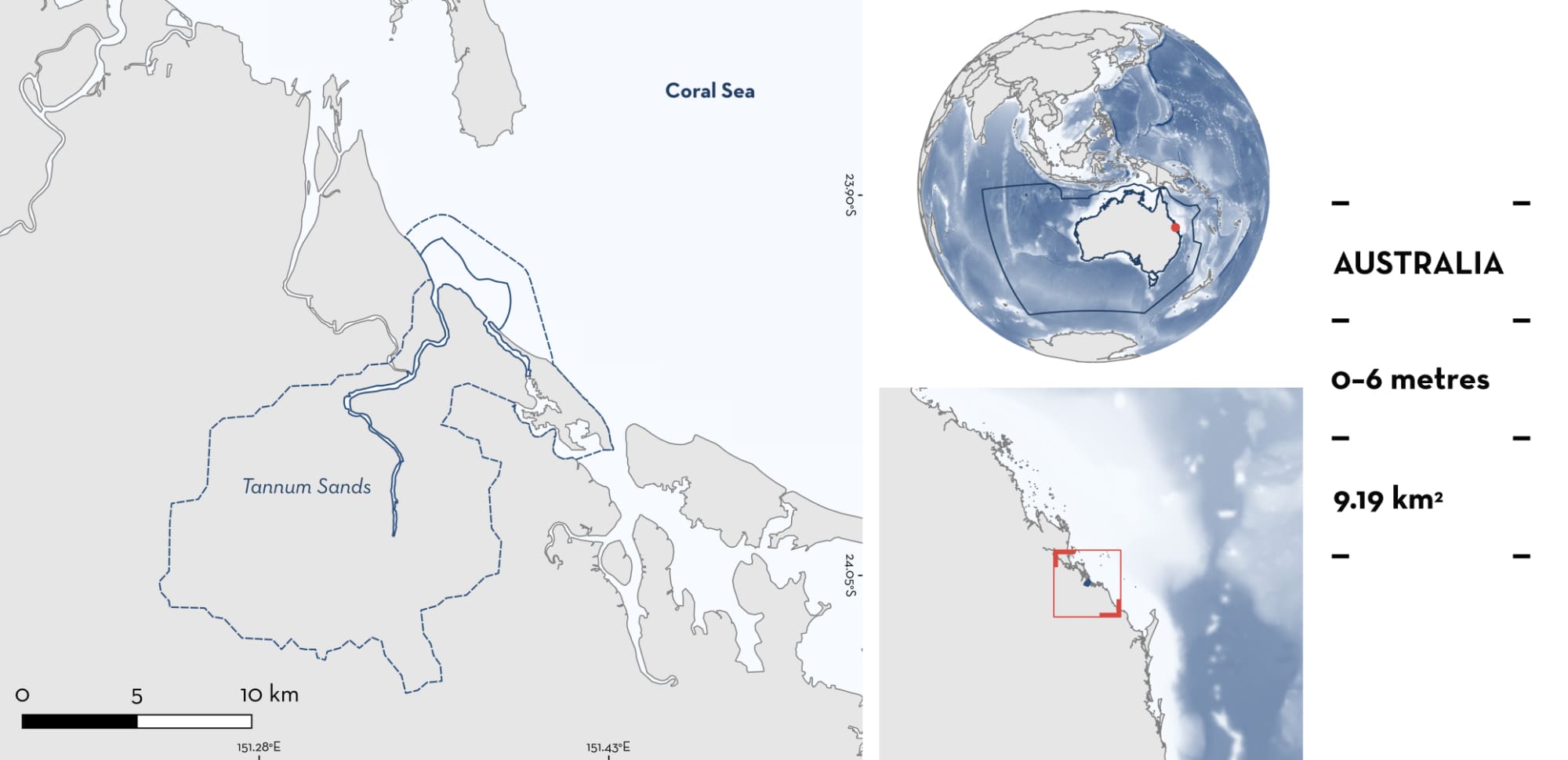
Tannum Sands
Summary
Tannum Sands is located on the central Queensland coast, Australia. The area is situated on the southern edge of Port Curtis and includes Boyne Island and the lower part of the Boyne River and Wild Cattle Creek. The habitat is characterised by sandy beaches, sandbars, extensive mangroves, and estuaries. The area is influenced by a local estuarine circulation and the East Australian Current, as well as strong local tidal flows and pronounced sediment mobility. Within this area there are: threatened species and reproductive areas (Bull Shark Carcharhinus leucas).
Download factsheet
Tannum Sands
DESCRIPTION OF HABITAT
Tannum Sands is located on the central Queensland coast, Australia. The area is situated on the southern edge of Port Curtis and includes the Boyne River and Wild Cattle Creek. It extends from the river mouth to Benaraby, ~8 km upstream including Boyne Island. The Boyne River drains a catchment of ~ 2,496 km2 and enters the Coral Sea (DES 2024). The habitat is characterised by sandy beaches, sandbars, saltmarsh, extensive mangroves, and estuaries.
The area is influenced by the East Australian Current, as well as strong local tidal flows and pronounced sediment mobility, with large, suspended particulate loads and turbidity variability driven by tidal exchange and water inputs from the Boyne River (GRC 2022). The prevailing winds are predominantly from the east, with wind speeds typically below 15 m/s. Southeasterly winds account for the largest proportion of strong wind events. The region is partially sheltered from southeasterly and southerly winds by the Rodds Peninsula and Middle Island (GRC 2022). Sediment transport around Boyne Island and Tannum Sands is primarily driven by wind and tidal processes, contributing to longshore currents generated near the shoreline and by waves breaking at oblique angles, which mobilise and transport sand along the coast (GRC 2022). The wave climate consists of locally generated, fetch-limited wind waves, as well as offshore swell that propagates across the Great Barrier Reef before reaching the coast (GRC 2022).
This Important Shark and Ray Area is benthic and pelagic and is delineated from inshore and surface waters (0 m) to 6 m based on the bathymetry of the area.
CRITERION A
VULNERABILITY
One Qualifying Species considered threatened with extinction according to the IUCN Red List of Threatened Species regularly occurs in the area. This is the Vulnerable Bull Shark (Rigby et al. 2021).
CRITERION C
SUB-CRITERION C1 – REPRODUCTIVE AREAS
Tannum Sands is an important reproductive area for one shark species.
Young-of-the-year (YOY) and juvenile Bull Sharks are regularly reported in this area in the Queensland Shark Control Program (QSCP; QSCP 2025) and in social media posts.
Between 1996–2025, the QSCP used year-round deployments of a combination of gillnets and drumlines along 85 beaches in Queensland. Drumlines and gillnets were positioned ~500–1,000 m from the shoreline, with gillnets running 186 m parallel to the shoreline, with a gauge of 50 cm and a 6 m drop (Banaghan et al. 2025; QSCP 2025). Species, sex, and size were recorded for all sharks caught.
Between 1996–2022, the area recorded the highest catch-per-unit-effort (CPUE) of Bull Sharks along the Queensland coast (Banaghan et al. 2025). Between 2021–2025, a total of 210 Bull Sharks were captured in the area within the QSCP, of which 53 (n = 25.2%) measured <100 cm total length (TL) (QSCP 2025). The size-at-birth for the species is 56–81 cm TL and YOY can be up to 99 cm TL (Pillans et al. 2020; Ebert et al. 2021), indicating that all 53 individuals were neonates or YOY. These neonate and YOY Bull Sharks were recorded in 2005 (n = 8) and then resuming after a decade without captures in 2016 (n = 1), 2017 (n = 1), 2018 (n = 4), 2019 (n = 19), 2020 (n = 2), 2021 (n = 3), 2022 (n = 5), 2023 (n = 4), 2024 (n = 5), and 2025 (n = 1; QSCP 2025). Early life-stage individuals were captured throughout the year (except in June), but most (72%) were observed between December–April (QSCP 2025). During this period, Tannum Sands registered the highest capture of Bull Sharks along the Queensland coast, and the highest number (similar to Emu Park) of individuals of <100 cm TL (QSCP 2025). Social media posts show that the species is also regularly captured in the Boyne River up to Benaraby within the area by recreational fishers.
This information indicates that Tannum Sands is an important area for early life-stages of Bull Sharks. Although the area is located only ~70 km south of the Keppel Bay-Fitzroy River, which also hosts important habitat for young Bull Sharks, these coastal areas and river systems are individually important. Bull Sharks in Australia display natal philopatry, with females returning to particular river systems to pup (Tillett et al. 2012; Lubitz 2023). For example, half-sibling pairs were found within a river on Australia’s east coast up to seven cohorts apart, highlighting the long-term natal philopatry of females (Lubitz 2023). Therefore, individual rivers and coastal habitats in this region represent discrete portions of habitat that are important to Bull Sharks.
Download factsheet
SUBMIT A REQUEST
ISRA SPATIAL LAYER REQUEST
To make a request to download the ISRA Layer in either a GIS compatible Shapefile (.shp) or Google Earth compatible Keyhole Markup Language Zipped file (.kmz) please complete the following form. We will review your request and send the download details to you. We will endeavor to send you the requested files as soon as we can. However, please note that this is not an automated process, and before requests are responded to, they undergo internal review and authorization. As such, requests normally take 5–10 working days to process.
Should you have questions about the data or process, please do not hesitate to contact us.

