ISRA FACTSHEETS
ISRA FACTSHEETS
AUSTRALIA AND SOUTHEAST INDIAN OCEAN
Wreck Bay
Summary
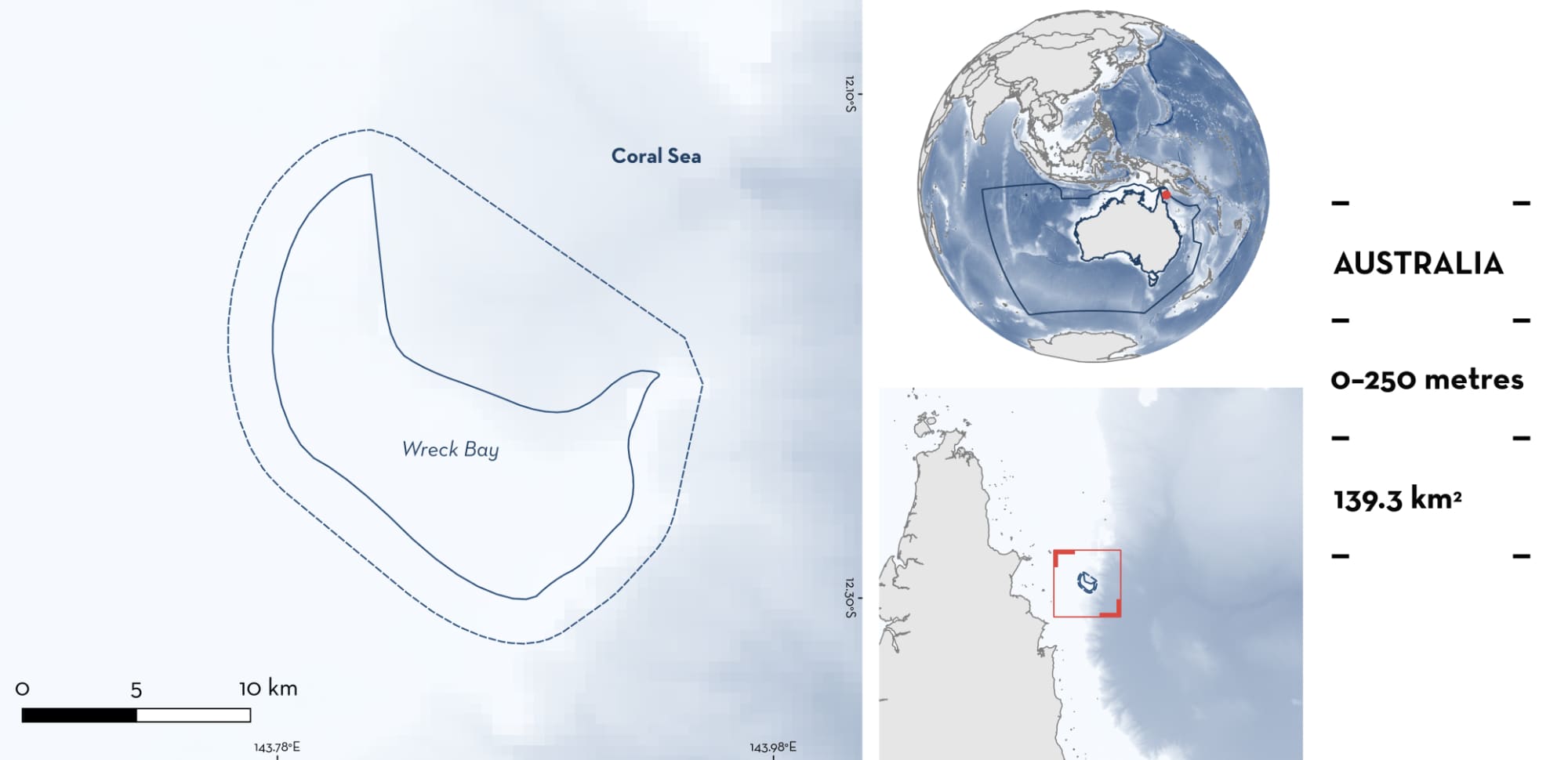
Wreck Bay is located off northeast Queensland, Australia. The area is a semi-enclosed, eastward-facing embayment on the outer continental shelf, bounded by shelf-edge barrier reefs of the Great Barrier Reef. The area features shallow coral reefs along its margins and a steep, funnel-shaped bathymetry that connects directly to the Coral Sea Basin. This high productivity area is influenced by seasonal monsoon dynamics and the North Queensland Current. The area overlaps with the Great Barrier Reef Marine Park. Within this area there are: threatened species and feeding areas (Whale Shark Rhincodon typus).
Download factsheet
Wreck Bay
DESCRIPTION OF HABITAT
Wreck Bay is located within the Great Barrier Reef off northeast Queensland, Australia. The area is characterised by a semi-enclosed, eastward-facing embayment located on the outer continental shelf of the far northern Great Barrier Reef, bounded by shelf-edge barrier reefs, including Mantis Reef to the south and the Wishbone Reef system to the north. The habitat is characterised by pelagic waters and is defined by shallow coral reefs influenced by tidal shelf waters. Wreck Bay has a funnel-like bathymetry that slopes steeply from near-surface reefs to over 1,000 m depth at its entrance, continuing to depths exceeding 3,000 m into the adjacent Coral Sea Basin (Hopley & Smithers 2019). The seafloor substrate within the bay and surrounding shelf areas is predominantly composed of carbonate gravel and gravelly sand (Mathews et al. 2007).
The region is strongly influenced by the North Queensland Current, a northward-flowing Western Boundary Current which forms part of a persistent cyclonic gyre system along the outer reef (Choukroun et al. 2010). Wreck Bay lies within a region affected by seasonal monsoon dynamics, with the northeast Australian monsoon driving coastal and shelf-edge upwelling events (Wolanski et al. 1988; Berkelmans et al. 2010; Kingsford & Wolanski 2019; Sun et al. 2024). These upwelling events elevate nutrient levels in the otherwise oligotrophic waters of the outer shelf, increasing productivity during the austral summer monsoon season from November–February (Wolanski & Hammer 1998). The semi-enclosed shape of the bay and physical protection from prevailing winds and swell likely enhance plankton accumulation and retention, distinguishing it from adjacent open shelf areas where upwelling-induced zooplankton are likely to be more rapidly dispersed (Miller et al. 2025).
Wreck Bay overlaps with the Great Barrier Reef Marine Park – Marine National Park Zone (UNEP-WCMC & IUCN 2025).
The Important Shark and Ray Area is pelagic and is delineated from surface waters (0 m) to a depth of 250 m based on the bathymetry of the area.
CRITERION A
VULNERABILITY
One Qualifying Species considered threatened with extinction according to the IUCN Red List of Threatened Species regularly occurs in the area. This is the Endangered Whale Shark (Pierce et al. 2025).
CRITERION C
SUB-CRITERION C2 – FEEDING AREAS
Wreck Bay is an important feeding area for one shark species.
Annual surveys using spotter planes and boats were conducted in this area in November and December from 2019–2024. Whale Sharks were photo-identified and their behaviour recorded. A total of 158 Whale Sharks were observed during the aerial surveys, and 59 individuals were photo-identified over the course of the four field expeditions with 5–7 survey days per trip (Miller et al. 2025).
The Whale Shark aggregation is dominated by juvenile males (male/female ratio = 3.5:1) (Miller et al. 2025; IB Miller et al. unpubl. data 2025). Feeding sharks were directly observed by researchers on eight occasions, and two further feeding aggregations were recorded by citizen scientists in 2011 and 2020 (IB Miller et al. unpubl. data 2025). In these observations, Whale Sharks were feeding at the surface. Group sizes of feeding Whale Sharks ranged from 1–50 with a mean of 7.2 individuals (± 14.2 standard deviation). Half of the feeding encounters were during the day and comprised 1–2 individuals (n = 5 observations); however, individuals (n = 2 observations) and groups of feeding Whale Sharks were predominantly observed around sunset and into the night (n = 3 observations; 3, 15–20, and 50 individuals, respectively). Analysis of 30 Whale Sharks tracked with SPOT tags that transmit locations whenever the shark is at the surface showed that surface activity within the aggregation area peaks at sunset and early hours of the night (IB Miller et al. unpubl. data 2025). These tracks further support that feeding regularly occurs at sunset in this area.
Preliminary analysis of zooplankton sampled from two of the nocturnal feeding observations indicates a dominance of krill species (euphausiids), with planktonic tunicates, amphipods, calanoid copepods, and medusozoans also present (Miller et al. 2025). Wreck Bay’s funnel-shaped reef formation, with a steep slope opening eastward into deep water, creates sheltered conditions that likely help accumulate and retain zooplankton (Miller et al. 2025). Seasonal upwelling during the monsoon, from November to February, brings nutrient-rich water to the surface (Berkelmans et al. 2010; Kingsford & Wolanski 2019; Sun et al. 2024), promoting plankton blooms that appear to concentrate within this area, making it a reliable feeding area for Whale Sharks. This is further supported by several return migrations recorded by the satellite-tagged Whale Sharks. One individual tagged in Wreck Bay in 2021 dispersed widely within the Coral Sea over its 770 days track, and returned to this area in November/December in 2022 and again in 2023 (Miller et al. 2025). Similarly, a Whale Shark tagged in 2023 returned to the area in 2024 (Miller et al. 2025). Additionally, one photo-identified individual was re-sighted in the year following its initial identification in 2023. Wreck Bay is the only known location on the east coast of Australia and in the greater Coral Sea area where Whale Sharks regularly and predictably aggregate to feed.
Download factsheet
SUBMIT A REQUEST
ISRA SPATIAL LAYER REQUEST
To make a request to download the ISRA Layer in either a GIS compatible Shapefile (.shp) or Google Earth compatible Keyhole Markup Language Zipped file (.kmz) please complete the following form. We will review your request and send the download details to you. We will endeavor to send you the requested files as soon as we can. However, please note that this is not an automated process, and before requests are responded to, they undergo internal review and authorization. As such, requests normally take 5–10 working days to process.
Should you have questions about the data or process, please do not hesitate to contact us.