ISRA FACTSHEETS
ISRA FACTSHEETS
AUSTRALIA AND SOUTHEAST INDIAN OCEAN
Cabbage Tree Bay
Summary
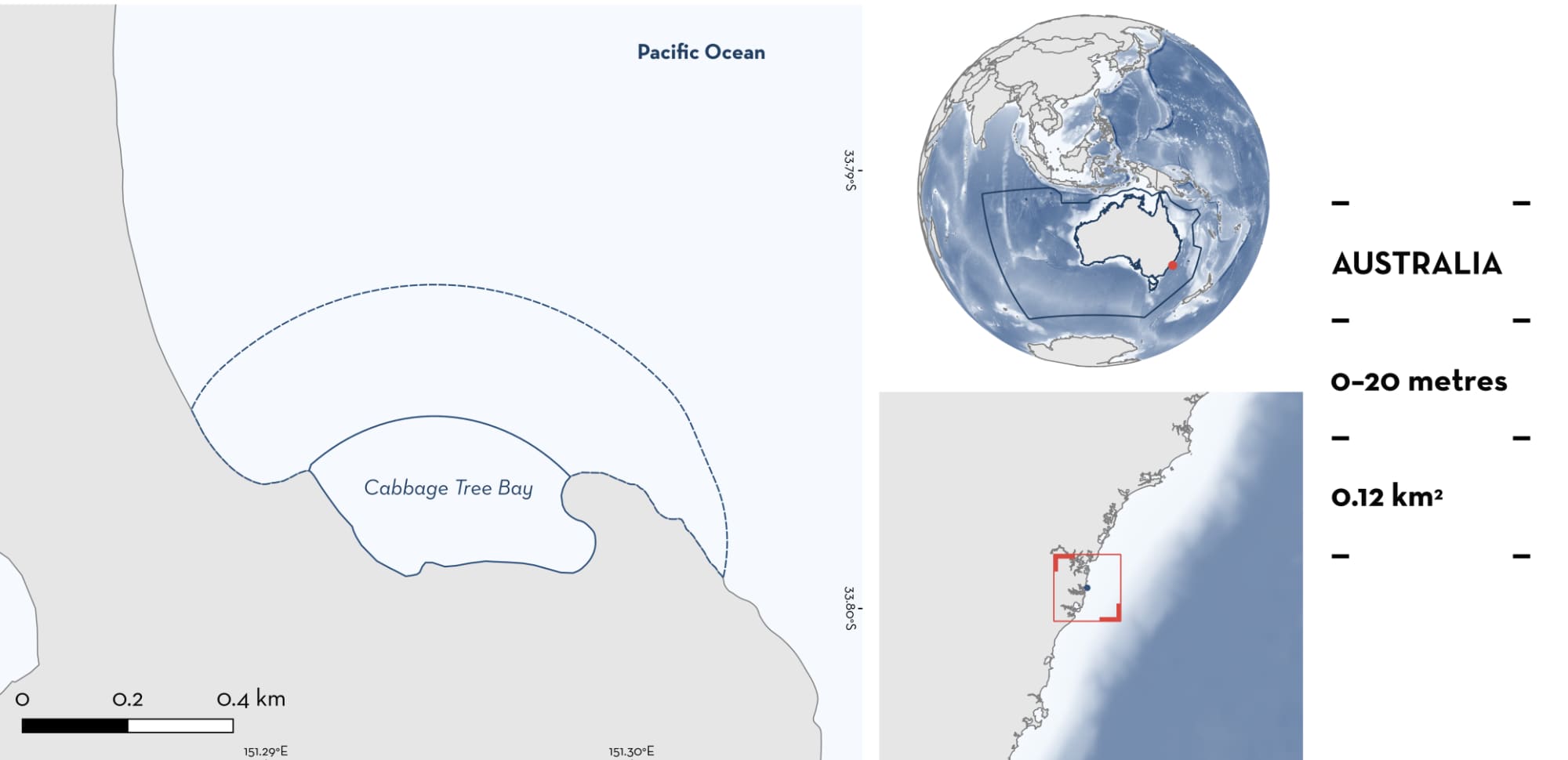
Cabbage Tree Bay is located in Sydney, New South Wales, Australia. This bay encompasses Manly Beach and Shelley Beach. The area is characterised by sandy beaches, rocky formations, seagrass, and kelp forests. It is sheltered from powerful swells and is influenced by the East Australian Current. The area overlaps with the Cabbage Tree Bay Aquatic Reserve. Within this area there are: threatened species (Dusky Shark Carcharhinus obscurus); and undefined aggregations (e.g., Port Jackson Shark Heterodontus portusjacksoni).
Download factsheet
Cabbage Tree Bay
DESCRIPTION OF HABITAT
Cabbage Tree Bay is located in Sydney, New South Wales, Australia. The area is a small north-facing Bay and encompasses the north-facing Manly Beach and west-facing Shelley Beach (NSW DPIRD 2025). It is characterised by sandy beaches, rocky formations, Posidonia seagrass, and kelp forests (Hello Manly 2025; Snorkelverse 2025).
The area is relatively sheltered with calm waters and is protected from powerful southeasterly swells and surges (Hello Manly 2025; Snorkelverse 2025). The main current that influences the area is the East Australian Current (Ridgway & Hill 2009). Sea surface temperature ranges between 17–23°C.
The area overlaps with the Cabbage Tree Bay Aquatic Reserve (NSW DPIRD 2025).
This Important Shark and Ray Area is benthic and pelagic and is delineated from inshore and surface waters (0 m) to 20 m based on the bathymetry of the area.
CRITERION A
VULNERABILITY
One Qualifying Species considered threatened with extinction according to the IUCN Red List of Threatened Species regularly occurs in the area. This is the Endangered Dusky Shark (Rigby et al. 2019).
CRITERION C
SUB-CRITERION C5 – UNDEFINED AGGREGATIONS
Cabbage Tree Bay is an important area for undefined aggregations of two shark species.
Between 2010–2025, depending on weather conditions, recreational divers undertook 2–3 dives per day, every day in this area (except for up to two weeks of holiday each year) (W Prior pers. obs. 2025; G Willis pers. obs. 2025).
Divers have regularly and predictably observed aggregations of Dusky Sharks in this area. These are observed annually and seasonally during the austral summer and autumn (January–April). Aggregations comprised 4–6 individuals, which were always immature (including neonates/young-of-the-year) based on visual estimation of their size (80–120 cm total length; TL). The size-at-birth of this species is 69–100 cm TL (Ebert et al. 2021). These aggregations are larger and more frequently recorded than in adjacent areas, although those locations may have a lower dive frequency due to this area being known for regular and predictable observations (W Prior pers. obs. 2025; G Willis pers. obs. 2025).
Since at least 2010, divers have also regularly and predictably observed aggregations of Port Jackson Sharks in this area. Aggregations are observed annually and seasonally during spring (September–November). Recreational divers anecdotally report aggregations of ~25 individuals, but aggregations of up to 40 individuals have been recorded (W Prior pers. obs. 2025; G Willis pers. obs. 2025). The function of these aggregations may be for reproductive purposes based on the observation of several mating events and egg cases within the area (e.g., YouTube 2022), which are generally eaten by other Port Jackson Sharks before hatching. Aggregations of Port Jackson Sharks in this area are larger and more frequently recorded than in adjacent areas, although those locations may have a lower dive frequency due to this area being known for regular and predictable observations.
Further information is required to understand the nature and the function of these aggregations.
Download factsheet
SUBMIT A REQUEST
ISRA SPATIAL LAYER REQUEST
To make a request to download the ISRA Layer in either a GIS compatible Shapefile (.shp) or Google Earth compatible Keyhole Markup Language Zipped file (.kmz) please complete the following form. We will review your request and send the download details to you. We will endeavor to send you the requested files as soon as we can. However, please note that this is not an automated process, and before requests are responded to, they undergo internal review and authorization. As such, requests normally take 5–10 working days to process.
Should you have questions about the data or process, please do not hesitate to contact us.