ISRA FACTSHEETS
ISRA FACTSHEETS
AUSTRALIA AND SOUTHEAST INDIAN OCEAN
Nguthungulli Julian Rocks
Summary
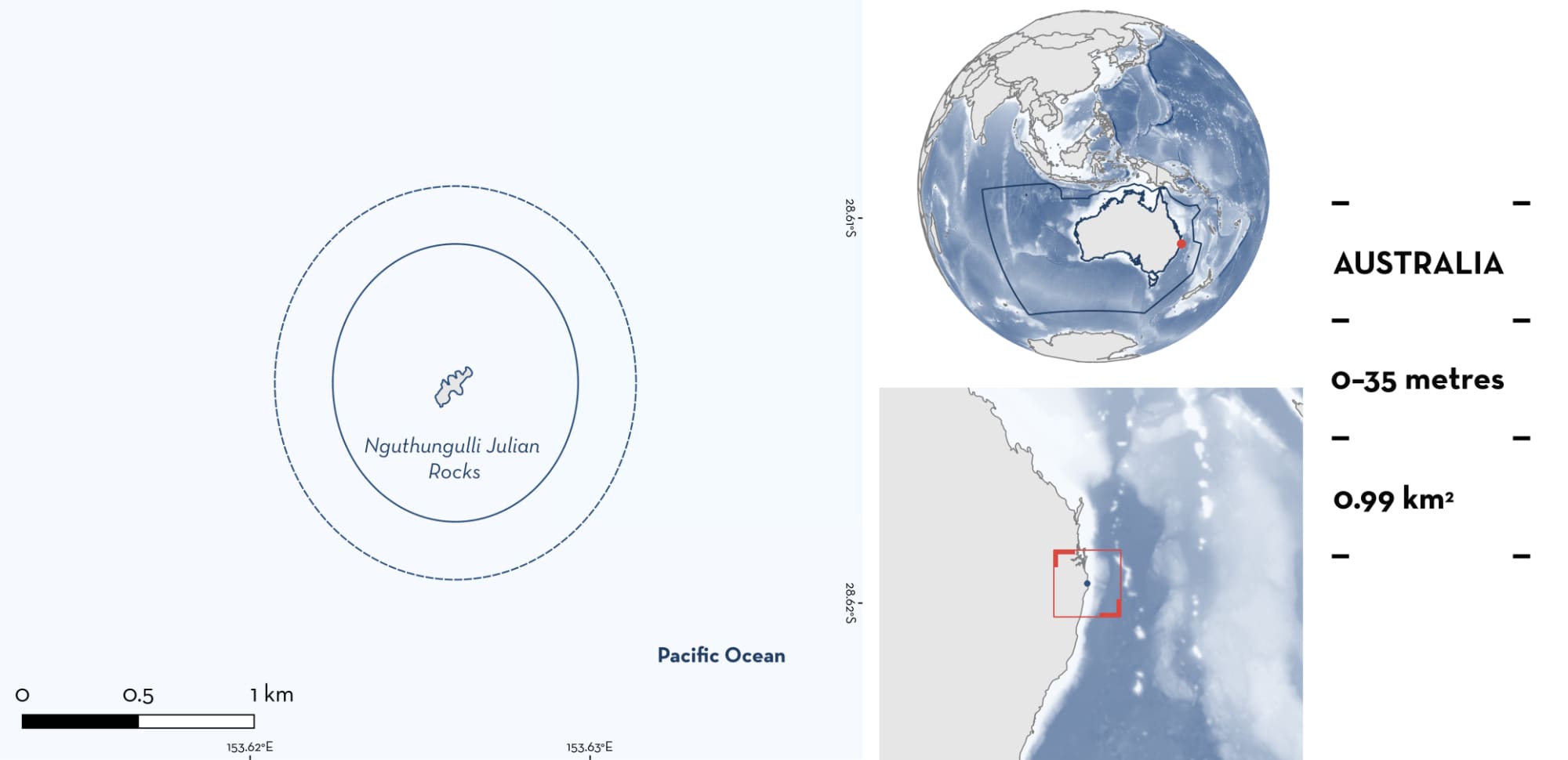
Nguthungulli Julian Rocks is located off Byron Bay in New South Wales, Australia. The habitat around this small volcanic islet includes rocky reefs, sandy and mixed sediments, patchy coral communities, and submerged pinnacles. The area is influenced by the East Australian Current, which accelerates in this region and generates seasonal upwelling and sustains a recurrent nearshore thermal front, most pronounced during the austral spring and summer. The area overlaps with Cape Byron Marine Park. Within this area there are: threatened species (e.g., Spotted Eagle Ray Aetobatus ocellatus); range-restricted species (e.g., Colclough’s Shark Brachaelurus colcloughi); resting areas (e.g., Sand Tiger Shark Carcharias taurus); undefined aggregations (e.g., Reef Manta Ray Mobula alfredi); and distinctive attributes (Indo-Pacific Leopard Shark Stegostoma tigrinum).
Download factsheet
Nguthungulli Julian Rocks
DESCRIPTION OF HABITAT
Nguthungulli Julian Rocks is located ~2 km off Byron Bay in New South Wales, Australia. This small volcanic islet complex encompasses a diverse mosaic of habitats, including rocky reefs, sandy and mixed sediments, patchy coral communities, and submerged pinnacles (NSW DECC 2007; NSW MPA 2010). The islets are erosional remnants of the Miocene-aged Tweed Volcano Province, composed of basalt–rhyolite lithologies, with adjacent underwater terrain marked by shallow platforms, walls, gutters, and caves ranging from 5–24 m depth (Bryant & Daily 1995).
The continental shelf is narrow in this region (average ~25 km wide) and dominated by the East Australian Current, a western boundary current flowing south along the slope at speeds up to 2 m/s (Ridgway & Dunn 2003). At Walgun Cape Byron, the shelf constricts and the East Australian Current accelerates, generating an upwelling bottom boundary layer and sustaining a recurrent nearshore thermal front, most pronounced during austral spring and summer (Oke & Middleton 2001; Roughan & Middleton 2002). These fronts typically exhibit cross-shelf temperature gradients of 2–3°C and are associated with elevated surface chlorophyll and enhanced primary productivity (Everett et al. 2014).
The area is influenced by seasonal upwelling and frontal activity which stimulate phytoplankton blooms that in turn drive concentrations of zooplankton and small pelagic fishes (Suthers et al. 2011). These prey fields attract higher trophic levels, including schooling reef fishes and planktivores that form dense aggregations around the reef slopes and pinnacles. In addition, the interaction of the East Australian Current with local reef topography promotes vertical mixing and nutrient renewal, creating short-term pulses of planktonic prey that support recurrent congregations of large predatory fishes and marine megafauna (Roughan & Middleton 2002; Suthers et al. 2011).
This area overlaps with Cape Byron Marine Park (NSW DPIRD 2025).
This Important Shark and Ray Area is benthic and pelagic and is delineated from inshore and surface waters (0 m) to 35 m based on the bathymetry of the area.
CRITERION A
VULNERABILITY
Six Qualifying Species considered threatened with extinction according to the IUCN Red List of Threatened Species regularly occur in the area. Threatened sharks comprise one Critically Endangered species, one Endangered species, and one Vulnerable species; threatened rays comprise one Endangered species and two Vulnerable species (IUCN 2025).
CRITERION B
RANGE RESTRICTED
This area holds the regular presence of Colclough’s Shark and Ornate Wobbegong as resident range-restricted species. Both species occur year-round and are regularly encountered by recreational divers in the area (MA Bradtke, T Hughes, DP Robinson, & N Swain pers. obs. 2025). Between 2018–2025, weekly recreational dives (weather permitting) in the area have reported Colclough’s Shark during ~60% of dives and Ornate Wobbegongs on ~90% of dives. Both species are cryptic, hiding deep under rocks, and can easily be missed unless actively searching for them.
All observations of Colclough’s Sharks are of animals resting under rocky crevices and in caves (MA Bradtke, T Hughes, DP Robinson, & N Swain pers. obs. 2025). In 2024, four dedicated dive surveys in the summer months found Colclough’s Sharks on each dive. This area is the only known recreational dive site in New South Wales where this species is regularly and predictably observed (DP Robinson pers. obs. 2025). A study of the species’ distribution reported Nguthungulli Julian Rocks as the southern extent of the geographic range, with 24% (n = 12) of records of the species from northern New South Wales (Kyne et al. 2011). Colclough’s Sharks occur primarily in the East Central Australian Shelf Large Marine Ecosystem (LME) and only marginally into the Northeast Australian Shelf LME.
An average of five Ornate Wobbegongs were observed during recreational dives in the area (range 1–10 individuals; T Hughes, DP Robinson, & N Swain pers. obs. 2025). Anecdotal reports confirm the presence of pregnant females, pupping, and neonates, suggesting the area may be important for reproduction for this species. Neonates have been recorded at least five times in this area (January 2021, April 2022, March 2024, September 2025, October 2025; DP Robinson unpubl. data 2025). Sizes were visually estimated at <20 cm total length (TL), with the known size-at-birth for this species of 20 cm TL (Ebert et al. 2021). In addition to these recent sightings, an aggregation of neonates (n = ~10) was observed in the area in 2015 (M Gray pers. comm. 2025). Citizen science generated sighting records highlight the importance of this area for this species, with more than half (n = 13; 56.5%) of sightings from the broader region (n = 23; Brunswick Heads to Evans Head, ~70 km) being from this area (iNaturalist 2025). Ornate Wobbegongs occur in the East Central Australian Shelf and Northeast Australian Shelf LMEs.
CRITERION C
SUB-CRITERION C3 – RESTING AREAS
Nguthungulli Julian Rocks is an important resting area for two shark species.
Between 2018–2025, weekly recreational dives were conducted in the area year-round (T Hughes & N Swain unpubl. data 2025). Sand Tiger Sharks were observed on all dives between May–October, with occasional sharks seen during other months. On average, ~20 Sand Tiger Sharks are observed on a single 50-minute dive (range 5–50 individuals, depending on weather conditions and visibility). All records are of Sand Tiger Sharks swimming slowly in groups between the trenches and rocky reefs found in this area, which is characteristic resting behaviour for this species (T HHughes & N Swain pers. obs. 2025). Sand Tiger Shark sightings have been logged on Sharkbook from citizen science submissions, with photo-identification used to identify individuals (Spot a Shark unpubl. data 2025). Between 2004–2025, 794 sightings were submitted, with 244 individuals identified using photo-identification. Overall, 90% (n = 714) of these sightings were logged between May–October (Spot a Shark unpubl. data 2025), supporting the regular and predictable nature of this species’ resting aggregation in this area.
Between 2018–2025, weekly recreational dives were conducted in the area (T Hughes & N Swain unpubl. data 2025). Grey Carpetsharks were observed on ~80% of dives between December–May, with occasional sharks seen outside this period. On average, two Grey Carpetsharks are observed on a single 50-minute dive (range 1–5 sharks, depending on weather conditions and visibility). Almost all sightings (~95%) are of Grey Carpetsharks resting under rocky crevices and in caves (T Hughes & N Swain pers. obs. 2025). Grey Carpetsharks are known as crepuscular/nocturnal foragers and rest during daylight hours (Harahush et al. 2008). All observations of resting sharks in this area were made during recreational dives in daylight hours, supporting their observed habitat use. This area provides the substrate and structural habitat for this species to rest with relative protection in comparison to the surrounding sandy substrates outside the area, and the species is not observed in surrounding waters outside the area during daylight hours.
CRITERION C
SUB-CRITERION C5 – UNDEFINED AGGREGATIONS
Nguthungulli Julian Rocks is an important area for undefined aggregations of two shark and five ray species.
Between 2018–2025, weekly recreational dives were conducted in the area (T Hughes & N Swain pers. obs. 2025). Spotted Wobbegongs were observed on all dives year-round. On average, ~30 Spotted Wobbegongs were observed aggregating in the area on a single 50-minute dive (range 10–50 sharks, depending on weather conditions and visibility). An analysis of wobbegong sighting records from recreational divers in New South Wales confirmed that some of the highest densities of observations were reported in this area (Huveneers et al. 2009). In addition, 114 sightings of Spotted Wobbegongs have been reported on iNaturalist (iNaturalist 2025). Feeding has been recorded on at least 10 occasions, with prey consisting of octopus, sharks (e.g., Blind Sharks), baitfish, and pufferfish (DP Robinson pers. obs. 2025). Pregnant females have also been observed in the area, however, more information is needed to understand why Spotted Wobbegongs aggregate in high numbers at Nguthungulli Julian Rocks.
Between 2018–2025, weekly recreational dives were conducted in the area year-round (T Hughes & N Swain unpubl. data 2025). Indo-Pacific Leopard Sharks were observed on all dives between December–April, with occasional individuals seen in other months. On average ~10 Indo-Pacific Leopard Sharks are observed on a single 50-minute dive (range 2–50 individuals, depending on weather conditions and visibility). The majority of sightings are of actively swimming sharks, using the water column, rather than resting on the sand. A photo-identification database for Indo-Pacific Leopard Sharks has collected information on individuals from citizen science and researcher-collected sightings in the area (Cape Byron Leopard Shark Project unpubl. data 2025). Overall, 599 individuals have been identified from sightings between 2006–2025 (n = 460 females; n = 74 males; n = 65 unknown sex). Of these individuals, there has been 1,880 encounters, with 95.8% of sightings (n = 1,801) falling between December–April. The function of these aggregations may be for reproductive purposes as the majority of Indo-Pacific Leopard Sharks that aggregate in this area are females (86%), and all are mature individuals. In addition, some pre-copulatory behaviours have been observed (males chasing and trying to bite female’s tail; DP Robinson pers. obs. 2025).
Between 2018–2025, weekly recreational dives were conducted in the area (T Hughes & N Swain unpubl. data 2025). Spotted Eagle Rays were observed on ~90% of dives year-round. There is no apparent seasonal peak in their aggregations at this site, with aggregations of rays observed during every month of the year (DP Robinson pers. obs. 2025). On average, five Spotted Eagle Rays are observed on a single 50-minute dive (range 1–25 individuals, depending on weather conditions and visibility). Most observations (~80%) are of aggregations of Spotted Eagle Rays (3+ individuals) gliding in the water column, often hanging in the current, with occasional individuals observed feeding in the sandy substrate (T Hughes & N Swain pers. obs. 2025). This area likely provides good resting habitat for this species, given the strong currents and natural trenches in the area.
Between 2018–2025, weekly recreational dives were conducted in the area (T Hughes & N Swain unpubl. data 2025). Reef Manta Rays were observed on ~20% of dives between December–April, with occasional rays seen outside this period. Usually, one Reef Manta Ray is observed on a single 50-minute dive, but up to five animals have been seen together (depending on weather conditions and visibility). The majority of sightings (~90%) are of Reef Manta Rays gliding over the rocky reefs being cleaned by cleaner wrasse (T Hughes & N Swain pers. obs. 2025). Between 2008–2025, there were 346 sightings of 184 individual Reef Manta Rays identified using photo-identification submitted by citizen scientists from the area (Project Manta unpubl. data 2025). Forty sightings had the associated behaviour of the Reef Manta Rays recorded, with 92.5% (n = 37) of these noting cleaning behaviour. Images of more than three individuals were submitted from citizen scientists visiting the area on 26 days (n = 3 on 13 days, n = 4 on eight days, n = 5 on two days, n = 6 on two days, and n = 7 on one day), with up to seven individual Reef Manta Rays recorded during a single day (up to 8 hours) using photo-identification (Project Manta unpubl. data 2025). This is the only location south of The Group in Queensland (~130 km north) where Reef Manta Rays are regularly and predictably observed to aggregate during the summer months and thus represents an important habitat for this species in their annual seasonal migrations.
Between 2018–2025, weekly recreational dives were conducted in the area year-round (T Hughes & N Swain unpubl. data 2025). Coral Sea Maskrays were observed on all dives between December–April, with occasional rays seen during other months. On average, 20 Coral Sea Maskrays are observed on a single 50-minute dive during these peak months (range 1–70 individuals, depending on weather conditions and visibility). The majority of Coral Sea Maskrays encountered are reported as female, and courtship has been observed (<10 times in this area) whereby the male bites onto the female’s pectoral fins to initiate mating (although mating itself has not been observed; DP Robinson pers. obs. 2025).
Between 2018–2025, weekly recreational dives were conducted in the area (T Hughes & N Swain unpubl. data 2025). Australian Cownose Rays were observed on ~10% of dives between October–May. On average, ~40 Australian Cownose Rays are observed on a single 50-minute dive (range 1–100 individuals, depending on weather conditions and visibility). Observations are generally of Australian Cownose Rays swimming in large aggregations, and it can be difficult to determine the extent and exact size of the aggregations (DP Robinson pers. obs. 2025). Anecdotal reports confirm the seasonal basis to these aggregations, with local skippers reporting sightings every day on the water during the summer months (M Gray pers. comm. 2025).
Between 2018–2025, weekly recreational dives were conducted in the area (T Hughes & N Swain unpubl. data. 2025). Blotched Fantail Rays were observed on ~90% of dives year-round. On average, two Blotched Fantail Rays are observed on a single 50-minute dive (range 1–10 rays, depending on weather conditions and visibility), with aggregations of >3 individuals common. Most observations are of Blotched Fantail Rays resting on the benthos or in the current between the trenches, with only rare observations of feeding. However more information is needed to understand their aggregations in this area. This species is not observed in surrounding waters outside the area, highlighting the importance of this area for this species.
More information is needed to understand the nature and function of these aggregations.
CRITERION D
SUB-CRITERION D1 – DISTINCTIVENESS
Nguthungulli Julian Rocks is an area with distinctive attributes for one shark species.
The area is important for large aggregations of mostly female Indo-Pacific Leopard Sharks actively swimming during all observations. It hosts the largest known aggregation of this species worldwide where more individuals have been identified than any other location around the world (n = 599 individuals between 2019–2025). The vast majority of sightings are of sharks actively swimming using the water column (>90%), rather than resting on the substrate. In every other location worldwide where this species is known to aggregate, most observations are of low numbers of individuals, with a mixture of males and females, resting on sandy substrates (e.g., Phi Phi Islands ISRA in Thailand; Jabado et al. 2024; DP Robinson pers. obs. 2025). Aggregations in this area are strongly female biased (86% females), and dominated by large, mature individuals. In addition, there is a strong seasonal element to the aggregations with 95.8% of sightings falling between December–April, potentially indicating the area may serve a specific life-history function such as pre-breeding conditioning or thermoregulation. The area is also positioned at the confluence of subtropical and temperate currents, a transition zone with significant biological implications (Suthers et al. 2011). In other parts of the species distribution, Indo-Pacific Leopard Sharks most reliably aggregate in tropical and subtropical reefs (e.g., Thailand, The Maldives, Philippines, and Papua New Guinea). No persistent aggregation sites have been recorded at higher latitudes than this area in northern New South Wales (~29°S; DP Robinson pers. obs. 2025). The active swimming behaviour of Indo-Pacific Leopard Sharks in this area is distinctive, alongside the predictable seasonal observations of large aggregations (average n = >10) that are not observed at any other aggregation site globally.
Download factsheet
SUBMIT A REQUEST
ISRA SPATIAL LAYER REQUEST
To make a request to download the ISRA Layer in either a GIS compatible Shapefile (.shp) or Google Earth compatible Keyhole Markup Language Zipped file (.kmz) please complete the following form. We will review your request and send the download details to you. We will endeavor to send you the requested files as soon as we can. However, please note that this is not an automated process, and before requests are responded to, they undergo internal review and authorization. As such, requests normally take 5–10 working days to process.
Should you have questions about the data or process, please do not hesitate to contact us.