ISRA FACTSHEETS
ISRA FACTSHEETS
AUSTRALIA AND SOUTHEAST INDIAN OCEAN
Ngari Capes
Summary
Ngari Capes is located in southwest Western Australia, Australia. The area encompasses the Land and Sea Country of the Wadandi people represented by the Karri Karrak Aboriginal Corporation. This coastal area encompasses protected seagrass meadows as well as higher-energy coastlines with macroalgae and limestone reefs. Within the area there are: range-restricted species (e.g., Blackspotted Catshark Aulohalaelurus labiosus).
Download factsheet
Ngari Capes
DESCRIPTION OF HABITAT
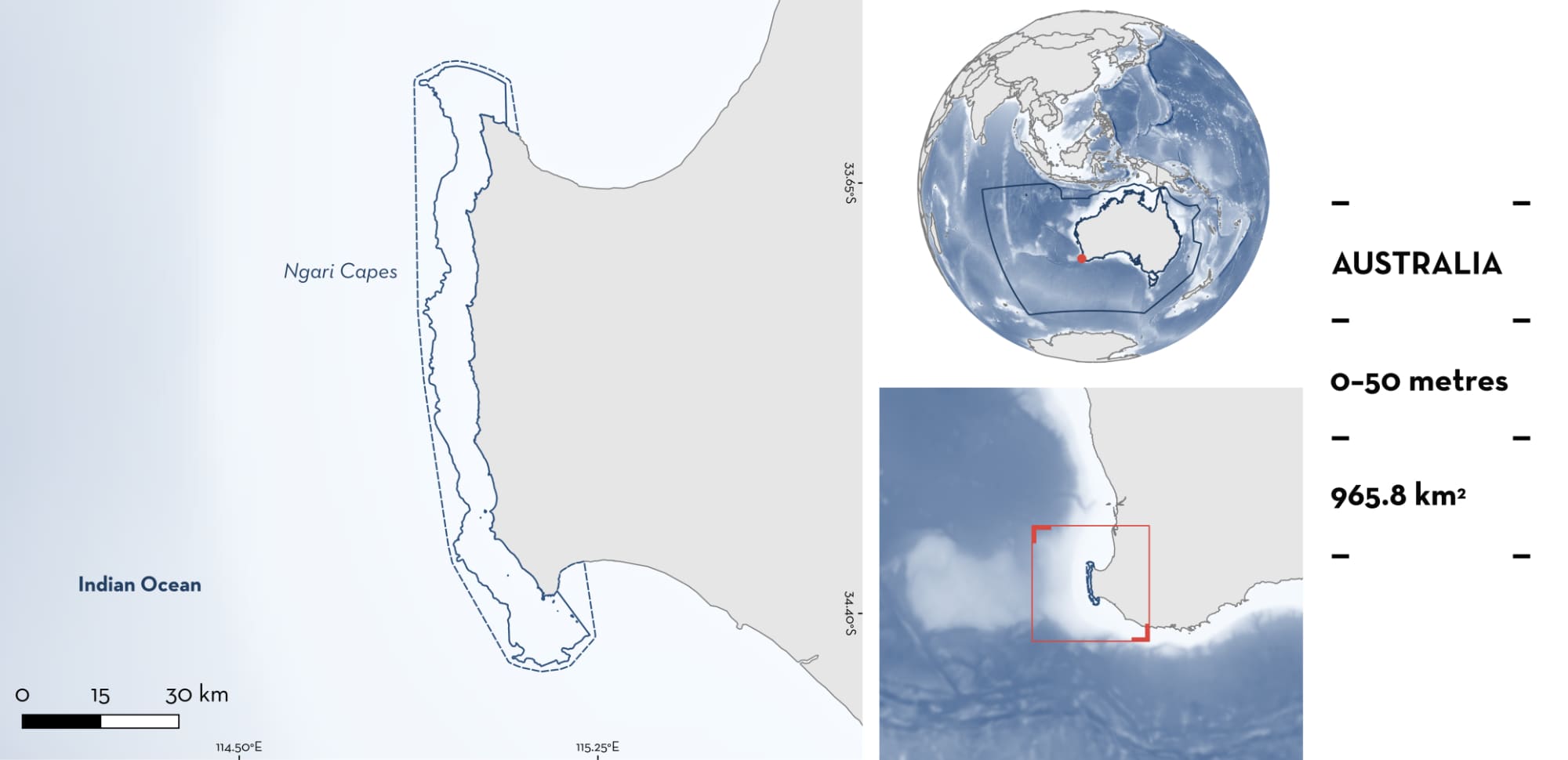
Ngari Capes is located on the coast of southwest Western Australia, Australia. It is situated between Cape Naturaliste and Cape Leeuwin. The area encompasses the Land and Sea Country of the Wadandi people represented by the Karri Karrak Aboriginal Corporation. It is characterised by seagrass meadows and higher-energy coastlines with macroalgae and limestone reefs (Gaynor 2014).
The area is influenced by significant nutrient input from runoff. It is partially sheltered from the southern Indian Ocean climate and generally maintains warmer conditions than more exposed regions (Gaynor 2014). Localised upwelling of nutrient-rich water occurs at the continental shelf break, influenced by the Leeuwin Current, which transports warm, oligotrophic water from northern Australia. A seasonal nutrient peak is observed in winter, primarily due to surface water runoff (Gaynor 2014). However, primary production during this period is limited by reduced light availability resulting from shorter day length and increased turbidity (Hanson et al. 2005).
This Important Shark and Ray Area is benthic and pelagic and is delineated from inshore and surface waters (0 m) to 50 m based on the bathymetry of the area.
CRITERION B
RANGE RESTRICTED
This area holds the regular presence of Blackspotted Catshark, Western Wobbegong, Cobbler Wobbegong, Western Shovelnose Stingaree, Masked Stingaree, and Circular Stingaree as resident range-restricted species.
Between 2006–2024, sharks and rays were recorded using a benthic stereo baited remote underwater video system (BRUVS) between Abrolhos Bank and the Recherche Archipelago in southwest Western Australia. Kernel Density Analysis (KDA) per species was extracted from the database of deployments where at least one shark or ray was recorded (Marine Futures Lab unpubl. data 2006–2024). As absence data were not available, results reflect areas of higher occurrence of records. Of 3,618 deployments in 11 main regions of southwest Australia (~362 deployments per region ranging 154–749), 743 were within this area (2006 = 63, 2007 = 184, 2008 = 16, 2009 = 169, 2010 = 311). Benthic surveys after 2010 were only conducted outside this area, in the Recherche Archipelago (2019, 2021, 2022, 2023, 2024) and Cockburn Sound (2020, 2021). The analysis showed that this area had the highest occurrence of Blackspotted Catshark, Western Wobbegong, and Circular Stingaree, and the second of highest occurrence of Western Shovelnose Stingaree and Masked Stingaree, all recorded between 1.5–50 m depth (Marine Futures Lab unpubl. data 2006–2024).
Between 2006–2019, a total of 102 BRUVS deployments recorded Blackspotted Catsharks in eight of the 11 main regions (two regions are outside the known distribution of the species), from Abrolhos Bank to the Recherche Archipelago (2006–2010 = 93; 2019 = 9). Of these, 71 (69.6%) records were from this area (2006–2010) (Marine Futures Lab unpubl. data 2006–2024). Blackspotted Catsharks were recorded in 9.5% (71 of 743) of deployments in this area, while in the remaining regions it was recorded in 0.5–2.0% of deployments. One record from iNaturalist from 2020 supports the species’ ongoing occurrence in this area (iNaturalist 2025).
Between 2008–2019, a total of 46 BRUVS deployments recorded Western Wobbegongs in five of the 11 main regions, from Abrolhos Bank to the Recherche Archipelago (2008–2010 = 44; 2018 = 1; 2019 = 1). Of these, 29 (63%) were from this area (2008–2010) (Marine Futures Lab unpubl. data 2006–2024). Western Wobbegongs were recorded in 3.9% (29 of 743) of deployments in this area, while in the remaining regions it was recorded in 0.1–2.1% of deployments. Contemporary records from iNaturalist (n = 7; 2020–2025) confirm the species’ ongoing occurrence in the area (iNaturalist 2025).
Cobbler Wobbegongs were only recorded in two deployments from the BRUVS database, one within this area and one outside the area, in the Recherche Archipelago (Marine Futures Lab unpubl. data 2006–2024). A comprehensive database of shark, ray, and chimaera occurrences across Western Australia (WA) using fisheries data has been compiled (Species Distribution Modeling Project [SDMP] unpubl. data 2025). Data were obtained from (1) logbook and observer programs from the Australian Fisheries Management Authority (AFMA) and Department of Primary Industries and Regional Development (DPIRD) WA, covering all commercial sectors, multiple gear types, and both targeted and incidental catch records; (2) biodiversity repositories including Global Biodiversity Information Facility (GBIF) and Ocean Biodiversity Information System (OBIS); (3) the Atlas of Living Australia providing georeferenced species-level occurrence records from museums, research institutions, and citizen science and where missing or erroneous coordinates and invalid, ambiguous, updated names, and outdated names were removed; (4) survey data that encompassed heterogeneous sources, including institutional surveys (DPIRD WA, Australian Ocean Data Network [AODN], Commonwealth Scientific and Industrial Research Organisation [CSIRO], and IMOS [Integrated Marine Observing System]); and (5) published and unpublished datasets sourced from academic researchers. Based on this information, this area has the highest number of records of Cobbler Wobbegongs across Western Australia. Based on contemporary (2010–2024) fisheries records in this area (n = 32,766 shots), Cobbler Wobbegong was recorded 23 times in the area from 2012, 2013, 2020, and 2021 (SDMP unpubl. data 2025).
Between 2007–2022, a total of 45 BRUVS deployments recorded Western Shovelnose Stingaree in six of the 11 main regions (one region is outside the known distribution of the species), from Rottnest Island to the Recherche Archipelago (2007 = 42; 2008 = 3; 2022 = 1). Of these, 13 (28.9%) were from this area (all in 2007) while 25 (46.7%) were from Two Peoples Bay (all in 2007), and the remaining seven are from four different areas, highlighting this as the second largest cluster (Marine Futures Lab unpubl. data 2006–2024). Western Shovelnose Stingaree were recorded in 1.8% (13 of 743) of deployments in this area, the second largest after Two Peoples Bay where it was recorded in 14.3% of the deployments in that area, while in the remaining regions it was recorded in 0.1–0.9% of deployments. Contemporary records from iNaturalist from 2025 (n = 3) confirm the species’ ongoing occurrence in the area (iNaturalist 2025).
Between 2007–2010, a total of 23 BRUVS deployments recorded Masked Stingaree in six of the 11 main regions (two regions are outside the known distribution of the species), from Rottnest Island to Two Peoples Bay. Of these, 10 (43.5%) were from this area (2007 = 2; 2008 = 4; 2009 = 3; 2010 = 1) (Marine Futures Lab unpubl. data 2006–2024). Masked Stingaree were recorded in 1.4% (10 of 743) of deployments in this area, the second largest after Rottnest Island where it was recorded in 1.9% of the deployments in that area, while the remaining regions it was recorded in 0.4–0.7% of deployments. Contemporary records from iNaturalist (n = 12; 2023–2025) confirm the species’ ongoing occurrence (iNaturalist 2025). Records of Masked Stingaree from iNaturalist are mostly from the Perth metro coast, this area, and Rottnest Island, the latter with only three records (iNaturalist 2025).
Between 2006–2010, a total of 17 BRUVS deployments recorded Circular Stingaree in four of the 11 main regions (three regions are outside the known distribution of the species), from Two Rocks to this area (2006, 2009, 2010), of which 12 (all in 2010) were within this area (Marine Futures Lab unpubl. data 2006–2024). Circular Stingaree were recorded in 6.6% (12 of 743) of deployments in this area, while the remaining regions it was recorded in 0.2–1.3% of deployments. Contemporary records from iNaturalist (n = 6; 2022–2025) confirm the species’ ongoing occurrence in the area (iNaturalist 2025).
Blackspotted Catsharks, Western Wobbegongs, Cobbler Wobbegongs, Western Shovelnose Stingaree, Masked Stingaree, and Circular Stingaree are restricted to the South West Australian Shelf Large Marine Ecosystem (LME) and the West Central Australian Shelf LME.
Download factsheet
SUBMIT A REQUEST
ISRA SPATIAL LAYER REQUEST
To make a request to download the ISRA Layer in either a GIS compatible Shapefile (.shp) or Google Earth compatible Keyhole Markup Language Zipped file (.kmz) please complete the following form. We will review your request and send the download details to you. We will endeavor to send you the requested files as soon as we can. However, please note that this is not an automated process, and before requests are responded to, they undergo internal review and authorization. As such, requests normally take 5–10 working days to process.
Should you have questions about the data or process, please do not hesitate to contact us.