
ISRA FACTSHEETS
ISRA FACTSHEETS
AUSTRALIA AND SOUTHEAST INDIAN OCEAN
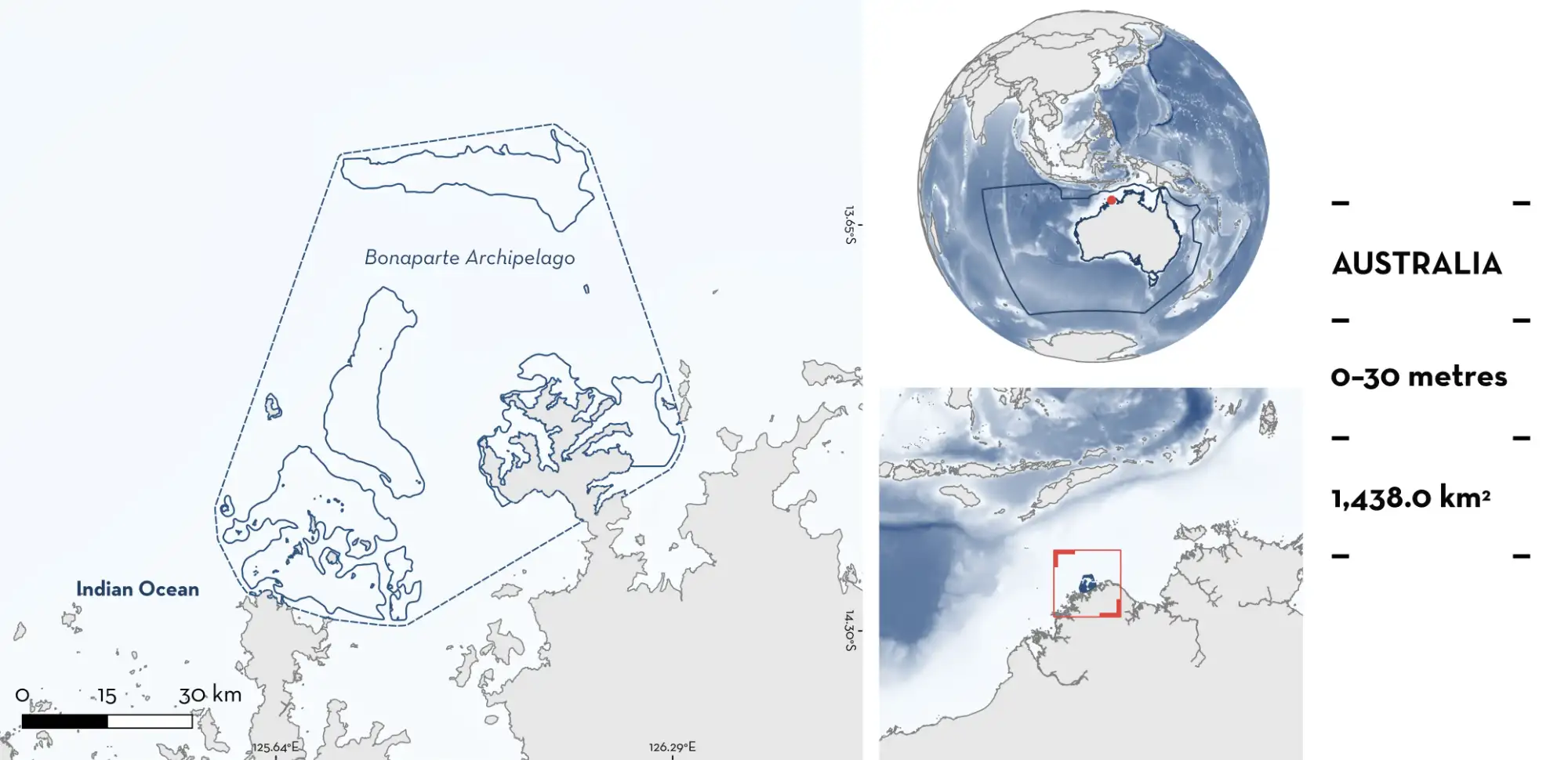
Bonaparte Archipelago
Summary
Bonaparte Archipelago is located in the Kimberley region of Western Australia, Australia. This area encompasses many islands that are mostly small, including islets and emergent rocks. The habitat is characterised by reefs, mangroves, seagrass, and mud and sand sandflats, and is exposed to large tidal fluctuations and high turbidity. This area overlaps with North Kimberley Marine Park. Within this area there are: threatened species and reproductive areas (Blacktip Reef Shark Carcharhinus melanopterus).
Download factsheet
Bonaparte Archipelago
DESCRIPTION OF HABITAT
Bonaparte Archipelago is located in the Kimberley region of Western Australia, Australia. It is situated in the Balanggarra, Wunambal Gaambera, Ngarinyin, and Miriuwung Gajerrong Countries. The archipelago is made up of several hundred islands and islets lying off a stretch of coastline between Collier Bay to the southwest and Admiralty Gulf to the northeast, including islands in Admiralty Gulf itself. The islands are mostly small, including islets or emergent rocks. Several submerged banks and shoals are also found within this area. The habitat is characterised by reef (225 species of hard corals have been recorded in the intertidal zone), mangroves, seagrass, and mud and sand sandflats (Wilson 2013; Richards et al. 2015).
This area is exposed to large tidal fluctuations (~8 m tides), and turbidity (Richards et al. 2015). This area is influenced by broader-scale currents including the Indonesian Throughflow (via the inner North-West Shelf). Rainfall is typically restricted to the austral summer monsoonal period between December–May.
This area overlaps with North Kimberley Marine Park (WA DBCA 2025).
This Important Shark and Ray Area is benthic and pelagic and is delineated from inshore and surface waters (0 m) to 30 m based on the depth range of Qualifying Species in the area.
CRITERION A
VULNERABILITY
One Qualifying Species considered threatened with extinction according to the IUCN Red List of Threatened Species regularly occurs in the area. This is the Vulnerable Blacktip Reef Shark (Simpfendorfer et al. 2020).
CRITERION C
SUB-CRITERION C1 – REPRODUCTIVE AREAS
Bonaparte Archipelago is an important reproductive area for one shark species.
Synthesised data from the Global Archive and The Fish Collective for Baited Remote Underwater Video System (BRUVS) surveys were extracted after quality control was undertaken using CheckEM (GlobalArchive 2025; The Fish Collective 2025; Gibbons et al. in press). From ~5,200 BRUVS surveys conducted mostly in Western Australia (2011–2024) within the geographic range of Blacktip Reef Sharks, stereo-BRUVS yielded body size measurements for 845 Blacktip Reef Sharks. Of these, 266 (31%) were neonates or young-of-the-year (YOY) (measuring 44.0–73.9 cm total length; TL) (GlobalArchive 2025; The Fish Collective 2025). In northeastern Australia, size-at-birth of the species is 58–67 cm TL, and YOY Blacktip Reef Sharks measure 58–73 cm TL (Chin et al. 2013). Here, we consider neonate/YOY as individuals measuring <74 cm TL. In 2015, 2016, and 2018, 212 BRUVS were deployed in this area between 0–63 m depth. A total of 87 neonate and YOY (44.0–73.7 cm TL) Blacktip Reef Sharks were recorded in this area (2015 = 4; 2016 = 38; 2018 = 45), representing 32.7% of all records in the nation-wide BRUVS survey dataset (GlobalArchive 2025; The Fish Collective 2025). Within this area, 19 adults were recorded, representing 10.3% of all adults documented in the nation-wide BRUVS dataset.
This area comprises multiple sites, reflecting the small home ranges of neonatal Blacktip Reef Sharks, which result in several nursery locations being dispersed along the coast. In Moorea (French Polynesia) research using mark-recapture and acoustic telemetry has shown that home ranges for this species are very small, likely due to the deep channels and the fragmented habitat (Bouyoucos et al. 2020). Additionally, pregnant female Blacktip Reef Sharks exhibit philopatry, returning to the same nursery for each birthing event (Mourier & Planes 2013). These factors together explain the presence of multiple nursery areas or sites that are crucial for neonate and YOY Blacktip Reef Sharks.
Download factsheet
SUBMIT A REQUEST
ISRA SPATIAL LAYER REQUEST
To make a request to download the ISRA Layer in either a GIS compatible Shapefile (.shp) or Google Earth compatible Keyhole Markup Language Zipped file (.kmz) please complete the following form. We will review your request and send the download details to you. We will endeavor to send you the requested files as soon as we can. However, please note that this is not an automated process, and before requests are responded to, they undergo internal review and authorization. As such, requests normally take 5–10 working days to process.
Should you have questions about the data or process, please do not hesitate to contact us.

