ISRA FACTSHEETS
ISRA FACTSHEETS
CENTRAL AND SOUTH AMERICAN PACIFIC REGION
Canoas de Punta Sal
Summary
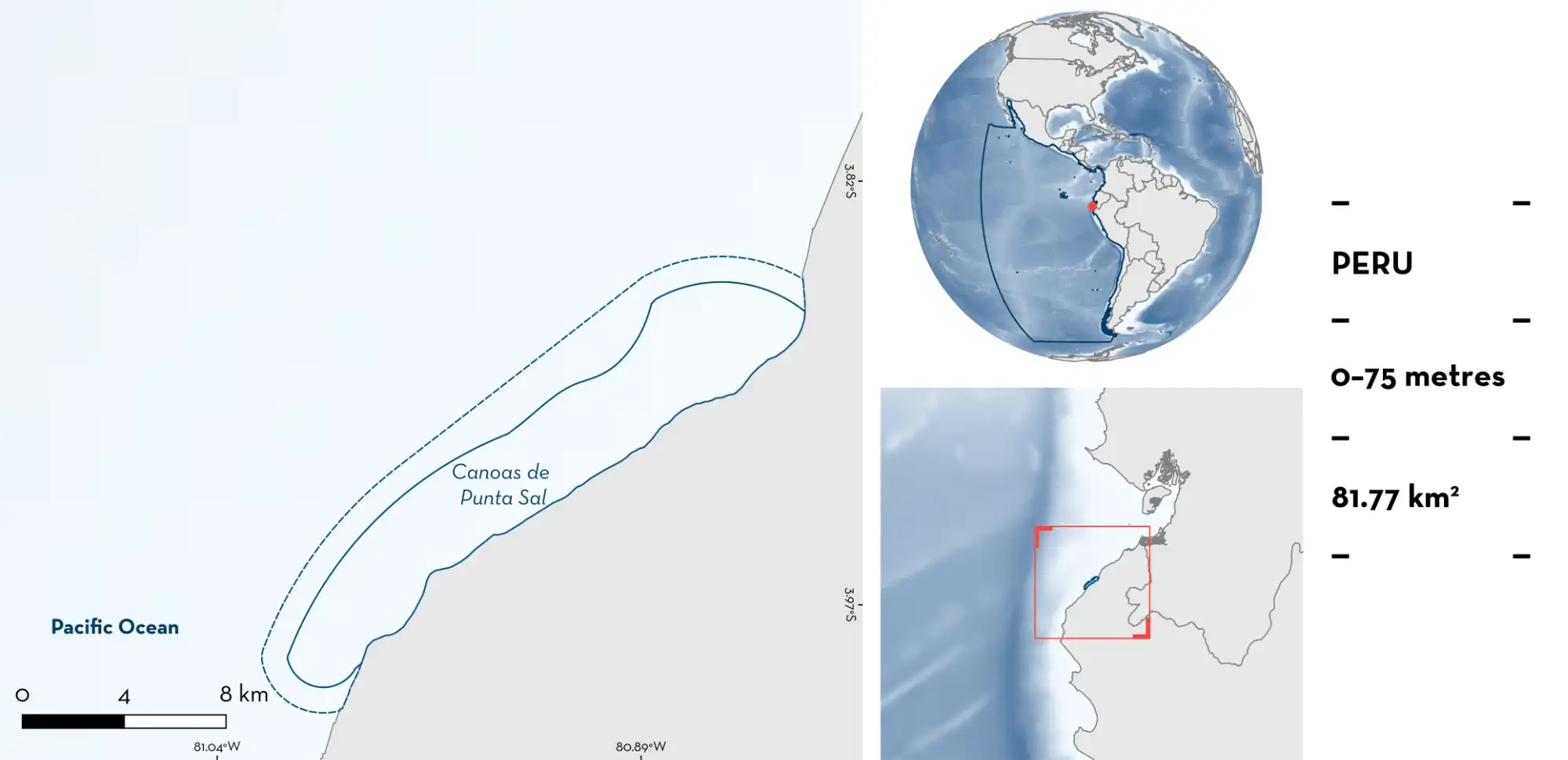
Canoas de Punta Sal is located in northern Peru. This area sits in the Equatorial Front which is a transitional zone between two marine currents with high biological productivity and is influenced by the Gulf of Guayaquil which is the largest estuary on the southeast Pacific coast. The area overlaps with two Ecologically or Biologically Significant Marine Areas and one marine protected area. It contains unique oceanographic and bathymetric conditions resulting in high biodiversity and exceptionally high marine productivity. Within this area there are: threatened species and feeding areas (Whale Shark Rhincodon typus).
Download factsheet
Canoas de Punta Sal
DESCRIPTION OF HABITAT
Canoas de Punta Sal is located in northern Peru. This area sits in the Equatorial Front which is a transitional zone between two marine currents with high biological productivity. This area at a larger scale is influenced by the Gulf of Guayaquil which is the largest estuary on the southeast Pacific coast (Stevenson 1981). It contains high biological productivity due to the oceanographic conditions associated with the development of the Equatorial Front, coastal outcrops, and interaction of various types of water masses (i.e., oceanic and fresh water transporting organic materials from the estuary’s interior). In the gulf, 23 hydrographic basins are discharged in which the Guayas River Basin constitutes the most important fluvial system of the entire western slope of the Andes. The dry season is from June to November and the rainy season from January to April, coinciding with greatest river discharge. At the local level, this area is influenced by two of the most important rivers of northern Peru (Zarumilla and Tumbes). Their riverine discharge influences primary productivity of estuarine and adjacent coastal waters (Paerl 2006).
This area has strong inter-annual variability due to the natural cycle of the ocean–atmosphere system called the El Niño Southern Oscillation (ENSO) (Fiedler 2002). These regime shifts are caused by periods of warm (El Niño) and cold (La Niña) temperature anomalies that can drastically change the oceanographic conditions and consequently cause changes in food availability and modify habitats (Fiedler 2002).
This area overlaps with the marine protected area Mar Tropical de Grau (UNEP-WCMC & IUCN 2026).
This Important Shark and Ray Area is delineated from the surface (0 m) to 75 m based on the global depth range of the Qualifying Species.
CRITERION A
VULNERABILITY
One Qualifying Species considered threatened with extinction according to the IUCN Red List of Threatened Species regularly occurs in the area. The Whale Shark is assessed as Endangered (Pierce & Norman 2016).
CRITERION C
SUB-CRITERION C2 – FEEDING AREAS
Canoas de Punta Sal is an important feeding area for one shark species.
Northern Peru has been identified as one of the 25 global Whale Shark aggregations (Araujo et al. 2022). Juvenile Whale Sharks (2–10 m total length) use this area seasonally (austral spring and summer) for feeding purposes. Between 2014–2018, in Tumbes (northern coastal Peru), most of the 191 juvenile Whale Sharks, predominately males, were recorded feeding (Maguiño et al. 2016, 2019). Furthermore, 185 interviews with fishers, on-board observers, captains, and diving companies provided information on 272 Whale Shark observations where most individuals were reportedly observed feeding (Maguiño et al. 2016). The probability of Whale Shark presence in northern Peru increases at high chlorophyll-a (4–6 mg/m3) and high sea surface temperature values (25–28°C). Whale Sharks appear to aggregate seasonally potentially exploiting rich foraging grounds when biological productivity is highest (Gonzalez-Pestana et al. 2020).
Download factsheet
SUBMIT A REQUEST
ISRA SPATIAL LAYER REQUEST
To make a request to download the ISRA Layer in either a GIS compatible Shapefile (.shp) or Google Earth compatible Keyhole Markup Language Zipped file (.kmz) please complete the following form. We will review your request and send the download details to you. We will endeavor to send you the requested files as soon as we can. However, please note that this is not an automated process, and before requests are responded to, they undergo internal review and authorization. As such, requests normally take 5–10 working days to process.
Should you have questions about the data or process, please do not hesitate to contact us.