
ISRA FACTSHEETS
ISRA FACTSHEETS
SOUTH AMERICAN ATLANTIC REGION
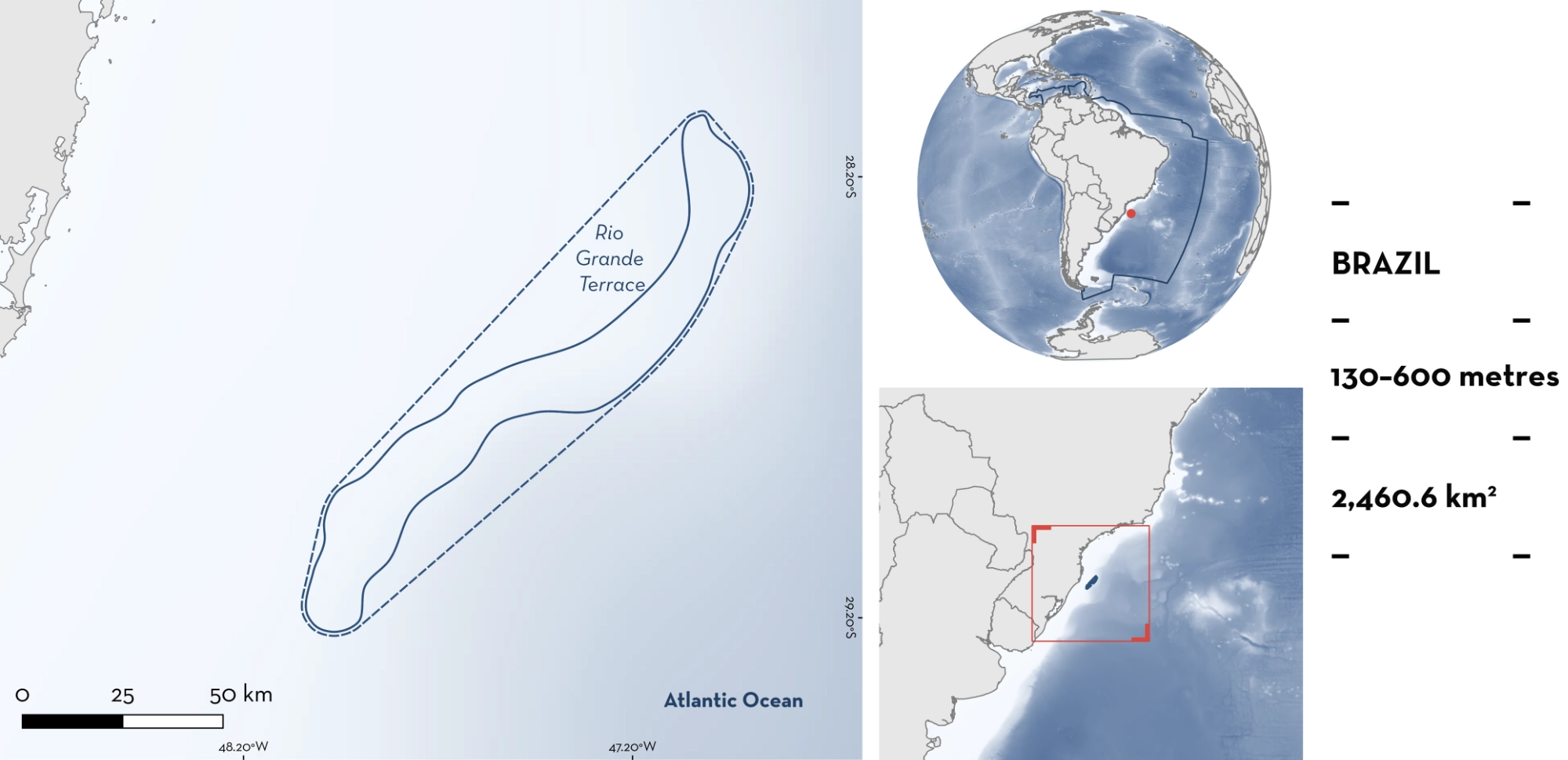
Rio Grande Terrace
Summary
Rio Grande Terrace is located off the southern coast of Brazil. It encompasses the outer continental shelf and upper slope off the states of Santa Catarina and Rio Grande do Sul. The area partially sits on the Rio Grande Terrace, a prominent deepsea feature. It is characterised by silty and muddy substrates. The area is mainly influenced by the Brazil Current and the South Atlantic Central Water Current. Within this area there are: threatened species and range-restricted species (Southern Sawtail Catshark Galeus mincaronei).
Download factsheet
Rio Grande Terrace
DESCRIPTION OF HABITAT
Rio Grande Terrace is located off the southern coast of Brazil. It encompasses the outer continental shelf and upper slope off the states of Santa Catarina and Rio Grande do Sul. The area partially sits on the Rio Grande Terrace, a prominent deepsea feature. The benthos is characterised by silty and muddy substrates (Razik et al. 2015; Borisov et al. 2020).
The area is mainly influenced by the Brazil Current and the South Atlantic Central Water Current (Kuhn et al. 2023). The direction of currents influencing this area is southward (Valla et al. 2018). With no adjacent river input, sedimentation appears to come from both the Plata mudbelt and the Pampean shelf (Razik et al. 2015).
This Important Shark and Ray Area is benthic and subsurface and is delineated from 130–600 m based on the depth range of Qualifying Species globally.
CRITERION A
VULNERABILITY
One Qualifying Species considered threatened with extinction according to the IUCN Red List of Threatened Species regularly occurs in the area. This is the Vulnerable Southern Sawtail Catshark (Pollom et al. 2020).
CRITERION B
RANGE RESTRICTED
Rio Grande Terrace holds the regular presence of Southern Sawtail Catshark as a resident range-restricted species.
Records of Southern Sawtail Catsharks from 1988–2013 were collated from scientific surveys and the incidental catch of commercial fisheries using longline, trawl, or trap-net (Macías-Cuyare & Oddone 2025). This included records from previous biological studies (e.g., Sêga & Kotas 2017). A total of 79 Southern Sawtail Catsharks were recorded from across the known geographic range of the species. These comprised both juveniles and adults ranging in size from 20.8–48.8 cm total length (TL). Rio Grande Terrace accounted for 76 records (96.2%) which were recorded between the Pelotas and Santos basins (Gaurisas & Bernardino 2023). Remaining records were from (1) inshore shelf waters west of the area (one individual); and (2) ~1,000 km northeast of the area (two individuals). Sharks were recorded across all seasons and in 11 different years of surveys and monitoring, demonstrating the regular year-round occurrence of the species in the area. Most records were historic, although half (49.4%) are from around the boundary between historic (i.e., > 15 years ago) and contemporary, with n = 29 from austral spring 2009, n = 8 from winter 2010, and n = 2 from summer 2013 (Macías-Cuyare & Oddone 2025), supporting the contemporary importance of the area. Evidence of reproductive activity, specifically early egg capsule formation (Macías-Cuyare & Oddone 2025) suggests that the area may be important for reproduction. Southern Sawtail Catshark are restricted to the South Brazil Shelf Large Marine Ecosystem (LME) and the East Brazil Shelf LME.
Download factsheet
SUBMIT A REQUEST
ISRA SPATIAL LAYER REQUEST
To make a request to download the ISRA Layer in either a GIS compatible Shapefile (.shp) or Google Earth compatible Keyhole Markup Language Zipped file (.kmz) please complete the following form. We will review your request and send the download details to you. We will endeavor to send you the requested files as soon as we can. However, please note that this is not an automated process, and before requests are responded to, they undergo internal review and authorization. As such, requests normally take 5–10 working days to process.
Should you have questions about the data or process, please do not hesitate to contact us.

